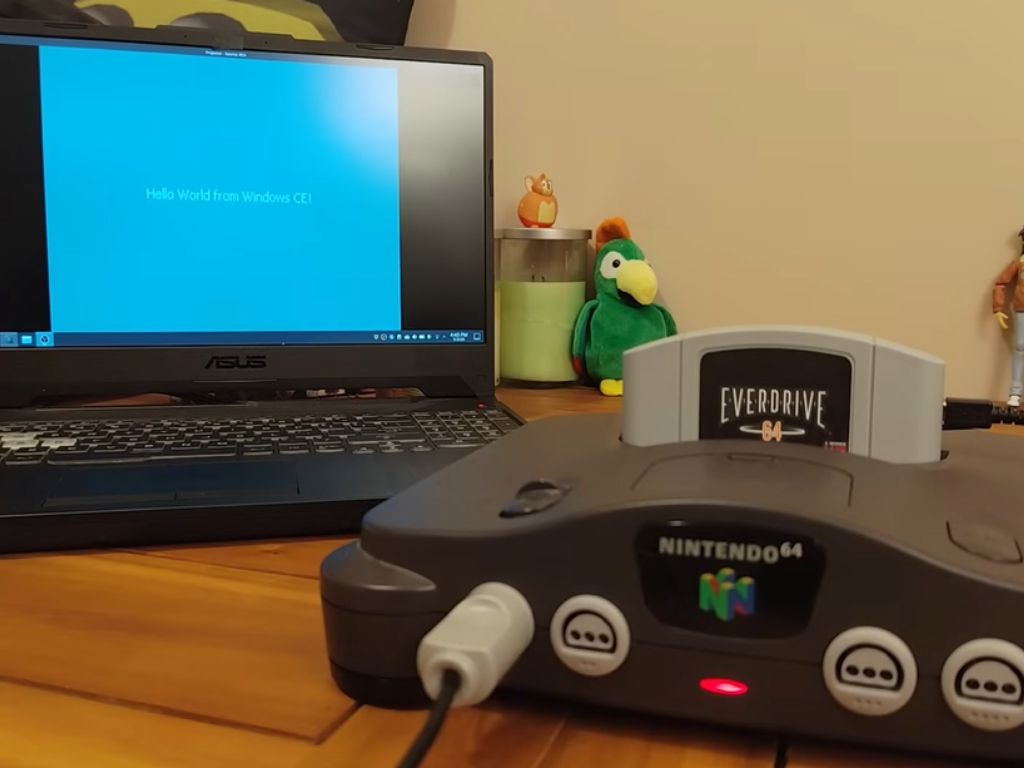
Modder Gets Windows CE 2.11 Running on a Real Nintendo 64
A retro hardware modder has pulled off one of the strangest and most impressive Nintendo 64 experiments in recent memory: Windows CE 2.11 is now running on original N64 hardware.
The project was created by developer and DIY modder Throaty Mumbo, who spent months turning an unusual idea into a working system. The inspiration came from a simple hardware connection. An old IBM WorkPad Z50 laptop used a MIPS processor and was capable of running Windows CE, while the Nintendo 64 also relies on a MIPS-based CPU. That overlap raised an interesting question: could Microsoft’s late-1990s embedded operating system run on Nintendo’s classic game console?
The answer is yes, but getting there was anything but simple.
There was never an official Windows CE 2.11 build for the Nintendo 64, so the entire project required reverse engineering, custom driver development, and plenty of trial and error. Throaty Mumbo described it as a hobby project and joked that it was “the ultimate challenge that nobody asked for,” adding that while it could be done, it probably never needed to be done.
That is exactly what makes it so fascinating.
To make Windows CE 2.11 work on the Nintendo 64, the modder used Microsoft’s old Platform Builder tools from the late 1990s, then built the missing pieces needed to communicate with the console’s hardware. The N64’s Reality Display Processor is used for graphics output and acceleration, while the system’s audio hardware handles sound. The standard Nintendo 64 controller has also been repurposed as a mouse input device, letting users move around the Windows desktop without a traditional PC setup.
The operating system runs from an EverDrive 64 X7 flash cartridge, which loads a ROM file of around 3.5 MB called N64C4.Z64. Once the console is powered on, a small bootloader starts the process, and within seconds the Nintendo 64 displays a familiar Windows CE desktop.
The result is a surprisingly complete retro-computing experience. The N64 boots into a desktop environment with a Start menu, taskbar, Recycle Bin, and other recognizable Windows interface elements. The regular Nintendo 64 controller works as a mouse, with the A button acting as left-click and the B button acting as right-click. For users who want smoother pointer movement, the official Nintendo 64 mouse offers more precise control.
The project also supports loading Windows CE applications from an SD card, giving the console access to compatible software beyond the basic desktop. In demonstrations, the system runs a Cube3D graphics demo that takes advantage of the N64’s hardware, along with a port of a 1997 Tetris release that plays smoothly and includes classic chiptune-style audio.
While this Windows CE Nintendo 64 port is not practical for everyday computing, it is a remarkable example of what can happen when retro gaming hardware meets modern reverse-engineering skill. The Nintendo 64 was already known for pushing 3D gaming forward in the 1990s, but seeing it boot into a working Windows desktop decades later gives the console an entirely different kind of legacy.
For fans of retro consoles, operating system experiments, and unusual hardware mods, Windows CE running on a Nintendo 64 is a reminder that classic systems still have plenty of surprises left.