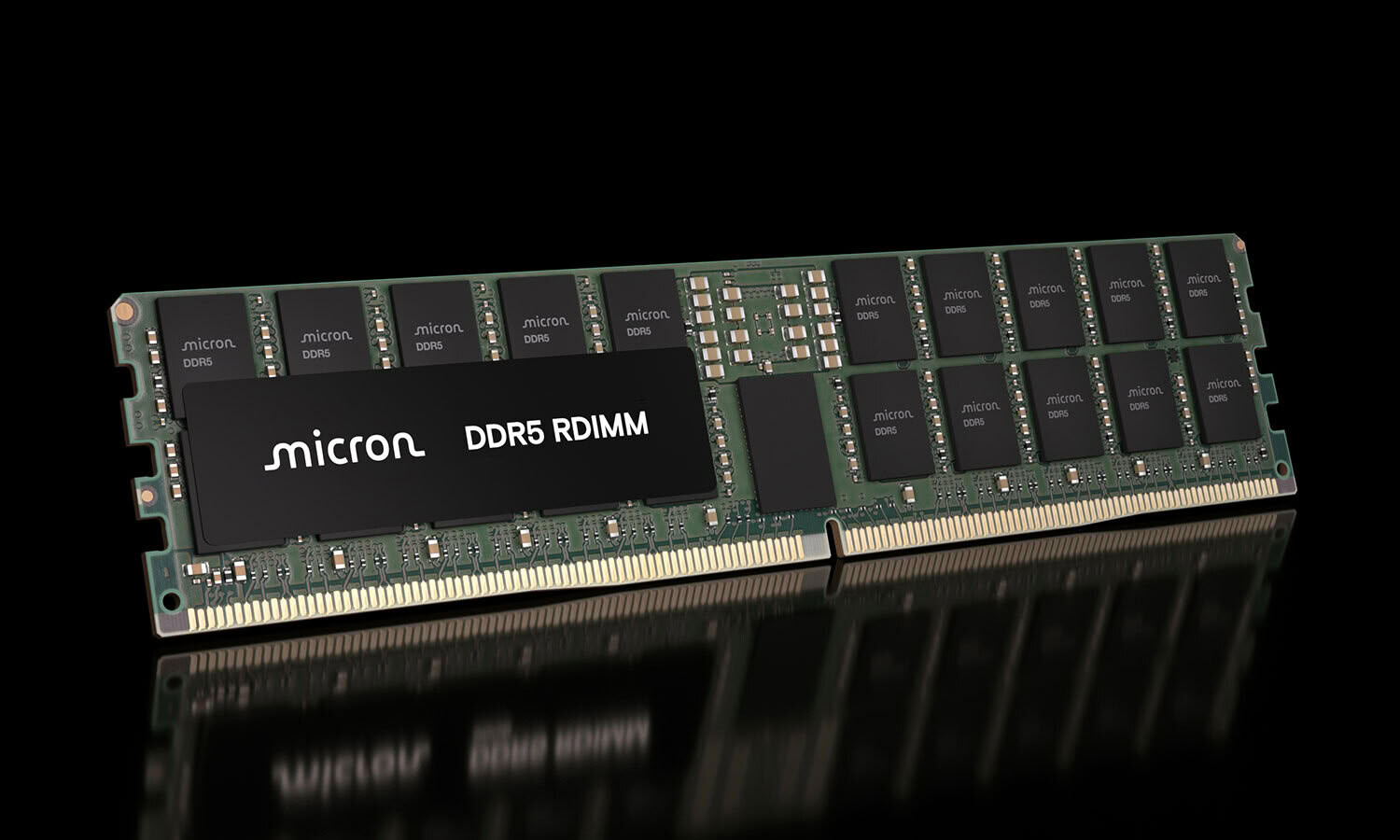
Micron Unveils 512GB DDR5 RDIMM for Next-Generation AI and Server Workloads
Micron has showcased a major step forward in data center memory technology with what it calls the world’s first 512GB DDR5 RDIMM. Designed for demanding enterprise workloads, the new high-capacity server memory module is aimed at artificial intelligence, large databases, real-time analytics, simulations, virtualization, and other memory-intensive applications.
The new 512GB DDR5 RDIMM is expected to reach speeds of up to 9,200 MT/s, giving next-generation servers more bandwidth to handle increasingly complex workloads. Just as importantly, Micron says the module can significantly reduce power consumption compared to today’s common high-capacity memory configurations.
According to Micron, a single 512GB RDIMM is rated at 16W. By comparison, using four 128GB DDR5 modules to reach the same 512GB capacity would consume around 44.2W. That means the new module could cut operating power by more than 60%, a major advantage for data centers trying to improve efficiency while scaling performance.
The breakthrough capacity is made possible through vertically stacked DRAM dies connected using through-silicon vias, often called TSVs. This advanced stacking approach allows Micron to pack far more memory into a single module without requiring servers to use additional memory slots.
For large-scale server deployments, the impact could be substantial. Micron says a dual-socket server with 24 memory slots could support up to 12TB of DDR5 memory when fully populated with 512GB RDIMMs. That kind of capacity is especially valuable for modern workloads that rely on keeping enormous datasets in memory instead of constantly moving data back and forth from slower storage systems.
This is particularly important for large language models, AI inference, in-memory databases, caching platforms, high-core-count CPU systems, and virtualized infrastructure. As AI models and enterprise datasets continue to grow, memory capacity and bandwidth are becoming just as critical as raw processor performance.
Micron also claims the 512GB DDR5 RDIMM can boost performance in workloads limited by memory capacity or memory bandwidth. In Spark SVM-based data analytics, systems using 512GB RDIMMs can deliver up to 1.4 times the performance of configurations using 256GB DDR5 memory. The company also expects improvements in platforms such as RocksDB and Redis, including better throughput and stronger concurrency, though real-world results will depend on the server platform and specific workload.
The timing of this technology also aligns with the industry’s push toward larger AI servers and more powerful cloud infrastructure. As businesses deploy increasingly advanced AI models, run more virtual machines, and analyze larger datasets in real time, demand for higher-density DDR5 server memory is expected to rise quickly.
Micron expects its 512GB DDR5 RDIMMs to move into volume production in the second half of 2027, depending on customer demand. AMD and Intel are already validating the new memory modules for their upcoming server platforms, suggesting that support for ultra-high-capacity DDR5 memory could become a key feature of next-generation enterprise systems.
With higher capacity, faster speeds, and much lower power consumption, Micron’s 512GB DDR5 RDIMM could become an important building block for future AI data centers, cloud servers, and high-performance computing environments.