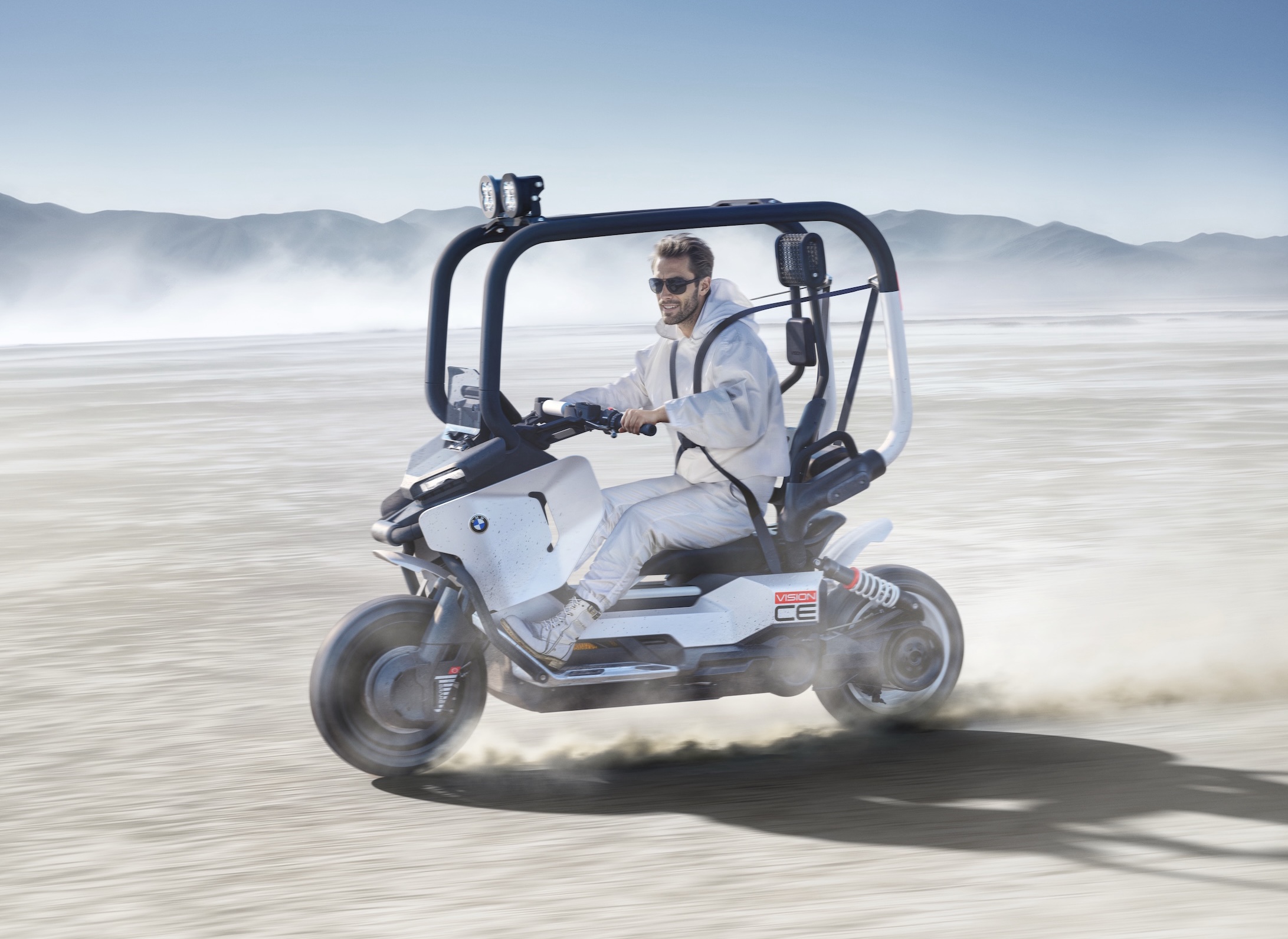
BMW’s next electric two-wheeler concept is turning heads for all the right reasons. Building on a recent streak of concept-to-production success with the CE 02 and CE 04, the new BMW Vision CE doubles down on urban mobility, confidence for newer riders, and standout safety innovations—without watering down the design DNA that made its predecessors so compelling.
At first glance, the silhouette feels familiar: a long wheelbase, low stance, and forward-set footrests that clearly trace back to the CE 04. But the star of the show is the enclosed, buggy-style protective cage. This integrated structure surrounds the rider like a roll cage and makes room for a proper seat with a full backrest, headrest, and seat belt. BMW suggests that this design could eliminate the need for a helmet and protective clothing—something that will still depend on local regulations, but underlines the safety-first approach of the concept. One render also reveals a rear-facing radar sensor, hinting at a rear collision warning system to help in stop-and-go city traffic.
Perhaps the most intriguing idea is self-balancing. BMW says the Vision CE can maintain balance when stationary and enhance stability at very low speeds—exactly where many beginners feel wobbly. It’s an ambitious feature previously floated on the far-out VISION NEXT 100 concept, and while it remains to be seen if it will reach production, the potential benefits for urban commuting are hard to ignore.
The Vision CE also leans into modularity. The external cage isn’t just protective—it’s a mounting framework. Riders could add accessories like auxiliary lights, luggage racks, a full windshield, a roof, and wind-deflecting leg panels to tailor the bike for all-weather commuting or last-mile delivery. That flexibility opens the door to purpose-built setups for different city lifestyles.
BMW hasn’t shared performance specs yet. If the Vision CE shares its platform with the CE 04, however, these reference numbers help set expectations:
– Peak power: around 31 kW (42 hp / 42.14 PS)
– Peak torque: around 62 Nm (about 46 lb-ft)
– Top speed: about 75 mph (120 km/h)
– Battery capacity: 8.9 kWh (8.5 kWh usable)
– Range (Eco mode): up to roughly 130 km (about 80 miles)
– Charging time with standard 2.3 kW charger: around 4 hours 20 minutes (0–100%)
– Charging time with optional 6.9 kW charger: about 45 minutes to 80%; about 1 hour 40 minutes to full
– MSRP of CE 04 (for context): approximately $12,195 (base)
Given the added weight of the protective cage and accessories, a slight reduction in range would be expected if the Vision CE uses similar hardware. Still, the trade-off for enhanced safety and utility could be well worth it for urban riders who value comfort, storage, and protection from the elements.
What sets this concept apart is the blend of futuristic tech with practical city-first design. The enclosed seating with seat belt, the potential for self-balancing, and the accessory-ready cage suggest a new category: an enclosed electric scooter that blurs the lines between motorcycle, scooter, and microcar—built to navigate dense city streets with more confidence and less gear.
BMW plans to showcase the Vision CE at IAA Mobility 2025 in Munich from September 9–14. If the company’s recent history is any guide, there’s a real chance this head-turning concept evolves into a road-going machine with remarkably few compromises. For commuters ready to go electric—and for new riders who want more stability and safety—this could be one of the most compelling urban EVs on the horizon.


