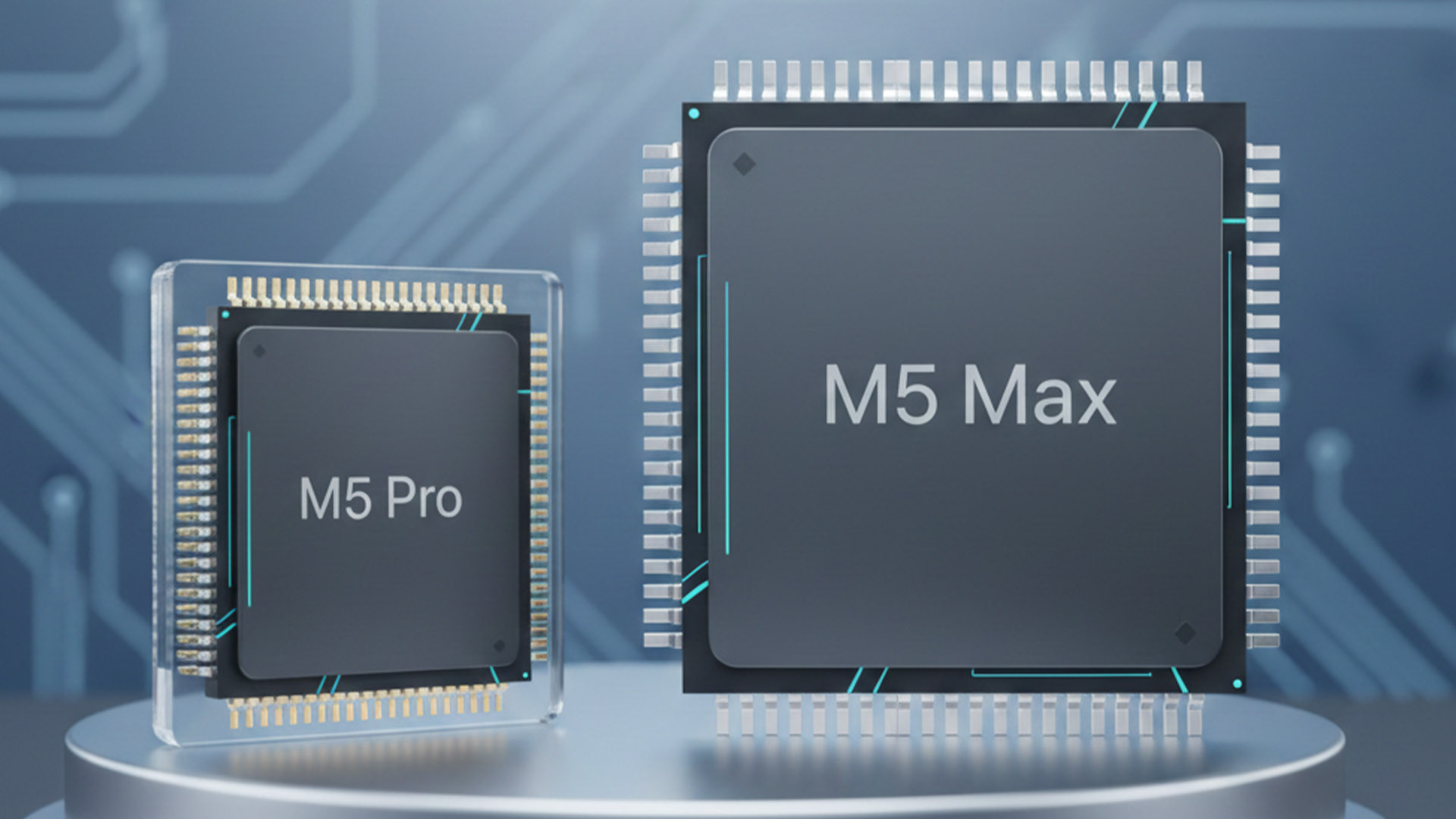
Apple’s next-generation Apple Silicon chips, the M5 Pro and M5 Max, are once again rumored to bring a major design shift that could reshape future Mac performance. The biggest talking point is the move to a new packaging and chip architecture: TSMC’s SoIC (Small Outline Integrated Circuit) packaging paired with a 2.5D chiplet design. If accurate, this approach could help Apple build more powerful system-on-chips while improving manufacturing efficiency and potentially lowering overall production costs.
A fresh report circulating on Weibo from the account Fixed-focus digital cameras reiterates many of the same claims that have been floating around, including Apple’s apparent transition away from InFO (Integrated Fan-Out) packaging technology in favor of a 2.5D solution. The post emphasizes the typical advantages associated with 2.5D and advanced packaging, such as better thermal characteristics and more efficient integration, but adds one new detail: the M5 Pro and M5 Max are said to feature a slight increase in transistor density.
That transistor density claim is difficult to verify right now because Apple hasn’t shared a transistor count for the standard M5, making direct comparisons tricky. Still, there is one plausible technical reason the M5 Pro and M5 Max could end up denser than the current M4 Pro and M4 Max: a rumored shift in TSMC’s 3nm process from N3E to the newer N3P technology. In general terms, newer revisions of the same process class can bring improvements in density, performance, efficiency, or a mix of all three, depending on how a chip is designed.
One especially interesting part of the chiplet rumor is what it could enable for real-world products. A 2.5D chiplet design may give Apple more freedom to create unique CPU and GPU configurations, improving flexibility across different Mac models. That could translate into more targeted performance tiers, better scaling from one device to the next, and potentially smoother segmentation between “Pro” and “Max” chips from generation to generation.
Of course, chiplets bring tradeoffs. A common concern with multi-chiplet designs is that communication between chiplets can increase power draw compared with a monolithic design, which is one reason some competitors have been cautious about going all-in on chiplets for certain platforms. If that concern applies broadly, it’s reasonable to wonder whether the M5 Pro and M5 Max could consume more power than expected.
However, Apple may be able to offset some of that through architectural efficiency improvements. Recent changes reported for Apple’s A19 Pro suggest Apple has been working on ways to increase efficiency-core performance without increasing power draw, at least in certain workloads. If similar design strategies carry over to the M5 Pro and M5 Max, Apple could potentially balance the added overhead that chiplet communication can introduce, keeping performance-per-watt at the center of the upgrade.
As for timing, the same source claims Apple could launch the M5 Pro and M5 Max in March. That said, the tipster’s reliability has been questioned in the past, so it’s best to treat the date as speculative until more consistent reporting lines up with it.
If these rumors hold, the M5 Pro and M5 Max could mark one of the more significant Apple Silicon transitions in years, not just in raw speed, but in how Apple builds and scales high-performance chips for future Macs.