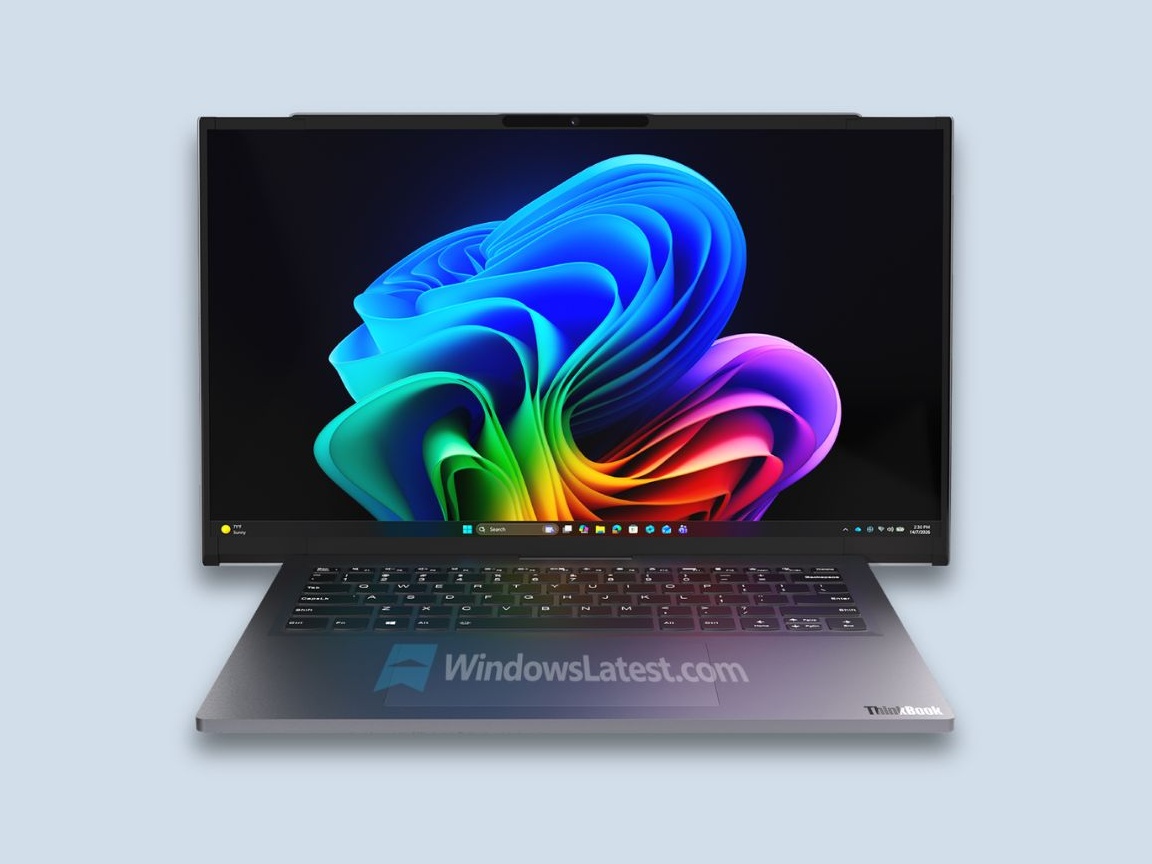
Lenovo Project Swan could bring a horizontally expanding display to the ThinkBook lineup
Lenovo may be preparing another bold experiment in laptop design, and this time the focus appears to be a screen that expands sideways. A reported concept device known as Project Swan is said to be a ThinkBook laptop with a motorized display that can extend horizontally from both the left and right sides, giving users extra screen space without requiring a larger traditional laptop body.
From the front, the device reportedly looks much like a standard Lenovo ThinkBook. It has a familiar business-laptop design, a centered webcam above the display, and visible USB-C ports along the side. At first glance, it could easily pass as a regular productivity notebook. The more interesting part appears to be hidden behind the screen, where the expansion mechanism is located.
The rear view of the reported prototype shows a display assembly designed to stretch outward from both sides. Instead of unfolding like a dual-screen laptop or opening like a foldable device, Project Swan seems to store additional screen area inside the left and right portions of the lid. When activated, a motorized rail system may pull the screen outward, creating a wider workspace on demand.
This approach could make the laptop especially appealing to professionals who need more horizontal screen real estate. A wider display would be useful for multitasking, editing spreadsheets, working with timelines, managing multiple browser windows, coding, or using creative software with tool panels spread across the screen. It could offer some of the benefits of an external monitor while still keeping the device portable.
The design appears to share a similar philosophy with Lenovo’s previous rollable laptop concepts, but with an important difference. Earlier designs focused on expanding the screen vertically, giving users a taller display for reading, writing, and viewing long documents. Project Swan, by contrast, appears to expand sideways, creating an ultrawide-like experience in a compact laptop format.
The hinge design also looks different from a typical notebook. Based on the reported images, the hinge seems shorter and more centrally positioned, likely to leave room for the extension rails on both sides of the display. This suggests Lenovo may be rethinking the entire lid structure to support the sliding screen mechanism while keeping the laptop stable during use.
For now, key specifications remain unknown. There is no confirmed information about the final screen size, display technology, processor, graphics, memory, storage, battery capacity, or overall weight. It is also unclear whether Project Swan is close to becoming a commercial product or if it is simply an internal concept designed to showcase Lenovo’s flexible display research.
The ThinkBook branding suggests the device may be aimed at business users, hybrid workers, and productivity-focused professionals rather than gamers or mainstream entertainment buyers. ThinkBook laptops typically sit between Lenovo’s consumer and enterprise-focused machines, offering business-friendly features in a modern design. A horizontally expanding screen would fit that identity well, especially for users who travel often but still want a larger workspace when needed.
Lenovo has already shown strong interest in experimental laptop form factors. The company has explored rollable screens, flexible displays, and unconventional notebook designs in recent years. Project Swan appears to be another step in that direction, showing how future laptops might move beyond fixed screen sizes.
The timing is also interesting. Foldable and expandable displays are gaining more attention across the tech industry, especially as mobile devices continue to offer larger screens in smaller bodies. Smartphones with foldable displays have already helped normalize the idea of devices that change shape depending on how they are used. Laptops could be next, particularly if manufacturers can make the technology durable, thin, and reliable enough for daily work.
Still, there are important questions. A motorized expanding display would need to be strong enough to handle repeated movement over time. Battery life could also be affected if the screen is larger and the mechanism requires power. Durability, repairability, display uniformity, weight, and price would all play a major role in whether such a laptop could succeed beyond the concept stage.
Project Swan may appear around IFA next month, though that has not been officially confirmed. If Lenovo does show the device publicly, it could become one of the most talked-about laptop concepts of the event. Even if it does not launch immediately, it may offer a strong preview of where portable computing is headed.
A ThinkBook with a horizontally expanding display could be a practical answer to a common problem: users want bigger screens, but they do not want bigger laptops. If Lenovo can solve the engineering challenges, Project Swan could make the idea of an expandable laptop display feel less like science fiction and more like the next evolution of mobile productivity.