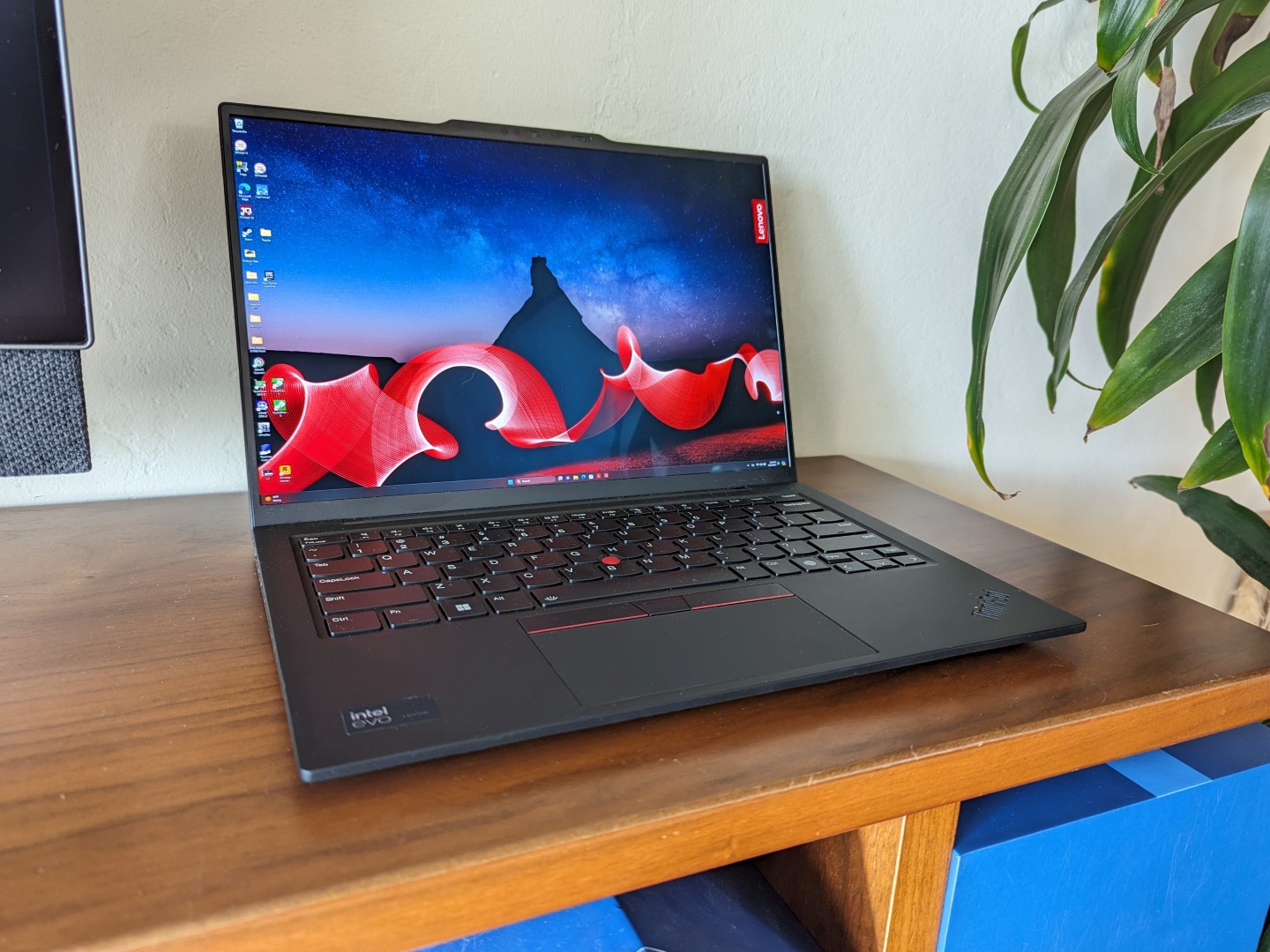
The latest iteration of Lenovo’s ThinkPad X1 Carbon, the G12, has undergone its first substantial refresh in three years. This premium laptop revamp introduces new features and upgrades that aim to solidify the device’s standing in a competitive market.
The ThinkPad X1 Carbon G12 now comes equipped with an Intel Core Ultra 7 155H processor along with an Intel Arc 8-Cores integrated graphics unit (iGPU). This setup positions the laptop as a serious contender against similar offerings from other manufacturers, such as the HP Spectre x360 and Dell Latitude 7440, as well as previous ThinkPad models like the X1 Carbon G10 and G11.
Intel’s Arc 8-Cores iGPU has been tested across various laptops, showing an average performance within the range of benchmark scores. The Lenovo ThinkPad X1 Carbon G12, for instance, records frames per second (fps) rates within 14.5 to 25.5 fps in certain stress-testing scenarios.
When pitched against the HP Spectre x360 and the Lenovo ThinkPad P14s G4 powered by an AMD Ryzen 7 PRO 7840U and an AMD Radeon 780M, the X1 Carbon G12’s integrated Intel Arc graphics show that it can hold its own, with modest differences in performance.
Performance comparisons among various models, such as the Asus ZenBook 14 and other ThinkPad generations, demonstrate the evolution and enhancements that the ThinkPad X1 Carbon G12 brings to the table.
Besides the improvements in the internal hardware, the X1 Carbon G12 is expected to continue the tradition of its predecessors by offering robust build quality, a stellar keyboard, and the business-oriented features that are synonymous with the ThinkPad brand.
With the new ThinkPad X1 Carbon G12, Lenovo is targeting professionals who need a reliable and powerful machine that balances performance with portability. The inclusion of the latest Intel Core processors and Iris Xe Graphics also implies an enhancement in areas like energy efficiency and graphical performance, which can be particularly appealing for power users.
While the technical performance metrics are promising, potential buyers are always encouraged to consider the full spectrum of features, including display quality, battery life, port selection, and overall design, before determining the right laptop for their needs.
By introducing these improvements in the ThinkPad X1 Carbon G12, Lenovo aims to continue leading in the ultra-portable business laptop segment while addressing the growing needs of modern professionals.In the competitive landscape of portable computing devices, graphics performance remains a significant aspect for consumers in evaluating the right laptop for their needs. Recent benchmarks have revealed the performance of laptops with various configurations, showing the capabilities of Intel’s Arc graphics and integrated GPUs compared to AMD’s offerings.
One of the standout models is the HP Spectre x360 14-eu0078ng, which is powered by an Intel Core Ultra 7 155H processor and an Intel Arc GPU with 8 cores. In frames per second (fps) tests, this laptop has demonstrated a solid performance of 36.3 fps under certain conditions. Laptops like the Lenovo ThinkPad X1 Carbon G12, also featuring the same CPU and GPU configuration, have shown slightly lower fps at 33.5, albeit still delivering above-average results.
Comparatively, devices utilizing the AMD Ryzen 7 7730U and AMD Radeon RX Vega 8, such as the Asus ZenBook 14 UM3402Y, have posted approximately 29.6 fps which is lower than their Intel counterparts. This reflects a 12% decrease from HP’s mentioned model, indicating that while AMD CPUs paired with Radeon RX Vega 8 graphics can offer decent performance, Intel’s latest Arc GPUs can provide an edge in graphical tasks.
Older models such as the Lenovo ThinkPad X1 Carbon G10 and Dell Latitude 7440, with Intel i7-1265U and i5-1345U CPUs respectively, and Iris Xe Graphics G7, have reported further decreased performance, ranging from 22.2 fps to 20.7 fps which is substantially lower than the newer models by up to 38%. This underscores the progress in integrated GPU performance in newer processor generations.
Gaming benchmarks in high-performing settings have placed the HP Spectre x360 and Lenovo ThinkPad models with Intel Ultra CPUs and Arc GPUs at the top of the charts, reaching upwards of 173.8 fps and 165.4 fps respectively. AMD’s Ryzen 7 PRO 7840U equipped machines, with Radeon 780M graphics, closely follow this lead, highlighting a competitive performance landscape between Intel and AMD in the integrated graphics arena.
Across varied gaming scenarios, the story remains consistent— newer hardware combinations, mainly Intel Arc GPUs, are setting the benchmark for integrated graphics performance, pushing previous generations and AMD’s integrated solutions to the lower end of the performance spectrum.
These benchmarks offer a clear comparison for prospective buyers, laying out the performance one can expect from the latest integrated graphics solutions. Consumers should consider these findings when making purchasing decisions, especially if their work or leisure activities are graphics-intensive.In the fast-evolving landscape of modern laptops, the performance of internal graphics processing units (iGPUs) remains a pivotal factor for users who need both productivity and some level of gaming or graphics performance on the go. One comparison to consider is between devices leveraging Intel’s Iris Xe Graphics and those using AMD Radeon solutions.
A standout in this category is the Lenovo ThinkPad X1 Carbon G11 with the model number 21HNS00000. This device is equipped with an Intel Core i7-1365U processor and Intel Iris Xe Graphics boasting 96 execution units (EUs). In performance tests, it recorded an average frame rate, cementing its position as a potent solution for moderate graphics-intensive tasks.
Dell’s Latitude 7440 models powered by the Intel Core i5-1345U and Intel Iris Xe Graphics with 80EUs also deliver a decent gaming experience, albeit with varying framerate results, highlighting a competent iGPU’s performance within their configurations.
AMD’s presence in the mobile graphics space is represented by models like the Asus ZenBook 14 UM3402Y, carrying a Ryzen 7 7730U CPU and AMD Radeon RX Vega 8 graphics. This pairing provides competitive graphics performance, illustrating the capacity of Ryzen mobile processors paired with Vega graphics in handling graphic loads.
Lenovo’s ThinkPad series stands out with numerous offerings. The ThinkPad P14s G4, for example, with its AMD Ryzen 7 PRO 7840U processor combined with an AMD Radeon 780M GPU, delivers impressive frame rates that can satisfy more demanding graphics requirements.
For those interested in exploring the latest innovations in iGPUs, the Lenovo ThinkPad X1 Carbon G12 showcases Intel’s Arc 8-Cores iGPU, delivering varied benchmark results. This indicates a progression in integrated graphics technology, pushing towards providing higher performance for integrated solutions.
Heavy contenders like the HP Spectre x360 14-eu0078ng also join the fray with configurations featuring the Intel Core Ultra 7 155H and Intel Arc 8-Cores iGPU, demonstrating a diversification in Intel’s lineup aimed at addressing different tiers of graphical needs.
Moreover, older models such as the Lenovo ThinkPad X1 Carbon 2020 with the Intel Core i7-10510U, sporting the Intel UHD Graphics 620, are still relevant for those with lighter graphics requirements, offering a benchmark of earlier integrated graphics performance.
These comparisons demonstrate that users have a wealth of choices when it comes to integrated graphics. High-performance options like the Intel Iris Xe Graphics or AMD’s Radeon offerings provide viable solutions for those who prioritize graphical prowess without a dedicated GPU. Whether for professional content creation, casual gaming, or everyday productivity, the convergence of advanced processors and capable iGPUs in laptops continues to offer a balanced combination of power efficiency and performance.