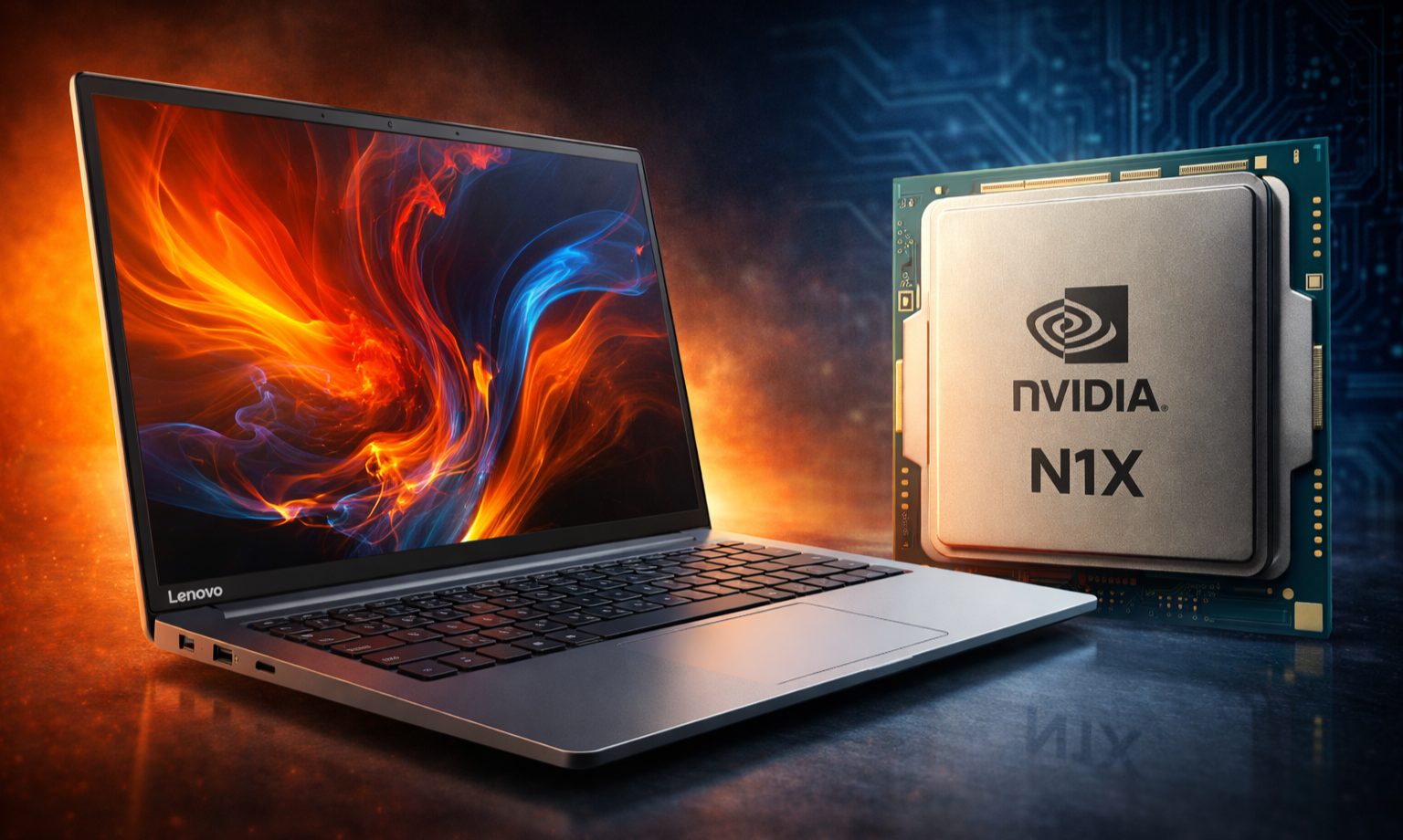
A fresh leak is giving PC gamers and laptop shoppers an early look at what could be a major shift for Windows gaming on Arm. According to the listing details that surfaced briefly online, Lenovo appears to be preparing multiple new laptops built around NVIDIA’s upcoming N1 and N1X Arm-based system-on-chip platforms. If these chips arrive as expected this year, they could pave the way for Lenovo’s first true Windows on Arm gaming laptops, designed to run modern games smoothly without relying on the traditional Intel or AMD setup.
Windows on Arm has steadily improved, but gaming has remained the big hurdle. Arm processors can be extremely power-efficient, which is great for thin laptops and long battery life, yet gaming performance has often been held back by graphics limitations. That’s where NVIDIA’s approach could change everything: combining an Arm CPU with Blackwell-based graphics on the same SoC, aiming to deliver a more capable all-in-one platform for gaming and creative workloads.
The early Lenovo model listings revealed several devices spanning different product families and price tiers, strongly suggesting a broader rollout rather than a single experimental machine. The models include:
One detail that stands out is the naming convention. These laptops don’t follow the usual Intel, AMD, or Qualcomm-style identifiers. Instead, the letter “N” appears right after the screen size in the model name, which lines up neatly with NVIDIA N1 and N1X branding and helps confirm these configurations are tied to NVIDIA’s new chips.
From what’s being suggested so far, Lenovo’s Ideapad Slim and Yoga Pro lines are expected to use the standard NVIDIA N1 chip. This version is believed to be the more efficiency-focused option, likely aimed at balancing everyday performance with improved battery life. Specs for N1 remain less clear at the moment.
The more exciting hardware, at least for gamers, is the NVIDIA N1X. Two Lenovo laptops are listed with the N1X variant: the Yoga 9 2-in-1 16N1X11 and the Legion 7 15N1X11. The rumored N1X configuration is described as a high-end “superchip,” featuring 10 Cortex-X925 cores plus 10 Cortex-A725 cores, paired with a Blackwell-based GPU said to include 6144 CUDA cores.
On paper, that integrated GPU count puts it in the conversation with desktop-class graphics like the GeForce RTX 5070, although earlier leaks have pointed to lower real-world performance due to laptop power limits and thermal constraints. Even so, expectations are building that the N1X could deliver the fastest integrated graphics seen to date, which would be a critical milestone for Windows on Arm gaming.
If these Lenovo listings reflect what’s coming soon, the next wave of laptops could finally bring a more credible “play modern games anywhere” experience to Arm-based Windows devices. And with Lenovo’s Legion line included in the mix, it’s clear the company may be treating this as a serious gaming push rather than a niche experiment.