Lenovo’s next handheld gaming PC is official, and it’s a big step up. The Legion Go 2 brings AMD’s new Ryzen Z2 family to the party—including an option for the Ryzen Z2 Extreme—alongside a faster 1200p OLED display, a larger battery, and a redesigned cooling system.
Design and versatility
The Legion Go 2 refines the look and feel of the original with a more ergonomic shape and a cleaner aesthetic. Its detachable controllers let you switch between handheld play, a console-like setup with the controller dock, or an FPS mode using the right “mouse-like” stick. In short, it’s built to work as a handheld, a tablet-style device, or a mini laptop replacement when docked.
Performance gets a generational bump
Lenovo is offering configurations “up to” AMD’s Ryzen Z2 Extreme. Here’s what to expect from the CPUs mentioned:
– Ryzen Z2 Extreme: Zen 5 cores paired with RDNA 3.5 graphics featuring 16 CUs for a substantial uplift in GPU capability.
– Ryzen Z2: Zen 4 cores with RDNA 3 graphics and 12 CUs.
Both chips are listed with 8 cores and 16 threads, so the bigger differences come from the newer Zen 5 CPU architecture and beefier RDNA 3.5 GPU on the Extreme model.
A smoother, richer display
Lenovo is moving from an IPS panel to an OLED screen. The Legion Go 2 features a 1200p OLED display rated up to 144Hz with a 16:10 aspect ratio, native landscape orientation, 500 nits brightness, and True Black 1000 HDR. The upgrade should deliver deeper blacks, higher contrast, and slicker motion than the original Legion Go’s 1600p IPS 144Hz panel.
Memory, storage, and expansion
Early details point to a memory upgrade to as much as 32 GB of LPDDR5X-8000, a jump over the prior generation’s 16 GB configurations. Storage includes a 1 TB PCIe SSD and microSD expansion, with mentions of support up to 2 TB via card. Expect multiple configurations at launch.
Bigger battery, better cooling
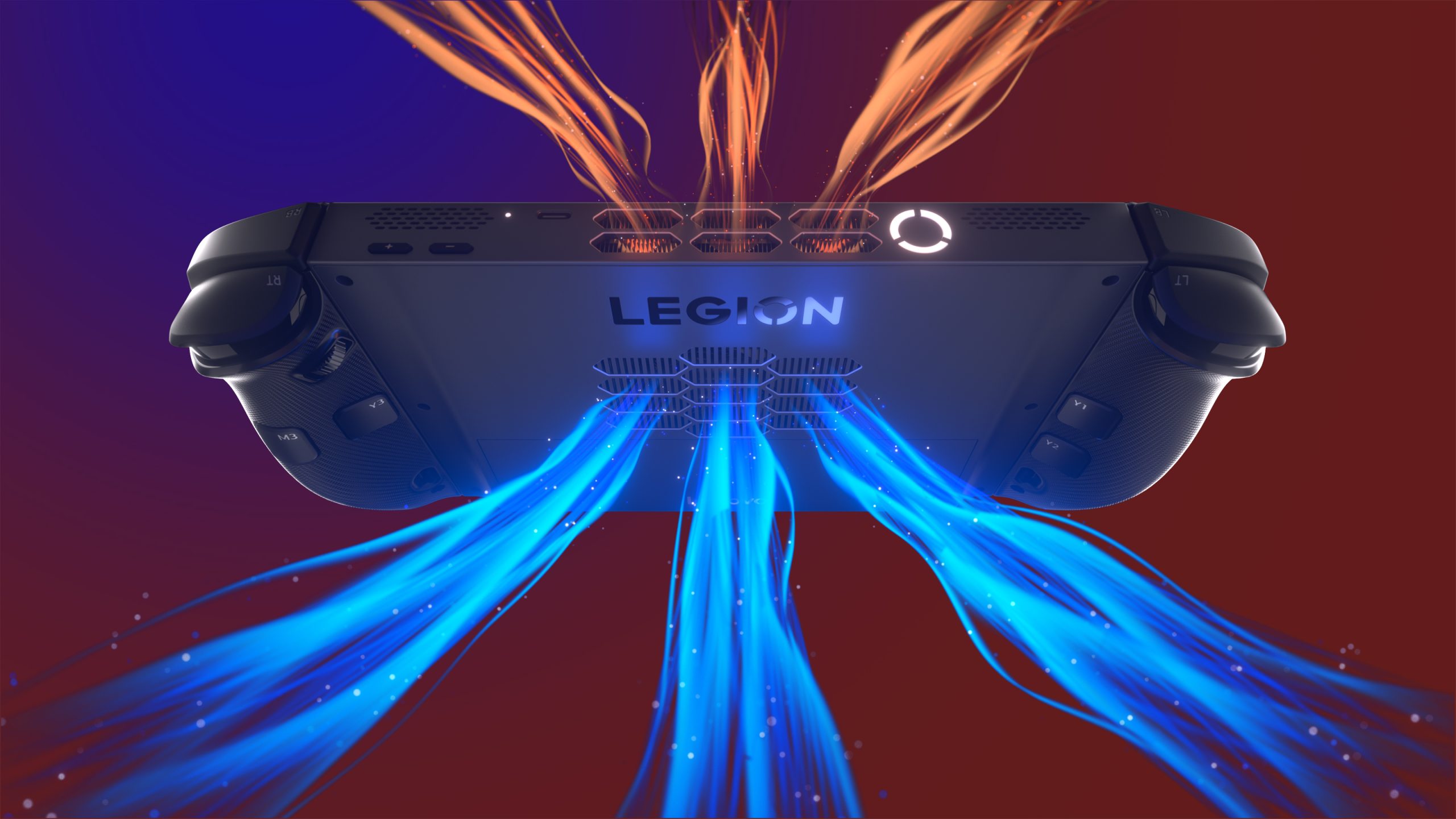
To keep the faster hardware and OLED screen happy, Lenovo reworked the thermal design with a larger fan and two prominent exhaust vents along the bottom and back. Fan behavior can be manually tuned, giving users more control over acoustics and thermals. Battery capacity jumps to 74 Whr (up from 49.2 Whr on the original), and a 65W AC adapter is included. A fingerprint reader on the back adds quick sign-in security.
Modern connectivity
I/O is well covered:
– Two USB4 Type-C ports with DisplayPort 2.0 and Power Delivery 3.0
– 3.5 mm headphone/mic combo jack
– microSD card slot
Wireless connectivity is listed as Wi‑Fi 7 with Bluetooth 5.4, a welcome future-proofing move for high-bandwidth game streaming and fast downloads.
How it compares to Lenovo’s earlier handhelds
– Legion Go (prior model): Launched with the Ryzen Z1 Extreme (Zen 4/RDNA 3) and a 1600p IPS 144Hz panel.
– Legion Go S: A more entry-focused handheld featuring the Ryzen Z2 Go platform.
The Legion Go 2 pushes the line forward with newer AMD architectures, an OLED display, Wi‑Fi 7, a larger 74 Whr battery, and a more robust thermal solution.
Price and availability
Lenovo hasn’t shared launch timing or pricing yet. For context, the original Legion Go with the Z1 Extreme debuted around the $700–$800 range, so a similar starting price wouldn’t be surprising. Expect more details soon.