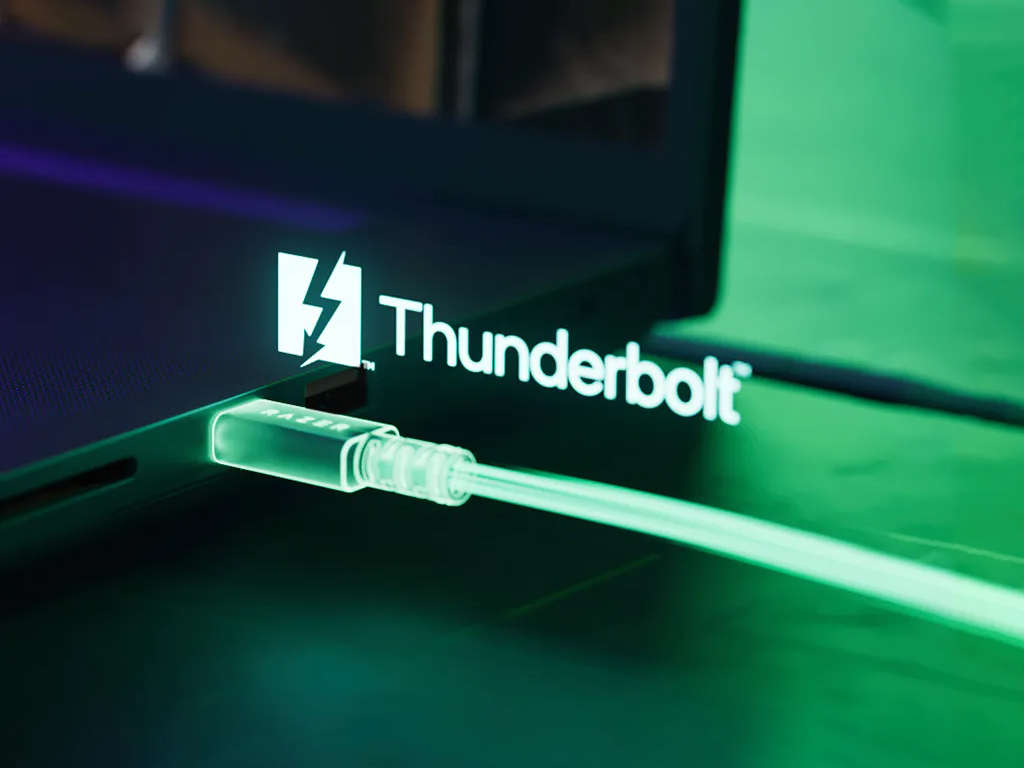
In September 2023, Intel unveiled Thunderbolt 5, setting the stage for a new era of connectivity. Yet, despite its promising capabilities, the tech world hasn’t rushed to embrace this advanced technology. Fast forward to CES 2025, where Thunderbolt 5 finally started to shine, with notable mentions by companies like Asus and Sparkle, which unveiled the first eGPU solutions to harness its power.
These innovative eGPUs now hold their ground against the older OCuLink port in terms of transfer bandwidth. With Asus’s 2025 XG Mobile eGPU featuring a Thunderbolt 5 link that boasts up to 64 Gbps of bandwidth, it surpasses previous iterations and USB4, aligning with the capabilities of OCuLink. Meanwhile, Sparkle has introduced the Studio-G Enclosure eGPU. Although Sparkle hasn’t disclosed its precise bandwidth, speculation suggests it may reach the impressive 120 Gbps maximum of Thunderbolt 5.
While these introductions are promising, the overall adoption of Thunderbolt 5 in the laptop industry remains sluggish. A product manager from Lenovo ThinkBook recently commented on Weibo, indicating it might still be some time before we see widespread adoption of Thunderbolt 5 ports in systems.
A few notable devices have already integrated this advanced port: the 2024 Razer Blade 18, which launched in April last year as the pioneering laptop offering Thunderbolt 5 connectivity. Other options include the Maingear ML-17 and Schenker KEY 17 Pro. For avid Mac users, the latest 14-inch and 16-inch MacBook Pro models with M4 Pro and M4 Max processors are available. However, according to Lenovo’s insights, the expansion of Thunderbolt 5 technology might not accelerate rapidly in the near future.
With this cautious yet hopeful momentum in Thunderbolt 5 adoption, tech enthusiasts and industry insiders are keenly watching to see when these advanced ports will become a standard fixture in next-generation devices.