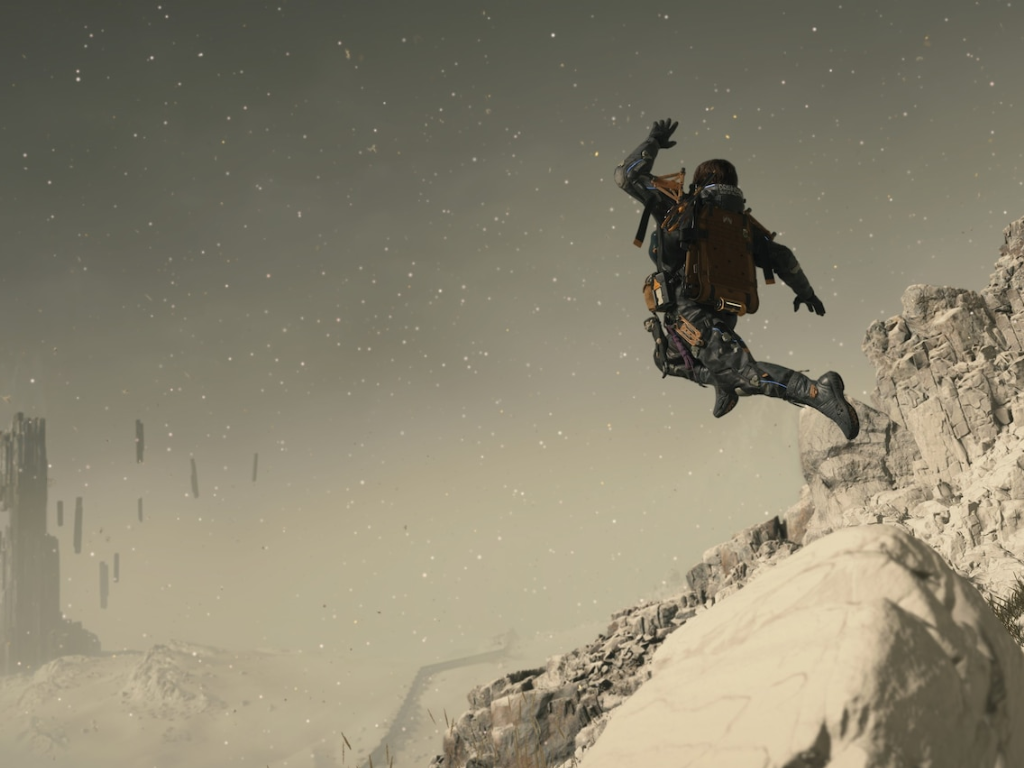
Death Stranding 2: On the Beach is shaping up to be a more welcoming, more playable journey—and that’s not an accident. According to lead level designer Hiroaki Yoshiike, Hideo Kojima gave the team a very specific directive during development: make the sequel more enjoyable. The goal wasn’t just to polish a few rough edges, but to ensure more players could stick with the experience and genuinely enjoy it all the way to the end.
That design mission appears to be a direct response to one of the biggest talking points around the original Death Stranding. While many players praised its atmosphere, ambition, and world-building, others felt the pacing was slow and that the delivery-focused gameplay could sometimes drag. The first game had the difficult job of introducing an entirely new world, an unfamiliar set of rules, and a concept unlike most mainstream action-adventure titles. That level of heavy lifting made the experience dense by design—but it also made it harder for some players to commit for the long haul.
Yoshiike’s comments also help clear up confusion sparked by earlier conversations around the sequel’s direction. In a previous interview, co-composer Woodkid suggested the early playtests influenced Kojima to push the game into even stranger territory. Kojima later pushed back on that interpretation, explaining that the playtest feedback wasn’t a signal to get more bizarre—it was guidance to make the game more digestible and, ultimately, more enjoyable. He framed it as wanting the kind of ideas that stay with players, but without making the experience so hard to process that people bounce off before reaching the payoff.
Now Yoshiike has put the intent into plain terms: Kojima wanted more people to enjoy Death Stranding 2 through the finish line, and he ordered the team to build around that goal.
A major part of that shift comes down to structure and how the sequel handles world-building. Since Death Stranding 2 doesn’t need to explain everything from scratch, the developers had more freedom to lighten the load. Yoshiike explained that the first game had to be “very elaborate” to establish its world and systems, but the second game could afford to be less heavy because the foundation was already laid.
That doesn’t mean the depth is gone. Instead, the team adjusted how that depth is delivered. Completionists and detail-hungry players can still dig into the richer layers, but players who don’t want to chase every lore thread aren’t punished for it. The story is designed to remain understandable and engaging through supplemental in-game elements, giving different types of players different ways to stay oriented and invested without forcing everyone into the same slow burn.
That approach seems to be paying off. Yoshiike noted that feedback suggests Death Stranding 2 is easier to recommend than the first game—an important sign for a series that’s always been polarizing in the best and worst ways. The team has also seen that players are progressing further than they did in Death Stranding 1, aligning with the developers’ plan to improve pacing and overall flow.
In short, Death Stranding 2: On the Beach isn’t trying to water down what made the original special. It’s aiming to deliver the same kind of distinctive, Kojima-style experience in a package that more players can enjoy, follow, and finish—without losing the intrigue that made the series stand out in the first place.


