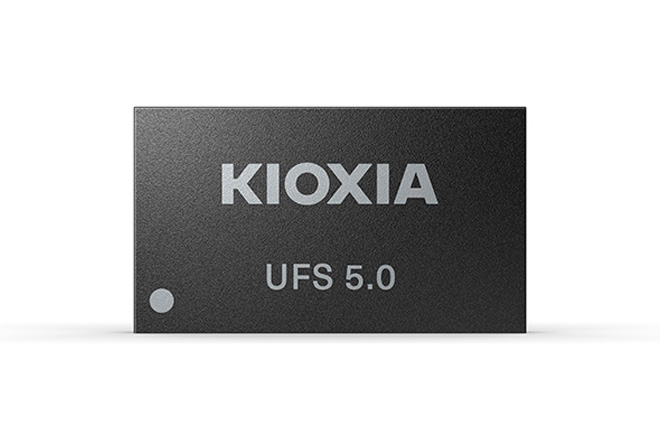
Kioxia has taken a big step toward the next generation of smartphone and embedded storage by shipping evaluation samples of its new UFS 5.0 embedded flash memory. Arriving in 512GB and 1TB capacities, these UFS 5.0 modules are aimed at devices that are quickly outgrowing the bandwidth limits of today’s mobile storage—especially as on-device AI, AR/VR, and high-resolution video workflows become more common.
While UFS 4.0 has been more than capable for everyday phone tasks like launching apps, multitasking, and background syncing, modern flagship hardware is increasingly “data-hungry.” Running advanced on-device AI models, processing large camera files, and handling richer real-time effects all put extra pressure on the link between storage and the processor. That’s the bottleneck UFS 5.0 is designed to ease.
The headline feature behind this jump is High-Speed Gear 6, also known as HS-GEAR6. Kioxia’s UFS 5.0 uses a dual-lane MIPI M-PHY 6.0 setup that can push up to 46.6 Gbps per lane. With two lanes in play, the effective total read/write performance can reach up to 10.8 GB/s—an attention-grabbing figure for embedded storage and a major uplift compared to the previous generation.
Kioxia pairs the new interface with its in-house 8th-generation BiCS FLASH controller, which is meant to provide extra headroom when workloads surge. That matters for scenarios where storage speed isn’t just about loading apps faster, but about enabling demanding pipelines such as local AI generation, rapid handling of large datasets, and on-the-fly processing of massive high-resolution video files in edge devices.
Even with the performance push, the physical design stays compact. Kioxia says the UFS 5.0 package uses a newly designed 7.5 x 13 mm footprint, making it small enough for space-constrained devices while still supporting the higher bandwidth requirements that next-gen mobile gaming and creator-focused features will increasingly depend on.
As for timing, Kioxia’s 512GB UFS 5.0 evaluation samples began shipping on February 24, and 1TB samples are expected to follow starting in March. Pricing hasn’t been shared yet, and Kioxia emphasizes these units are intended for functional evaluation only—meaning the final commercial specifications may change before UFS 5.0 products reach consumer devices.
UFS 5.0 is also still in the standardization process through JEDEC, but the early sampling indicates the industry is moving quickly. If these speeds translate into mass-market phones, tablets, and AI-focused embedded hardware, UFS 5.0 could become one of the key upgrades that makes on-device AI and richer real-time experiences feel faster, smoother, and more practical without leaning so heavily on the cloud.