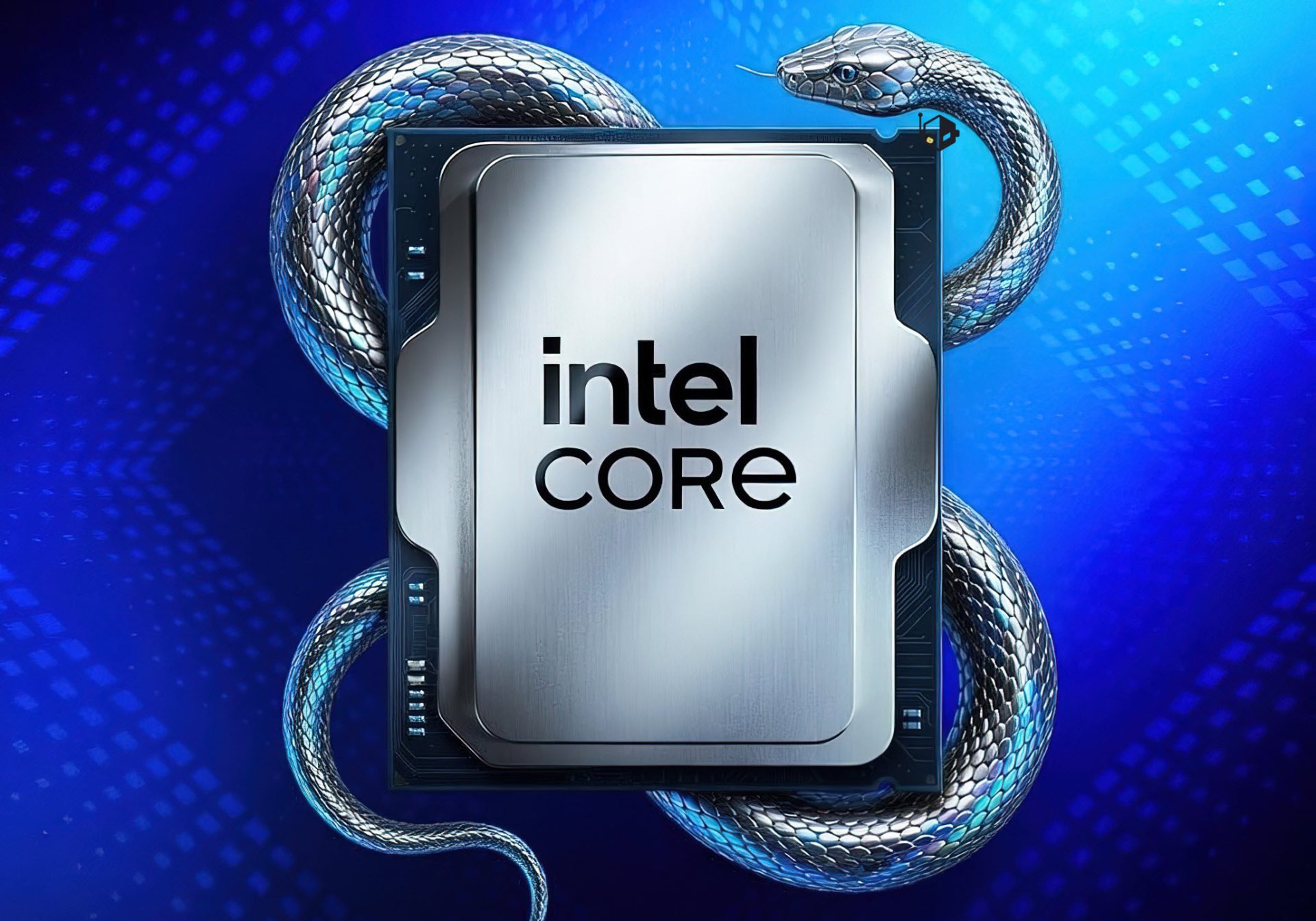
Intel’s long-term CPU roadmap is starting to sound a lot more ambitious, with fresh chatter pointing to a future family of chips that could blend Intel’s x86 CPU strengths with NVIDIA RTX-class graphics in a single package. If the leaks are accurate, the first Intel processor to use an NVIDIA GPU “tile” won’t arrive with the earlier rumored generations, but later—under a product branch referred to as Serpent Lake.
The key claim is that Intel Serpent Lake SoCs are expected to be built as a branch of Titan Lake rather than a straightforward mainstream successor. In other words, Serpent Lake may sit alongside Intel’s main CPU cadence as a special, higher-integration design—described as “Halo-like” in the sense that it targets a more powerful, all-in-one SoC approach than typical desktop parts. The broader timeline being discussed places Titan Lake after Razer Lake, with Hammer Lake following Titan Lake, and all of it landing in the 2028+ window. Serpent Lake, however, is framed as something distinct within that era—especially because of the graphics strategy.
What makes Serpent Lake stand out is the expectation that it will be the first Intel CPU to incorporate an NVIDIA RTX-based GPU tile. Specific configurations haven’t been detailed, so it’s unclear whether this would target thin-and-light laptops, high-end mobile workstations, compact desktops, or something else entirely. Still, the word “RTX” carries obvious implications: hardware-accelerated ray tracing, strong AI compute capabilities, and a more direct challenge to today’s premium integrated graphics expectations. If Serpent Lake truly launches around 2028–2029, it would likely align with whatever NVIDIA’s current-generation GPU architecture is at that time—potentially something in the Rubin era or a follow-up platform—making it a notable leap for integrated graphics performance in an Intel-led design.
Alongside the Serpent Lake discussion, there’s also a new name being circulated for Intel’s next-generation performance-core direction: Cooper Shark. This matters because Intel has been the subject of ongoing speculation about a “unified core” future—an approach that would blur or eliminate the distinction between P-cores (performance cores) and E-cores (efficiency cores). While unified-core talk has been gaining momentum in rumor circles, this latest information suggests Intel may still be operating with separate, dedicated P-core and E-core architecture tracks for at least part of the upcoming roadmap.
In this leak, Cooper Shark is presented as the next P-core architecture, while Golden Eagle is mentioned as the next E-core architecture. Exactly which CPU family gets which core type isn’t fully confirmed. Previous rumors have associated Griffin Cove P-cores and Golden Eagle E-cores with Razer Lake, while Titan Lake was often linked to the idea of a unified-core approach. If the new information is right, Intel may have pushed back, altered, or re-scoped those unified-core plans—potentially favoring an evolved hybrid approach (distinct P and E cores) using newer designs instead.
Stepping back, it’s important to treat all of this as forward-looking and unconfirmed. Intel’s CPU naming, platform plans, and architectural targets can shift over time, especially this far from launch. Still, the rumors offer a compelling preview of where next-gen Intel processors could be headed: more SoC-like designs, potentially much stronger built-in graphics, and continued experimentation with core architectures to balance peak performance with efficiency.
To put the broader Intel desktop CPU timeline into context, recent and rumored generations have been discussed along these lines:
Alder Lake (12th Gen) introduced the modern hybrid approach with Golden Cove P-cores and Gracemont E-cores.
Raptor Lake (13th Gen) and its refresh continued with Raptor Cove P-cores and Gracemont E-cores.
Arrow Lake (Core Ultra 200) is associated with Lion Cove P-cores and Skymont E-cores.
Nova Lake is widely rumored to push core counts further, with Coyote Cove P-cores and Arctic Wolf E-cores often mentioned.
Beyond that, Razer Lake, Titan Lake, and Hammer Lake are commonly listed as the next steps, but many details remain fluid—making new architecture names like Cooper Shark and Golden Eagle especially interesting for anyone tracking Intel’s long-term competitiveness in CPUs and integrated graphics.
If Serpent Lake does end up pairing Intel CPU technology with an NVIDIA RTX GPU tile, it could become one of the most talked-about PC silicon shifts of the decade—especially for laptops and compact systems where integrated performance and power efficiency matter most.