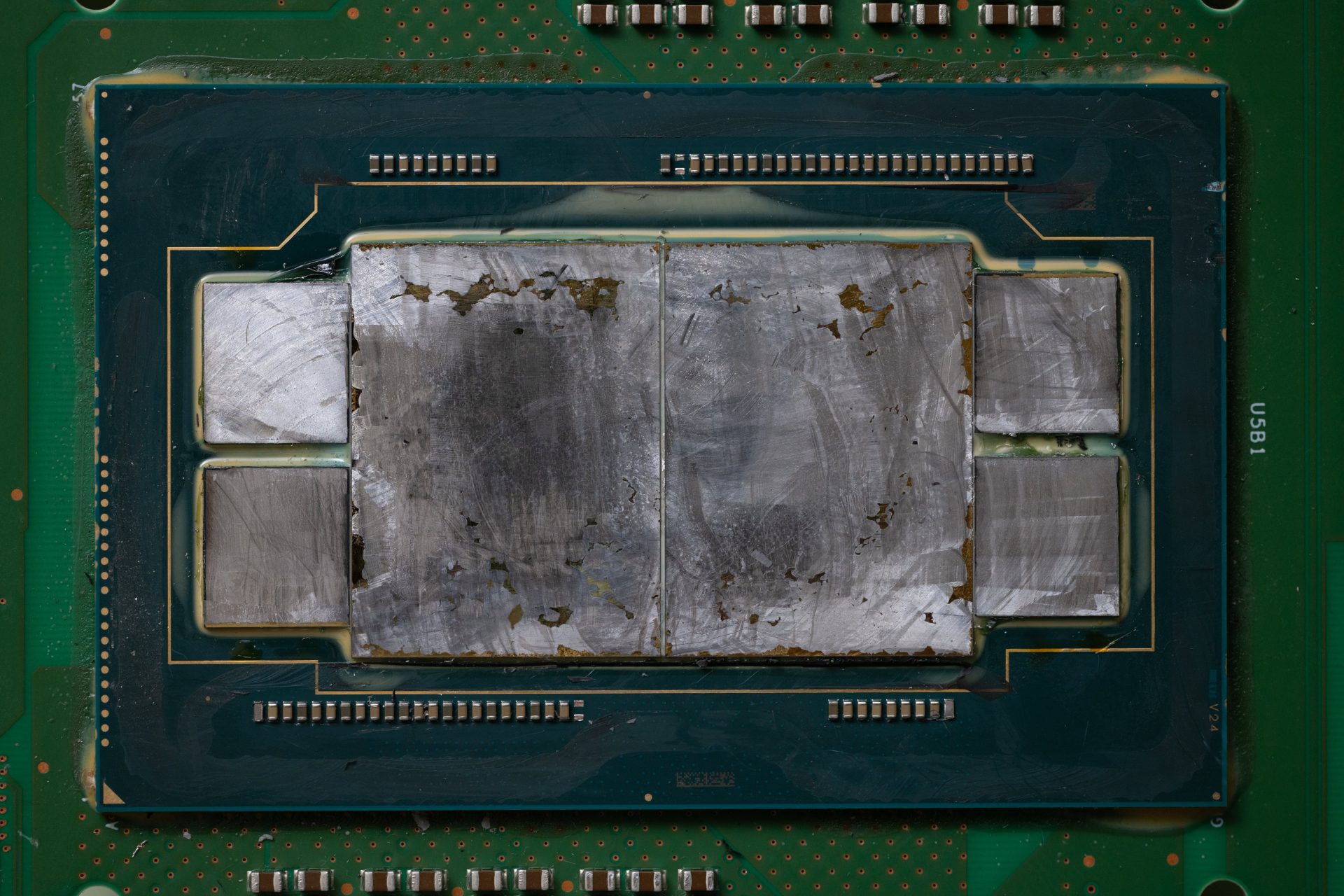
Intel’s canceled Arctic Sound 2T GPU resurfaces in rare photos after being mistaken for Ponte Vecchio
A rare piece of Intel graphics history has surfaced online: an Arctic Sound 2T GPU sample based on the company’s Xe-HP architecture. The card is especially interesting because Arctic Sound was canceled years ago, making any physical sample a notable find for hardware collectors and GPU enthusiasts.
According to the shared details, a user reportedly ordered an Intel Ponte Vecchio GPU sample but instead received an Arctic Sound 2T engineering sample. That unexpected mix-up has given the public a fresh look at one of Intel’s abandoned data center GPU projects from the early Xe era.
The story goes back to 2018, when Intel was preparing a major push into discrete graphics. At the time, the company’s graphics division was working on several products built around its first-generation Xe GPU architecture. These included solutions aimed at gaming, professional workstations, and data centers.
One of Intel’s most ambitious designs was Ponte Vecchio, a complex multi-tile GPU built for high-performance computing. Alongside it, Intel was also developing Arctic Sound, a GPU family aimed at workstation and server workloads. Early information suggested that Arctic Sound would come in several tile configurations, including 1-Tile, 2-Tile, and 4-Tile versions.
The newly pictured sample appears to be the 2-Tile Arctic Sound model. Images shared online show a dual-chiplet GPU package with two compute tiles based on Xe-HP, accompanied by four HBM2E memory sites. The chip is marked with “Intel Confidential” and carries a “QVS8 1.00 GHz” identifier, strongly indicating that it was an internal engineering sample rather than a retail-ready product.
The Arctic Sound 2T GPU was expected to feature 1024 execution units, split across two compute tiles with 512 EUs per tile. Based on the expected configurations from that generation, Intel’s Xe-HP lineup would have looked something like this:
Intel Xe-HP 1-Tile GPU: 512 execution units, estimated 4096 cores, around 12.2 TFLOPs at 1.5 GHz, with a roughly 150W power target.
Intel Xe-HP 2-Tile GPU: 1024 execution units, estimated 8192 cores, around 20.48 TFLOPs at 1.25 GHz, with a roughly 300W power target.
Intel Xe-HP 4-Tile GPU: 2048 execution units, estimated 16,384 cores, around 36 TFLOPs at 1.1 GHz, with a 400W to 500W power target.
Although Arctic Sound generated plenty of excitement during Intel’s early discrete GPU push, the project never made it to market as originally planned. Intel eventually canceled Arctic Sound, while Ponte Vecchio faced major delays before finally being deployed for the Aurora supercomputer years later than initially expected.
Intel’s data center GPU roadmap has changed several times since then. The company later shifted attention toward XPU-style products such as Falcon Shores, but that plan was also canceled. Intel is now looking ahead to Jaguar Shores, which is expected around 2027 and could become an important step in the company’s effort to regain momentum in high-performance computing and AI acceleration.
The resurfacing of Arctic Sound 2T is a reminder of how ambitious Intel’s original Xe-HP plans were. The chip represented a period when Intel was trying to challenge established GPU leaders in workstation, server, and data center markets with large multi-tile designs and HBM memory.
Today, Intel’s graphics strategy looks different. The company has found stronger footing with integrated graphics and value-focused discrete GPU offerings. It has also moved away from HBM in many of its current GPU designs, instead using GDDR and LPDDR memory solutions depending on the product class.
Upcoming products such as Crescent Island, expected to use Xe3P graphics technology and LPDDR5X memory, could help Intel strengthen its position in AI and professional workloads. Reports suggest configurations may reach up to 480 GB of LPDDR5X memory, making it a potentially interesting option for memory-heavy accelerator tasks.
Still, Intel faces a difficult road in the data center AI market. NVIDIA and AMD have built significant leads, particularly in AI accelerators and high-performance computing GPUs. Jaguar Shores may become Intel’s next major opportunity to prove it can compete in that space, but its expected 2027 arrival means the company still has time to refine its strategy.
For now, the Arctic Sound 2T sample stands as a fascinating artifact from Intel’s canceled GPU roadmap. It shows how far Intel was willing to go with multi-tile GPU engineering years ago, even if the final product never reached customers. For hardware enthusiasts, it is a rare glimpse at what could have been one of Intel’s most important early data center GPU designs.