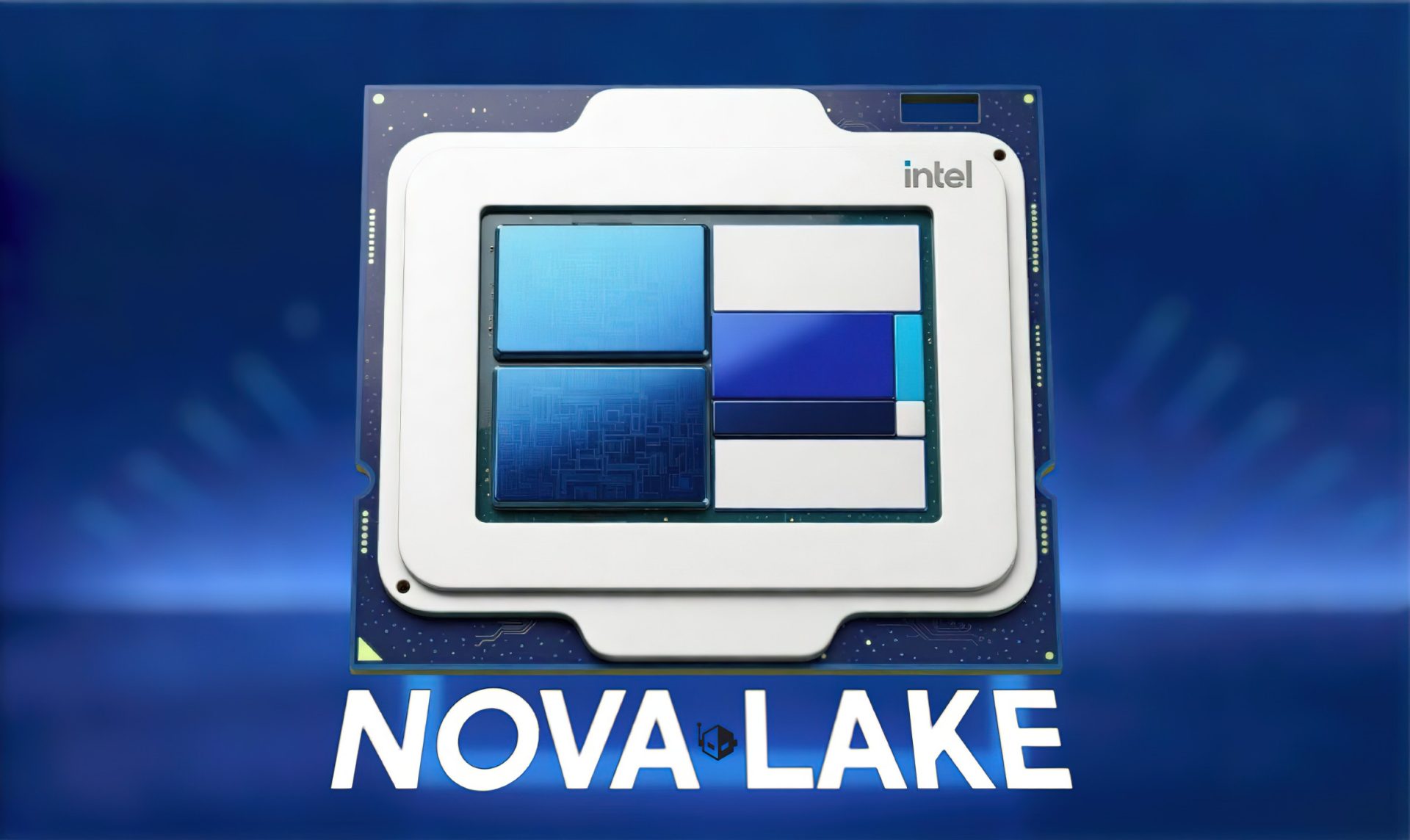
Intel Nova Lake CPUs reportedly enter engineering sample stage with major performance gains expected
Intel’s next-generation Nova Lake desktop processors are reportedly moving into a key pre-launch phase, with early engineering samples said to be shipping now. If the latest information proves accurate, Nova Lake could become one of Intel’s biggest desktop CPU upgrades in years, bringing far higher core counts, larger cache, new instruction support, and a fresh motherboard platform.
The upcoming desktop lineup, expected to be known as Nova Lake-S, is currently anticipated for the second half of 2026. While Intel has not yet shared full product details, early reports suggest that the company is preparing a major leap over Arrow Lake-S, especially in multi-core performance.
According to the latest rumors, Nova Lake engineering samples are already being distributed for early testing and validation. These samples are typically used by Intel partners, motherboard makers, and internal teams to fine-tune platform compatibility, firmware, power behavior, and performance before the retail launch.
One of the biggest talking points around Intel Nova Lake-S is the expected jump in core count. Previous leaks have suggested that Nova Lake desktop CPUs may arrive in two main designs: a single compute tile version and a dual compute tile version.
The single compute tile models are rumored to offer up to 28 cores, while the higher-end dual compute tile models may scale all the way up to 52 cores. That would be a huge increase compared to current Arrow Lake-S desktop chips, which top out at 24 cores.
For users who run heavy workloads such as rendering, compiling code, video editing, streaming, simulation, and content creation, this kind of core count increase could deliver a noticeable performance boost. Rumors currently point to multi-threaded performance improving by around 1.8x to 2.0x compared to Arrow Lake, though final results will depend on clock speeds, power limits, cooling, and retail silicon.
Single-core performance is also expected to improve. Early claims suggest Nova Lake may deliver at least a 20 percent uplift in single-threaded performance. That improvement is said to come from a mix of architectural changes and new technologies, including higher IPC, new Coyote Cove performance cores, new Arctic Wolf efficiency cores, bLLC cache, AVX10.2, and APX instruction support.
A 20 percent single-core gain would be important for gaming and everyday responsiveness. Many PC applications still rely heavily on strong single-thread performance, so improvements in IPC and clock behavior could make Nova Lake feel faster even outside of heavy multi-core workloads.
Cache may be another major upgrade. Intel is reportedly preparing to include a much larger bLLC cache structure on Nova Lake CPUs. The single compute tile models may feature up to 144 MB of bLLC, while dual compute tile models could offer up to 288 MB.
This could be especially important for gaming performance. Larger cache helps reduce memory latency in certain workloads and can improve frame rates in games that benefit from having more data closer to the CPU cores. AMD has seen strong success with its cache-heavy Ryzen X3D processors, so Intel’s move toward larger cache designs could make Nova Lake more competitive in gaming-focused desktop builds.
When looking at total cache, Nova Lake-S is rumored to offer between 160 MB and 320 MB of combined L2 and L3 cache, depending on the model. By comparison, Arrow Lake-S offers up to 76 MB. If these figures are accurate, Nova Lake would represent a dramatic increase in on-chip cache capacity.
The platform is also expected to change. Nova Lake-S will reportedly use a new LGA 1954 socket, meaning it will not be compatible with current LGA 1851 motherboards. The new CPUs are expected to launch alongside Intel 900-series chipsets, with Z990 likely serving as the flagship enthusiast chipset.
That means users planning a future Nova Lake upgrade will probably need a new motherboard. While that may be disappointing for those hoping for a drop-in upgrade, a new platform could also bring important improvements in memory support, I/O, connectivity, and power delivery.
DDR5 memory support is expected to improve as well. Nova Lake platforms are rumored to support faster DDR5 speeds, including newer CUDIMM and CQDIMM memory standards. These technologies are designed to help push memory frequencies higher while improving signal stability. Early platform details suggest support could reach around DDR5-8000 in certain configurations, compared to lower official speeds on Arrow Lake-S.
PCIe support may also be expanded. Nova Lake-S is rumored to offer up to 36 PCIe 5.0 lanes and up to 16 PCIe 4.0 lanes, compared to Arrow Lake-S with up to 24 PCIe 5.0 lanes and 4 PCIe 4.0 lanes. This would give high-end desktop users more flexibility for next-generation graphics cards, ultra-fast SSDs, capture cards, expansion cards, and other bandwidth-heavy devices.
Power consumption remains one of the biggest questions. Rumored figures suggest Nova Lake-S could have PL1 ratings ranging from 125W to 175W, depending on the model. Some early claims point to much higher maximum power draw under extreme conditions, especially for dual compute tile variants. However, these numbers should be treated cautiously until Intel releases official specifications and independent testing is available.
Compared to Arrow Lake-S, the rumored Nova Lake-S specifications look much more aggressive. Arrow Lake-S tops out at 24 cores, while Nova Lake-S may reach 52 cores. Arrow Lake-S has up to 8 performance cores and 16 efficiency cores, while Nova Lake-S may scale to 16 performance cores, 32 efficiency cores, and 4 low-power efficiency cores. Cache, memory support, PCIe lanes, and platform capabilities are all expected to increase as well.
Intel will not be alone in the next-generation desktop CPU race. AMD is also preparing its Zen 6-based Ryzen desktop processors, which are expected to bring major upgrades in core architecture, I/O, platform features, and 3D V-Cache technology. Rumors suggest AMD’s next-generation desktop chips may offer up to 24 cores and 48 threads, along with improvements designed to strengthen both productivity and gaming performance.
That sets the stage for a very competitive desktop CPU market in 2026. Intel appears to be aiming for a major comeback in high-performance desktop computing with Nova Lake, while AMD is expected to continue pushing gaming efficiency and cache-driven performance with its future Ryzen lineup.
For PC builders, gamers, and workstation users, Nova Lake could be one of the most exciting CPU launches to watch. Higher core counts, bigger cache, new architectures, faster DDR5 support, and a new enthusiast platform all point to a significant generational shift.
Intel has already confirmed that Nova Lake is planned for the second half of 2026, but the exact launch date remains unknown. More details may surface as motherboard partners prepare next-generation 900-series boards and as early engineering samples continue testing.
For now, Nova Lake-S looks like a major upgrade on paper. If Intel can deliver strong gaming performance, improved efficiency, and the rumored multi-core gains, its next desktop CPU family could become a serious contender for high-end gaming PCs and powerful productivity systems in 2026.