Intel may have dropped an unexpected hint about its next high-end Arc graphics card, and it wasn’t in a flashy product announcement. It showed up quietly inside documentation for the latest version of Intel’s AI Playground utility.
With the release of AI Playground v3.0.0 (Alpha), Intel is rolling out new capabilities designed to better support its Arc GPU lineup, with special attention on future Panther Lake systems built around the Xe3 architecture. But the real curiosity is tucked inside the updated user guide, where an Arc GPU configuration appears to be listed with a striking 32 GB of VRAM.
That’s a big deal because, in Intel’s current Arc family, 32 GB on a single GPU isn’t something buyers can point to on shelves today. The largest single-card memory capacity in the lineup tops out below that, with higher totals typically reserved for specialized dual-die or multi-GPU-style solutions. So seeing “32 GB” in an official guide instantly raises eyebrows—and fuels speculation that Intel may already be testing new hardware behind the scenes.
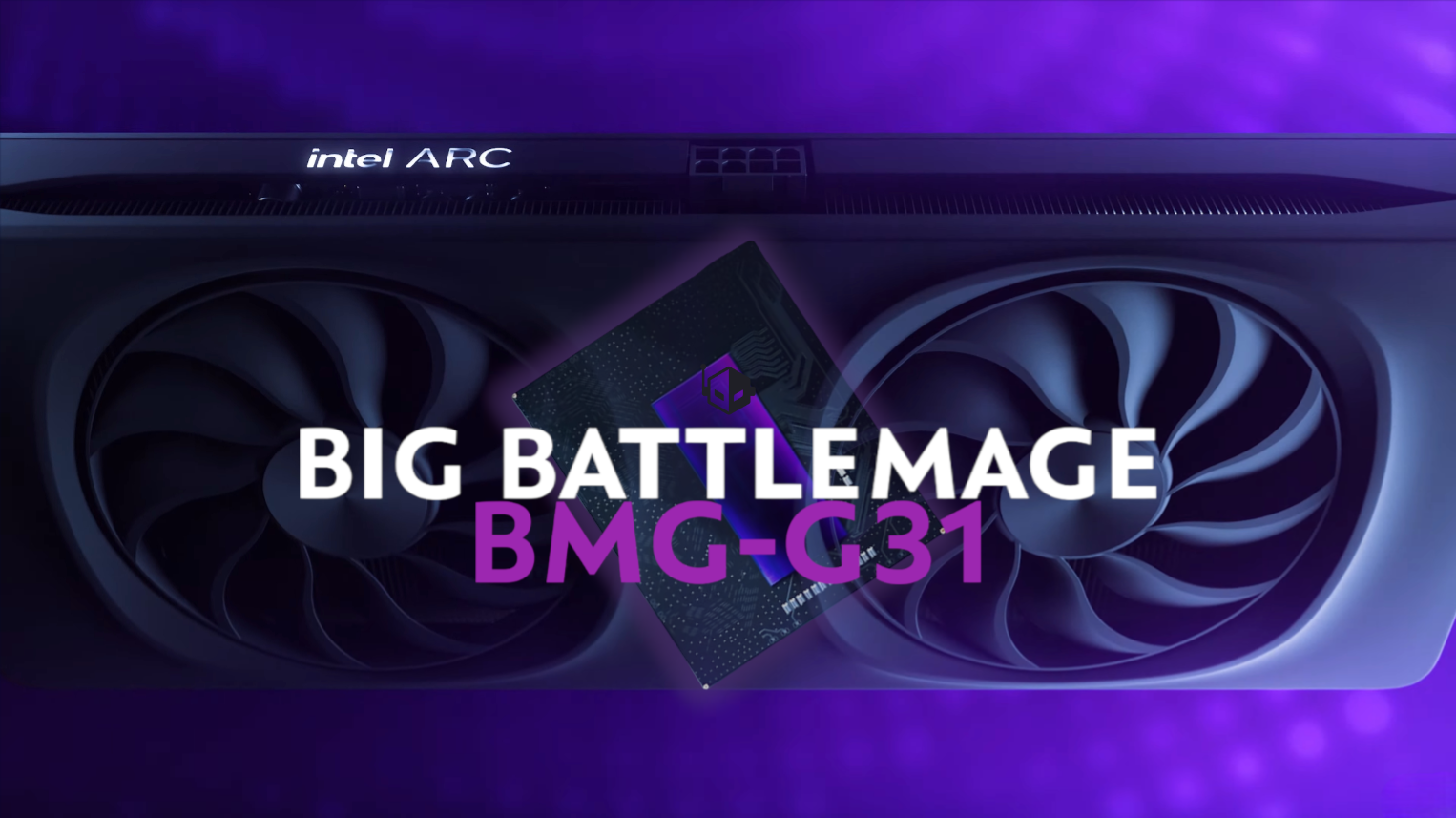
The 32 GB entry appears in the context of generating an AI image (a panther wearing a necklace featuring a “12Xe” logo). The assumption is straightforward: someone used an Arc GPU with a 32 GB memory configuration to create the image and document the process. If that hardware wasn’t just a placeholder or an error, it could be one of the first signs of a working sample from Intel’s more powerful “Big Battlemage” plans, widely expected to be built on the BMG-G31 GPU.
Why does that matter for specs? Because a higher-end Battlemage card based on BMG-G31 is expected to use a 256-bit memory interface. With that bus width, 16 GB and 32 GB models both make sense, depending on the memory modules and the card’s positioning. In other words, 32 GB isn’t a random number here—it fits what a more premium Battlemage design could realistically ship with.
There’s also a practical product strategy angle. If Intel is preparing multiple variants (as rumors suggest), the most likely split would be 16 GB for mainstream gaming models and 32 GB for professional or creator-focused versions where large VRAM pools can matter for AI work, rendering, and heavy content creation. Still, a limited or flagship gaming edition with 32 GB would certainly grab attention, especially in a market where VRAM capacity is becoming a major buying point for high-end users.
That said, there is an alternative explanation that could make this less dramatic. Intel’s graphics software includes a shared GPU memory override feature that can allocate system RAM to graphics workloads. In a laptop—especially a future Panther Lake system with 64 GB of memory or more—it’s possible to dedicate as much as 32 GB of shared memory to the GPU. If that’s what the guide was showing, the “32 GB” could represent shared system memory rather than physical VRAM on a discrete graphics card. At the moment, it’s hard to confirm which scenario is correct.
Even if this 32 GB mention turns out not to be a discrete “Big Battlemage” card, it still reinforces the bigger story: Intel is actively advancing Arc, and support updates have been steadily appearing around the BMG-G31 track. With CES 2026 approaching, Intel has a clear opportunity to deliver its next major GPU update—and it may be one of the most important graphics moments for the company in the first half of 2026.
Rumored Intel Arc Battlemage (and comparison) specs have floated around with a potential Arc B7XX class card based on BMG-G31 featuring 4096 shading units (32 Xe2 cores), a 256-bit bus, 16 GB of GDDR6 in at least one configuration, and a power target around 300W. Those figures, combined with the sudden appearance of “32 GB” in Intel’s own software documentation, are exactly the kind of breadcrumb that keeps GPU watchers paying close attention.
For now, the 32 GB Arc GPU listing stands as a compelling clue—either a glimpse of a real next-gen Battlemage card in testing, or evidence of how Intel is preparing Arc and Panther Lake to better handle memory-heavy AI workloads. Either way, it’s the kind of detail that tends to surface before bigger announcements follow.