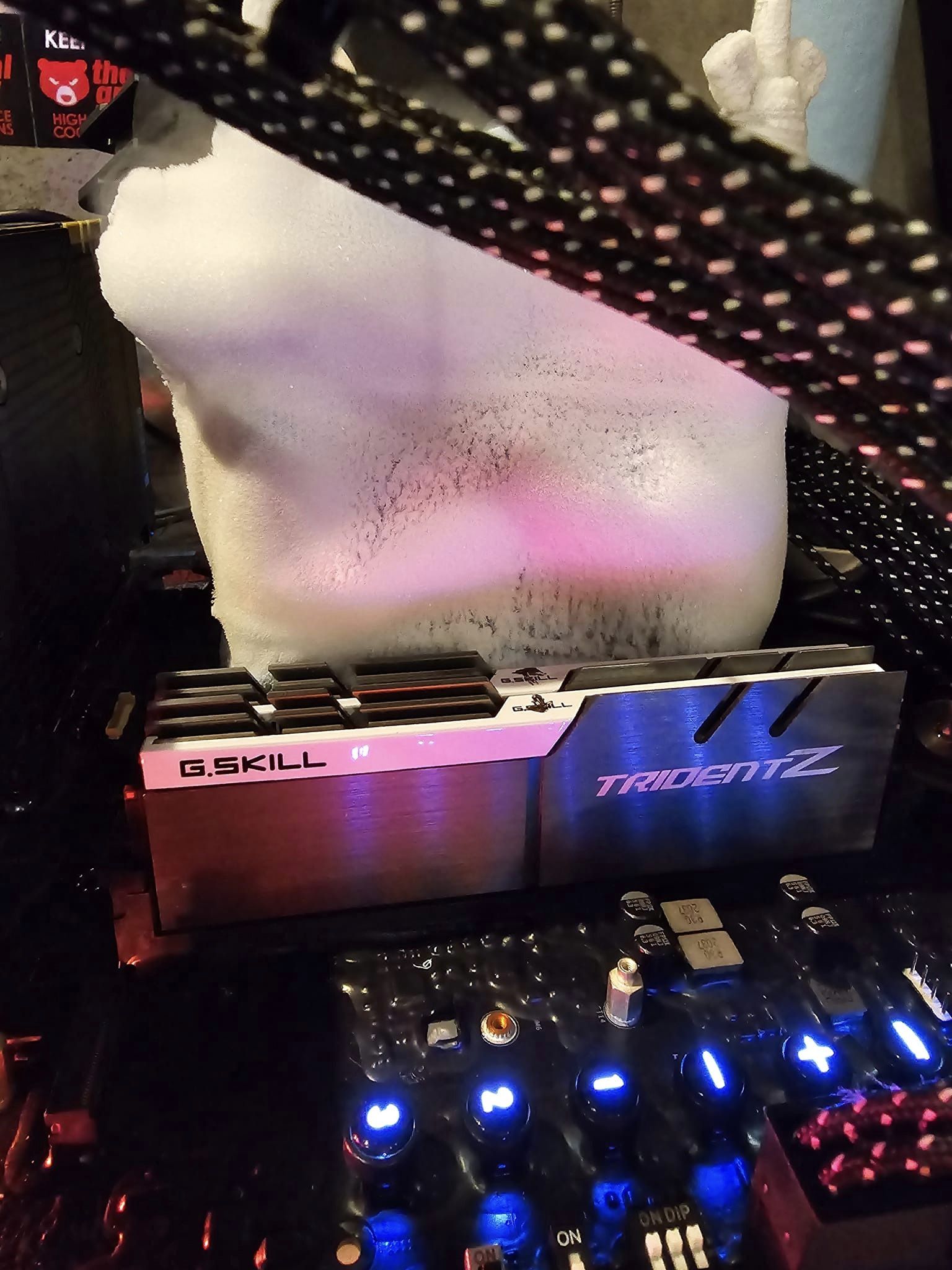
In the dynamic world of computer hardware, an unexpected champion has emerged in the realm of memory overclocking. The three-year-old Intel Core i9-11900K processor, teamed up with DDR4 memory, recently claimed the top spot in the PYPrime latency benchmark, outperforming the newer Core i9-14900KS that operates with DDR5 memory.
Intel’s Veteran Core i9-11900K Shows Modern Capabilities
Despite initial criticism for minor performance improvements and a regression in core count, the Intel Rocket Lake CPUs have shown that when properly fine-tuned, they are capable of immense prowess. Overclocking enthusiasts have breathed new life into these processors, surpassing the performance of modern chips.
The groundbreaking achievement in memory overclocking was attained by a well-known overclocker, Allen Matthew, also known as SPLAVE. He leveraged the power of the Intel Core i9-11900K on the ASRock Z590 OC Formula motherboard, a platform renowned for its DDR4 memory support and its optimized dual DIMM design for memory overclocking. The used benchmark PYPrime, specifically its 32B iteration, focuses on calculating latency performance.
New Benchmark Triumph
The prior world record was held by another celebrated overclocker, SAFEDISK. His arrangement comprised an Intel Core i9-14900KS CPU with a clock speed of 8.37 GHz across eight P-Cores and two memory kits of G.Skill Trident Z5 RGB at DDR5-9306, providing a time of 1 minute, 37 seconds, and 596 milliseconds.
Determined to surpass this mark, SPLAVE optimized the Intel Core i9-11900K CPU to a speed of 6.957 GHz and pushed a pair of G.Skill Trident Z DDR4 memory sticks to DDR4-3914 with extremely tight timings. Triumphantly, the overclock completed the benchmark in 1 minute, 37 seconds, and 311 milliseconds — a margin of 285ms faster — achieving an impressive 10% latency reduction, vital for this specific benchmark.
DDR4 Outpaces DDR5 In Latency—For Now
One of the interesting revelations from this benchmarking feat is the latency comparison between DDR4 and DDR5 memory. Although DDR5 memory has seen vast improvements in bandwidth and speed, initial iterations seem to lag behind DDR4 due to higher clock timings and latency. This aspect is anticipated to improve with future DDR5 memory kits.
Moreover, the comparison sheds light on the performance differences attributed to ‘Gear 1’ and ‘Gear 2’ modes, where ‘Gear 2’ can limit performance by reducing clock frequencies in relation to the internal memory controller (IMC). This situation is also noticed with AMD’s Ryzen CPUs that often operate with a 1:2 memory clock ratio to accommodate higher speeds.
While the Rocket Lake CPUs exhibit exceptional performance in terms of lower latency memory operations, this comparison should not be misconstrued as a definitive advantage over newer Alder Lake or Raptor Lake CPUs. The latest generation chips offer significantly higher core counts, clock speeds, and instructions per cycle (IPC), which translate to overall superior performance in a broad spectrum of uses, from productivity applications to gaming, despite the latency differences with DDR4 memory.
This record-breaking feat illustrates that with innovative tuning, older hardware can still challenge and even outperform newer technologies in specific conditions. It highlights the importance of understanding the nuances of computer hardware performance, especially for those looking to optimize systems for competitive computing or to extract high efficiency from their current setups.


