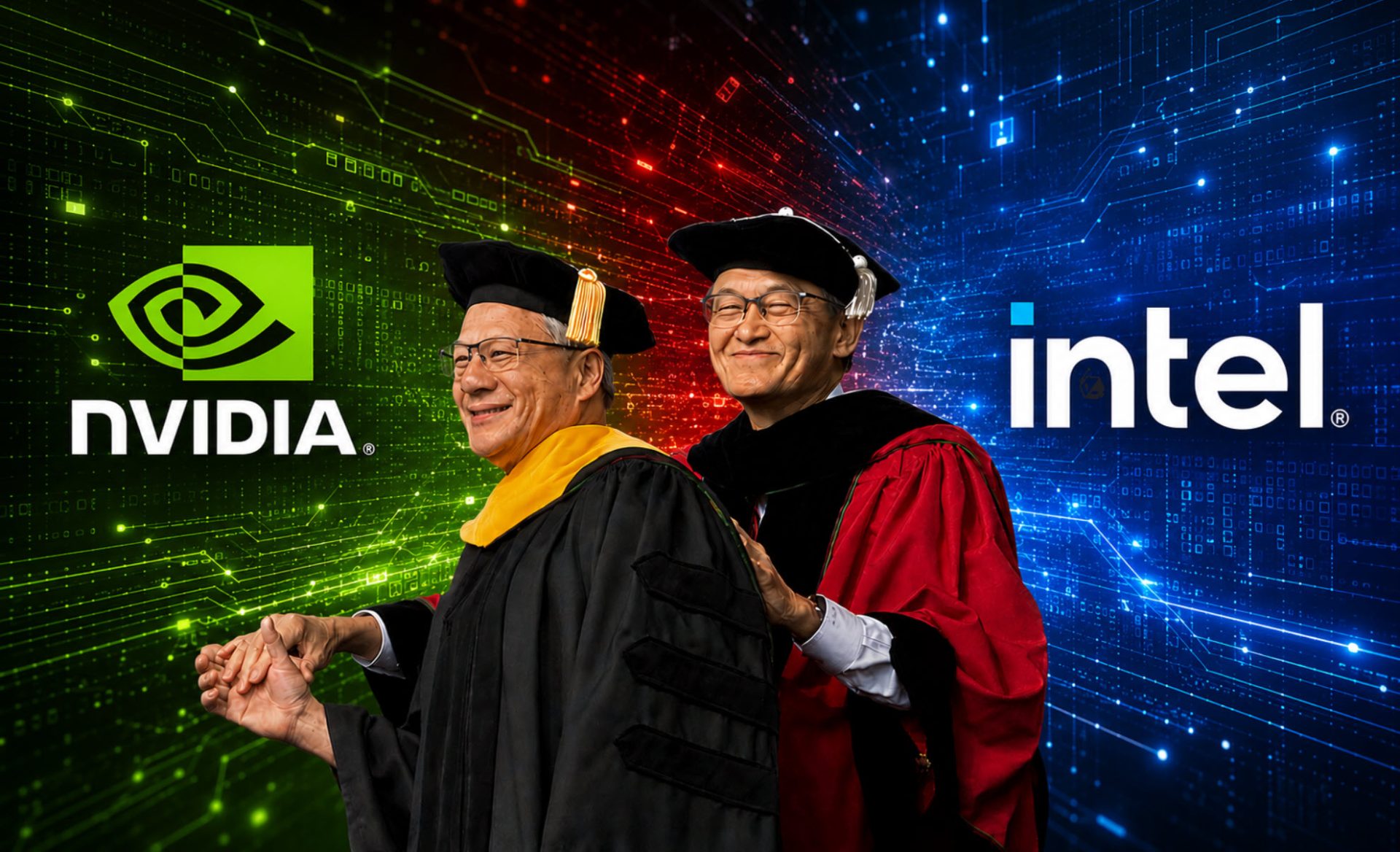
Intel CEO Lip-Bu Tan is publicly celebrating NVIDIA CEO Jensen Huang after Huang received an honorary Doctor of Science and Technology degree during Carnegie Mellon’s 2026 commencement, and the timing is anything but routine. Alongside his congratulations, Tan also confirmed that Intel and NVIDIA are actively working together on “exciting new products,” signaling that the partnership between two of the biggest names in semiconductors is moving into a far more visible phase.
Tan praised Huang’s impact on accelerated computing and artificial intelligence, noting the honor of presenting the doctoral hood. But the bigger takeaway for the tech world is what comes next: Intel and NVIDIA are expanding collaboration across data center and consumer platforms, and the industry is watching closely because the implications could stretch from enterprise AI infrastructure all the way to future gaming and PC hardware.
The relationship has already been trending in this direction, with both companies previously outlining plans to co-develop multiple products. One widely discussed part of that cooperation involves data center technology, where a custom Intel Xeon CPU could integrate NVIDIA’s NVLink, a move that would tightly connect CPU and GPU resources for high-performance computing, AI training, and large-scale inference workloads. If that effort materializes, it could reshape how certain data centers build systems that depend on ultra-fast interconnects between processors and accelerators.
On the consumer side, the talk is even more intriguing for PC enthusiasts. Industry chatter points to NVIDIA’s RTX graphics intellectual property being integrated into next-generation system-on-chip designs. A first candidate frequently mentioned is an SoC platform known as Serpent Lake, with a possible arrival window around 2028 to 2029. If this direction becomes real, it could open the door to new kinds of laptops and compact PCs that blend Intel CPU technology with NVIDIA-derived graphics capabilities in more unified designs.
However, there may be an even larger strategic win sitting behind the product headlines: Intel Foundry. For NVIDIA, which has heavily depended on TSMC for major GPU production, manufacturing capacity and advanced packaging have become increasingly important constraints as AI demand continues to surge. Packaging capacity—especially for cutting-edge approaches used in high-end accelerators—has been a bottleneck across the industry, and meeting wafer demand at the scale NVIDIA needs is not always easy when multiple customers are fighting for the same supply.
That’s where Intel could become more than a partner on product design. Intel’s push to grow its foundry business, supported by recent high-profile manufacturing momentum, positions it as a potential secondary production and packaging option for large customers that want to diversify beyond a single primary supplier. For NVIDIA, adding another credible foundry partner could mean more flexibility, more predictable supply, and reduced risk during periods of extreme demand.
Current speculation suggests NVIDIA’s next-generation Feynman GPUs may use Intel’s EMIB advanced packaging technology. There are also reports that future Intel process nodes such as 18A-P or 14A could potentially be used for certain GPU products—possibly in the entry-to-midrange client segment, including gaming-focused graphics chips. Nothing is confirmed yet about which exact GPUs would be built where, but the direction of travel is clear: Intel and NVIDIA are getting closer, and their cooperation is expanding beyond polite industry alignment into tangible technology and manufacturing opportunities.
For now, the clearest message is that the relationship is warming fast and the companies want people to know it. With both CEOs signaling momentum and “exciting new products” on the horizon, upcoming announcements could have real consequences for AI hardware roadmaps, data center architecture, and the next era of consumer computing.