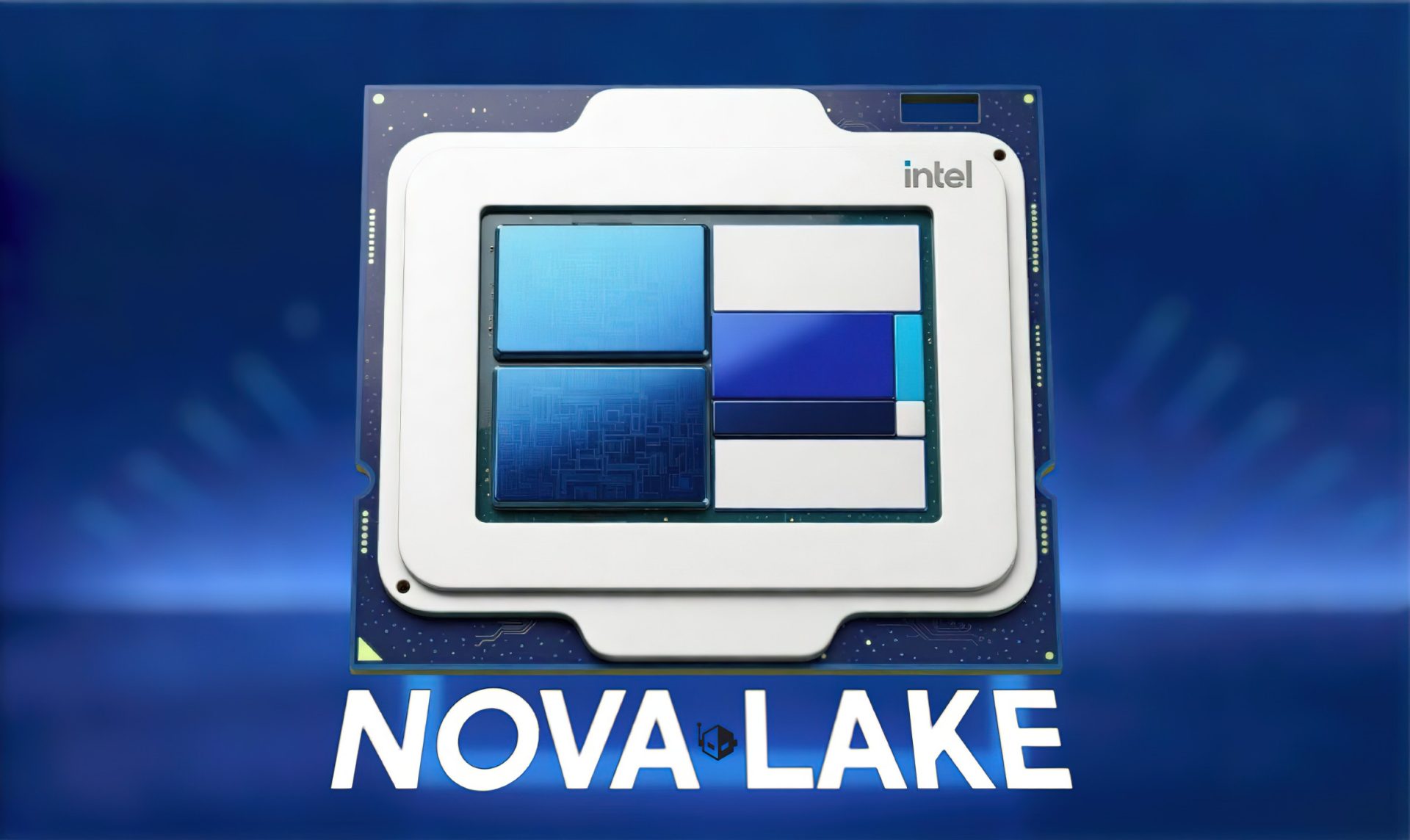
Intel’s upcoming Nova Lake-S desktop CPUs are shaping up to be a major leap forward, and a new leak suggests Intel is already boosting specs before the chips even arrive. What was previously rumored as a 42-core Nova Lake-S configuration is now said to be upgraded to a 44-core design—while keeping the same “Dual Compute Tile” approach and the large bLLC cache that’s expected to be a key feature of this generation.
According to the latest information, the updated 44-core Nova Lake-S variant will include 16 Performance cores arranged as 2×8, plus 24 Efficiency cores arranged as 2×12, along with 4 additional LP-E cores. The P-cores are expected to use the Coyote Cove architecture, while the E-cores are based on Arctic Wolf. Earlier rumors pointed to a 42-core version built around 14 P-cores and 24 E-cores, so the new configuration adds more high-performance muscle.
The change also feels more logical from a product design standpoint. A 42-core setup implied an unusual 7 P-cores enabled per compute tile, which would be an odd split for a tiled design. Moving to a clean 8 P-cores per tile (for 16 total) makes the lineup easier to scale and segment, though it’s still possible Intel could introduce alternative core mixes later on.
Another big talking point is bLLC (a large on-package cache concept expected across these parts). Dual compute tile Nova Lake-S CPUs are rumored to carry up to 288 MB of bLLC, while single compute tile models may top out at 144 MB. Here’s the current list of bLLC-equipped Nova Lake-S variants being discussed:
Platform changes are also a big part of the Nova Lake-S story. These CPUs are expected to be the first desktop family to use the upcoming LGA 1954 socket, launching alongside new 900-series motherboards. What will matter most to DIY PC builders is Intel’s hint that this socket may last for multiple CPU generations—welcome news for anyone who doesn’t want to replace a motherboard every couple of upgrades.
As for timing, the Nova Lake-S desktop lineup—often associated with the “Core Ultra 400” naming—has been rumored for the second half of 2026. Intel has also indicated it aims to reclaim performance leadership versus AMD around this timeframe. Whether that promise becomes reality will depend on real-world benchmarks, pricing, and availability, but on paper Nova Lake-S looks positioned to intensify competition in the enthusiast desktop CPU market.
For an idea of how ambitious Nova Lake-S appears compared to Arrow Lake-S, the rumored platform-level differences include higher maximum core counts, substantially more total cache (including bLLC), faster DDR5 support targets (up to DDR5-8000 in certain configurations), and more PCIe 5.0 lanes—along with a new socket and motherboard series. Power limits and peak consumption figures are still the kind of early numbers that can change before launch, but the overall direction is clear: Intel is preparing a more scalable, higher-core desktop strategy than its immediate predecessor.
If more leaks continue to point in the same direction, Nova Lake-S could become one of Intel’s most important DIY desktop releases in years—especially for users who want more cores, more cache, and a platform built to stick around longer than a single upgrade cycle.