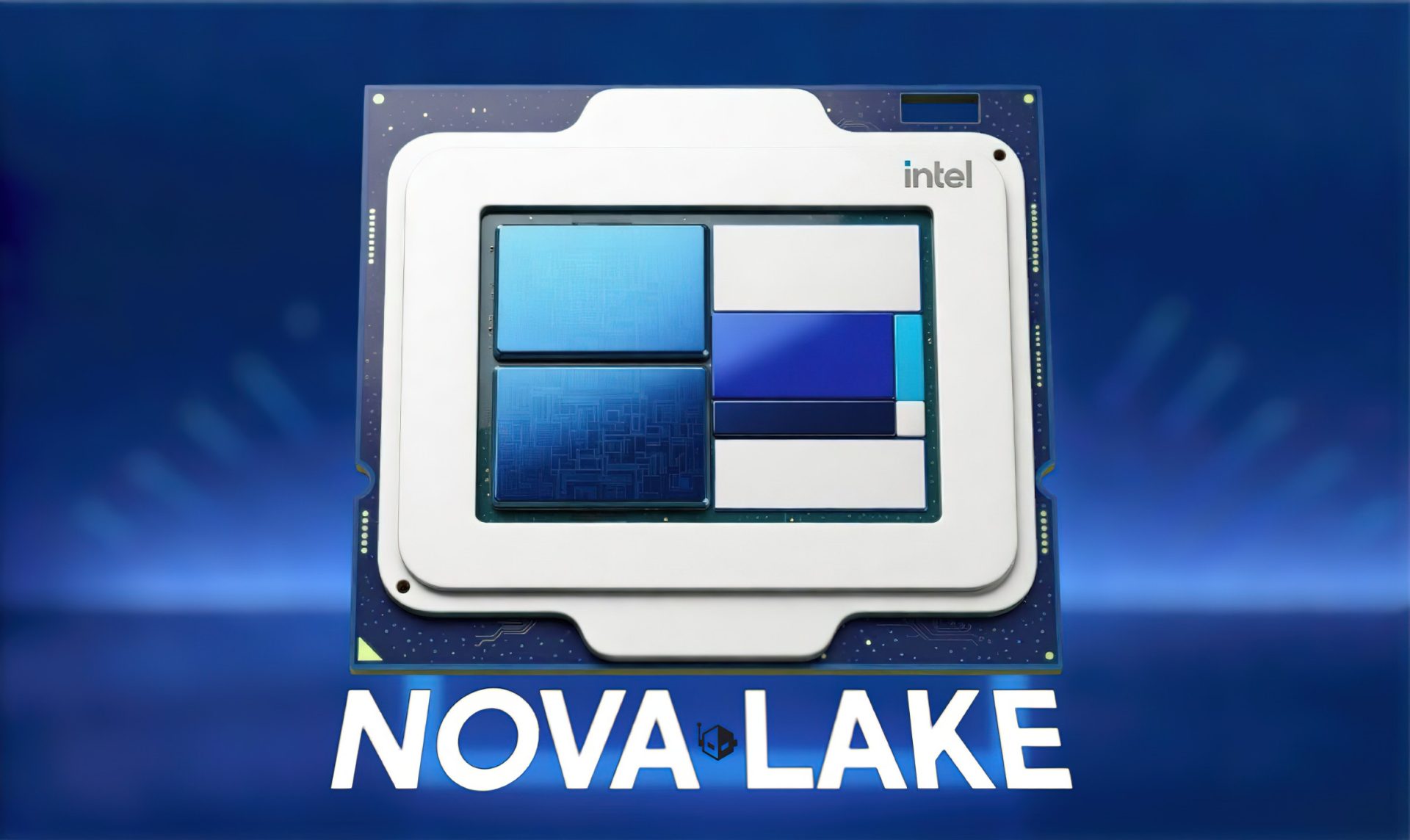
Fresh leaks around Intel’s upcoming Nova Lake desktop processors suggest the company is preparing a major push for performance desktops again. Expected to arrive as the Core Ultra Series 4 family, Nova Lake is shaping up to be more than a routine refresh, bringing new CPU architectures, a new platform, and a big jump in AI-focused capabilities.
A big reason enthusiasts are paying attention is the architectural overhaul. Nova Lake is rumored to use Coyote Cove for performance cores (P-cores), Arctic Wolf for efficiency and low-power efficiency cores (E-cores/LP-E), and Xe3/Xe3P for integrated graphics. On top of that, Intel is said to be introducing an upgraded NPU6 engine aimed at dramatically improving on-device AI throughput, with figures floating around 74 TOPS. For context, that’s a sizeable leap over recent desktop offerings and positions Nova Lake as a much more AI-capable desktop platform—especially as more apps and creator tools begin leaning on local AI acceleration.
Performance rumors are bold, too. Current chatter points to a single-thread uplift of around 10%, plus higher IPC claims versus AMD’s upcoming Zen 6. Where Nova Lake could really stand out, though, is multi-thread scaling—because leaks suggest Intel plans to push desktop core counts as high as 52 cores. If that holds, it’s a dramatic jump in parallel performance potential, especially for heavy productivity, content creation, compilation, and workstation-style workloads that thrive on more cores.
Die configurations: five designs, including a 52-core dual-tile option
According to the leaked details, Intel’s Nova Lake-S desktop lineup will be built around five main die configurations. These include both single compute tile designs and enthusiast-focused dual compute tile designs (often labeled as “DS”). Here’s how the reported configurations break down:
1) 8-core class: 4 P-cores + 4 LP-E cores
This appears to be the entry point, prioritizing basic performance with low-power cores included.
2) 16-core class: 4 P-cores + 8 E-cores + 4 LP-E cores
A step up aimed at mainstream desktops that benefit from more background throughput and better multi-tasking.
3) 28-core class (standard): 8 P-cores + 16 E-cores + 4 LP-E cores
This looks like the core of the desktop range for higher-end builds.
4) 28-core class (bLLC “Big LLC”): 8 P-cores + 16 E-cores + 4 LP-E cores with expanded last-level cache
This “big cache” variant is particularly interesting. It’s positioned as Intel’s response to the idea behind AMD’s 3D V-Cache-style gaming chips, although the leak suggests Intel’s approach is not based on the same stacked cache method.
5) 52-core class (dual compute tile, bLLC): 2x (8 P-cores + 16 E-cores) + 4 LP-E cores
This is the headline-grabber. Two compute tiles combine for massive core counts, while LP-E cores remain at 4 (they reportedly don’t double because they aren’t located on the compute tile).
Cache figures being discussed are equally attention-grabbing. Reports suggest the single-tile bLLC parts could offer 144 MB of cache, while the dual-tile bLLC models may reach 288 MB. There are also size estimates floating around, with standard compute tiles at 98mm² and bLLC compute tiles at 154mm².
At least 13 desktop SKUs are expected, spanning Ultra 3 to Ultra 9 (plus an even higher tier)
Leaks also outline a broad SKU stack, with at least 13 models planned across Core Ultra 9, Core Ultra 7, Core Ultra 5, and Core Ultra 3 branding. There’s also talk of an even higher-tier label for the top dual-tile chips, including a 52-core and a 44-core variant.
Power targets reportedly scale across the lineup:
– Enthusiast dual-tile models may reach up to 175W TDP.
– Much of the standard desktop lineup is expected around 125W.
– Lower-power and power-optimized configurations are also planned, ranging down to 35W, with some “unlocked” versions pushing higher (up to around 65W for certain entry models).
“F” variants without integrated graphics are also expected. As for iGPU capability, the early info suggests all Nova Lake CPUs may ship with a small Xe3-based iGPU configuration (2 Xe3 cores mentioned), while one SKU could potentially introduce a higher-end iGPU option.
New socket and platform upgrades: LGA 1954, DDR5-8000, and more modern I/O
Nova Lake desktop processors are rumored to debut on a new LGA 1954 platform, also referred to as Socket V. One intriguing claim is extended socket support, with multiple future CPU generations said to be planned for the same package—good news for DIY builders who prefer longer upgrade paths.
Cooling compatibility may also be a selling point. Leaks suggest users may be able to reuse existing coolers rather than replacing their entire cooling solution with the platform upgrade. There’s also mention of enthusiast-class motherboards using a 2-layer ILM design with two loading levers, aiming for better mounting and cooling performance without requiring aftermarket contact frames.
On the memory side, Nova Lake is expected to push DDR5 support further, with up to DDR5-8000 MT/s reportedly supported by default, plus higher speeds via overclocking. The platform is also expected to lean more heavily into newer memory module standards like CUDIMM and CQDIMM, with claims that memory capacity support could scale beyond 256GB—even on boards with fewer DIMM slots.
Connectivity and expansion upgrades are also part of the rumored package, including:
– Native Wi‑Fi 7
– Thunderbolt 5.0
– Low-Energy Audio support
– ECC capabilities (as referenced in the leak)
For PCIe and storage, the rumor points to up to x16 Gen5 for discrete graphics, with the ability to split lanes into four x4 connections, potentially useful for multi-accelerator or AI-focused builds. Storage expansion could be substantial as well, with talk of up to 8 SSDs supported and multiple Gen5 x4 lanes supplied via the chipset, alongside additional Gen4 lanes.
Intel vs AMD in 2026: a real desktop clash is brewing
If these specs land anywhere close to what’s being rumored, Nova Lake could be Intel’s most aggressive desktop play in years—especially with 52-core scaling and large-cache variants designed to target both creators and high-FPS gamers. It also sets the stage for a major face-off with AMD’s next-generation Ryzen lineup based on Zen 6, with both platforms rumored for the second half of 2026.
Until Intel and AMD share official details, it’s best to treat leaked specs as tentative. Still, the direction is clear: more cores, more cache, faster DDR5, stronger AI acceleration, and a platform built for modern connectivity and expansion. For PC builders waiting to plan their next big upgrade, 2026 is lining up to be one of the most competitive years for desktop CPUs in a long time.