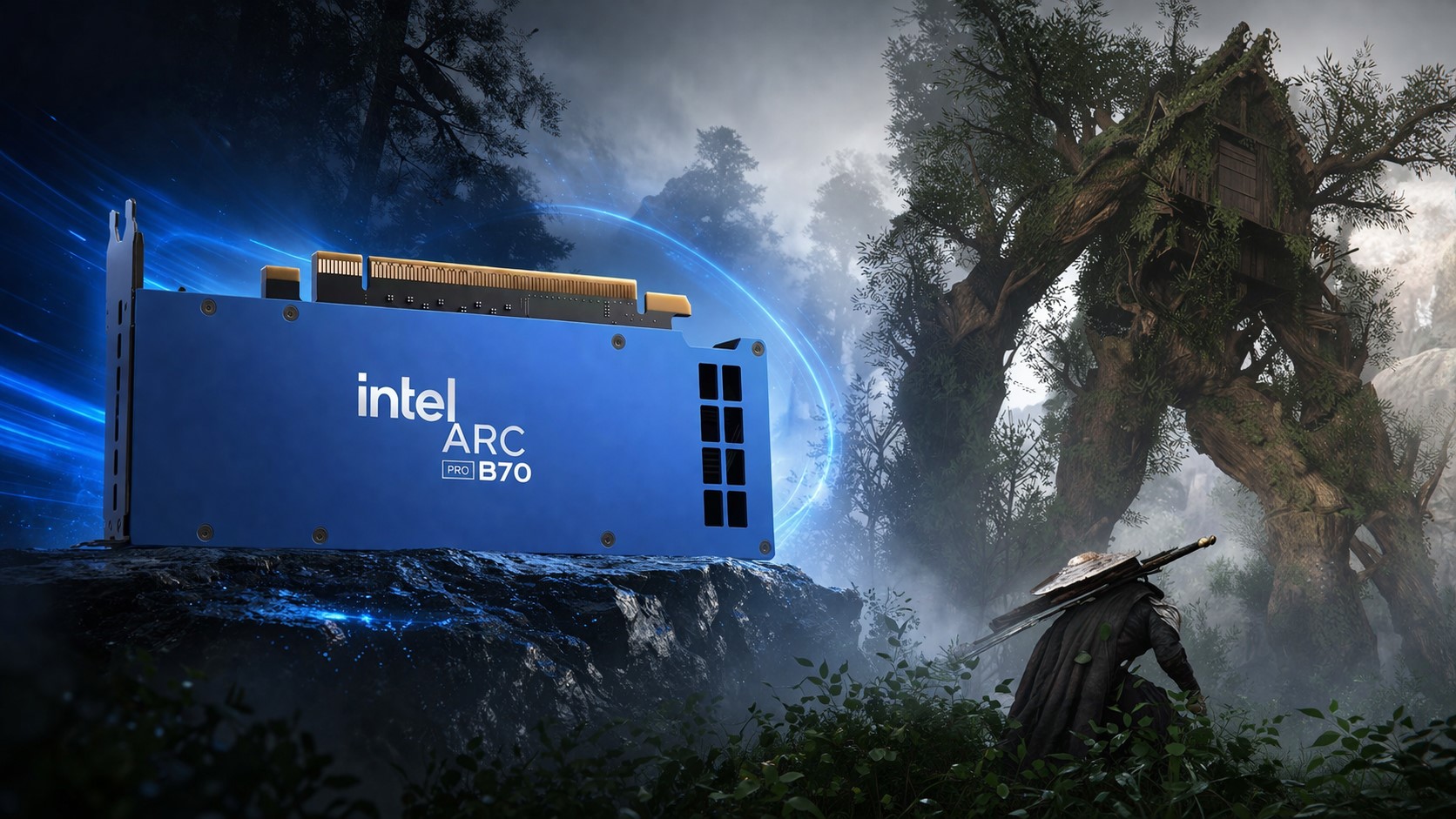
Crimson Desert has started to look a lot more welcoming to Intel GPU owners. Nearly three weeks after launch, Pearl Abyss rolled out an update that adds support for Intel Arc graphics, covering both discrete cards and integrated solutions. The patch notes also mention support for XeSS 3 and Frame Generation, signaling that the developer is actively working to improve performance and features on Intel hardware.
That update doesn’t just matter for mainstream gaming cards. It also appears to extend to Intel’s workstation lineup. A recent test shows Crimson Desert running on the Intel Arc Pro B70, Intel’s current flagship Battlemage workstation GPU. The Arc Pro B70 uses the BMG-G31 die, a configuration not currently found in consumer Arc models, making it an interesting proof point for compatibility and real-world performance.
In gameplay testing on the Arc Pro B70, Crimson Desert runs successfully and delivers solid frame rates. Performance lands around the 70–80 FPS range on average, with 1% lows sitting in the 60s, which is a good sign for smoothness during heavier scenes. For a workstation-focused card running a major new title, those results suggest Intel’s Arc driver and game-side support are moving in the right direction.
There is, however, a major visual issue that can spoil the experience. When Crimson Desert is set to Medium or High presets, the game can show heavy shimmering and artifacting. Oddly, switching the settings to Ultra makes the problem disappear. That’s an unusual behavior pattern, and it points to a bug tied to specific quality settings rather than a general stability problem. Similar early-stage quirks have also been seen on consumer Arc GPUs, which reinforces the idea that Intel Arc support in Crimson Desert is still fresh and needs more polishing.
Upscaling support is another mixed area right now. XeSS 3.0 does function and can lift performance a bit, but it may also cause unwanted “detexturing,” where some surfaces lose detail or appear degraded. In contrast, FSR 3.1 is reported to deliver better-looking results overall in its current state, offering acceptable image quality while still helping performance. Ideally, XeSS 3 should be one of the best options for Intel cards, but it’s clear the game needs additional optimization work to make that feature operate as intended.
The good news is that these issues look like the kind that can improve quickly with regular updates. Crimson Desert now runs on Intel Arc hardware, including Intel’s Arc Pro B70 workstation GPU, and the raw performance is already promising. If upcoming patches address the shimmering on non-Ultra presets and tighten up XeSS 3 image quality, Intel Arc users could be in for a much better experience in the near future.


