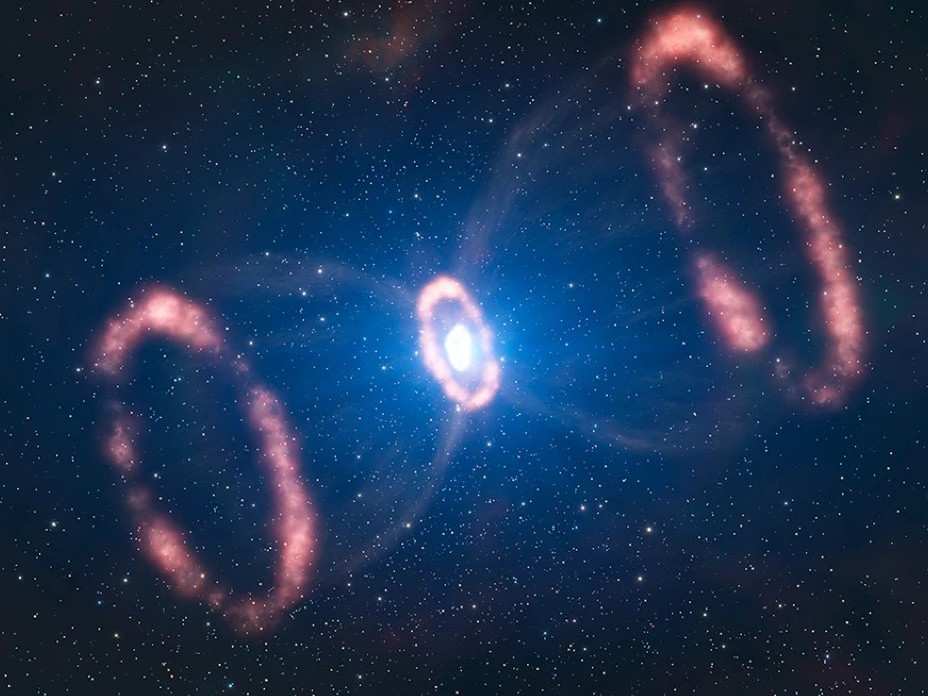
A star, after exhausting its hydrogen fuel, continues to fuse elements such as helium until eventually, gravitational forces become too much to bear. It’s when a star has a mass at least eight times that of our Sun that this incredible force can trigger an explosion known as a supernova. Such a cataclysmic event not only produces brilliant light but also releases a massive amount of neutrinos and a veritable periodic table of elements in all directions, contributing to the cosmic diversity we see, including the elements on Earth.
One historically significant supernova, known as Supernova 1987A, was the first to be indicated by a flood of neutrinos on Earth back in 1987 before the actual explosion was visible in the Large Magellanic Cloud, which is a satellite galaxy near the Milky Way, located approximately 163,000 light-years away.
For over three decades, astronomers have been intrigued not only by the radiation and elements springing from such a large-scale stellar event but also by the aftermath—what remains after the dust settles. The key question: Does the cataclysm give birth to a black hole or a neutron star?
Thanks to the capabilities of the James Webb Space Telescope, which has been operational since 2021, researchers were able to secure detailed and high-resolution images over the course of 9 hours to delve deeper into this question. Despite the remaining dust obscuring the very center of the supernova, scientists identified ionized argon and sulfur, signs pointing towards the existence of a neutron star. This is based on the ionization detected, which is believed to be a result of radiation from such a neutron star, following comprehensive analysis and calculations.
It now appears that rather than a black hole, Supernova 1987A has left behind a neutron star, an object immensely dense, packing masses comparable to several suns into a sphere only a few kilometers in diameter. The Hubble Space Telescope has also captured detailed images of SN1987A, offering a direct link to full-resolution images for those who would like an even closer look (Warning: file size is 34 megabytes).