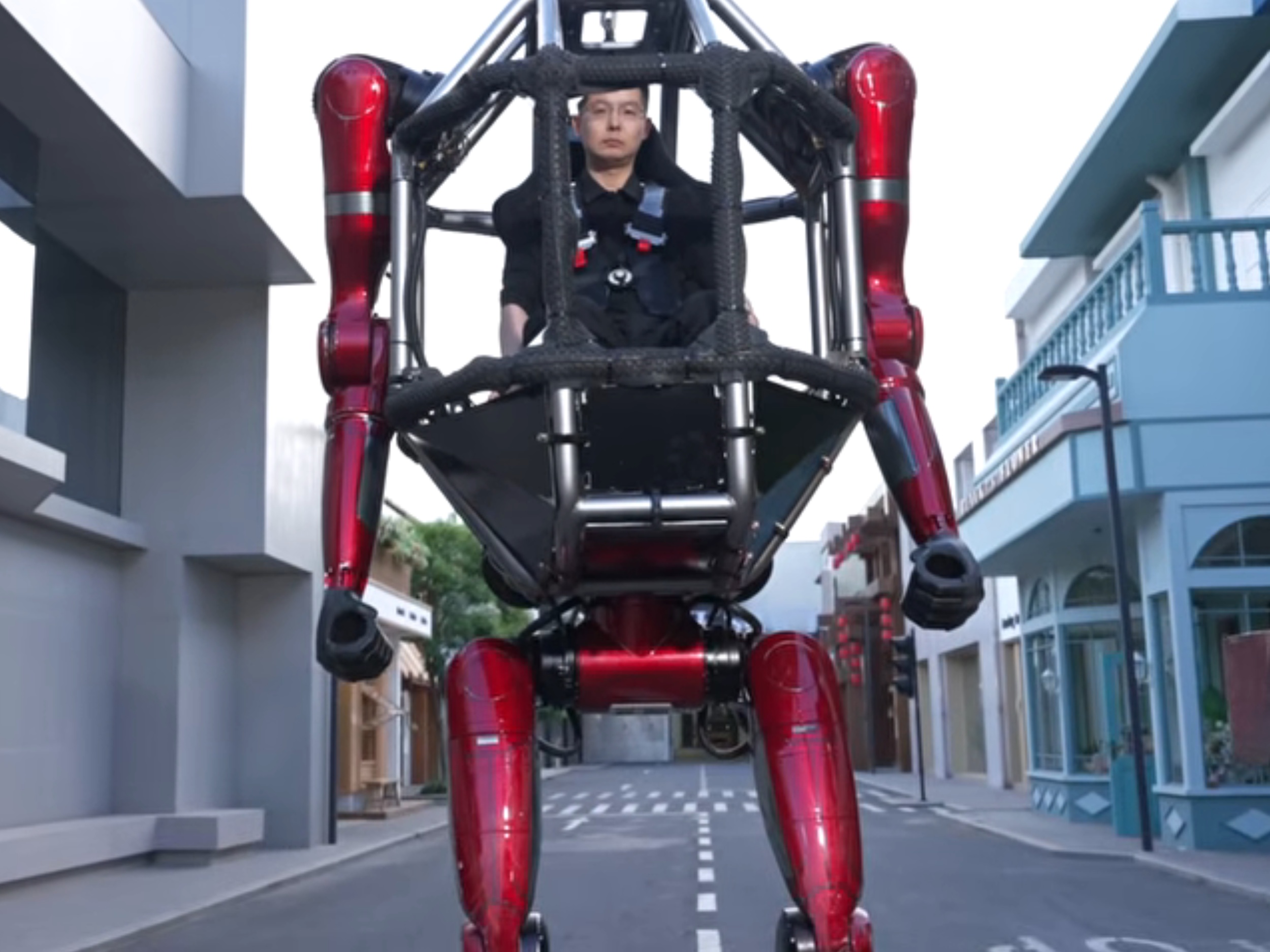
Unitree GD01: The 11-Foot Manned Mecha Robot That Looks Like It Walked Out of Sci-Fi
Unitree has revealed the GD01, a towering manned mecha robot that immediately brings science-fiction machines to mind. Standing at roughly 11 feet tall, the GD01 features a humanoid-style frame with two arms, two legs, and a cage-like cockpit designed to hold a pilot.
The company introduced the robot in a video released on May 12, presenting it as a civilian vehicle or transportation platform. With its industrial metal frame and oversized proportions, the GD01 looks less like a typical robot and more like something built for a futuristic construction site, disaster zone, or movie set.
One of the most unusual features shown in the demonstration is the robot’s ability to recover when it risks losing balance. Instead of falling helplessly, the GD01 can drop onto its back and continue moving in a four-legged position. This could make it more capable on uneven terrain, though it may not be the most comfortable experience for anyone sitting inside. In the footage, the pilot seat does not appear to rotate or adjust when the robot changes orientation, raising questions about comfort and safety during real-world use.
Unitree describes the GD01 as a “production-ready manned mecha,” with a reported starting price of 3.9 million yuan, or about $540,000. However, the demonstration suggests the machine may still be closer to an advanced prototype than a finished consumer-ready product.
Some details in the video have fueled skepticism. Parts of the frame appear to use makeshift padding, including material that looks similar to pieces of bicycle tire. That does not exactly inspire confidence in mass-production readiness. Safety also appears to be a major concern. While Unitree founder Wang Xingxing is shown climbing into the cockpit at the beginning of the video, later walking scenes appear to feature a dummy in the pilot area instead of a person.
So what can the Unitree GD01 actually do?
That is the biggest question surrounding this impressive machine. Unitree has not provided many specifics beyond describing it as a civilian vehicle or transportation platform. Based on the video, the GD01 clearly has strength. In one scene, it pushes through a wall of stacked concrete blocks with little effort, suggesting it could handle heavy-duty tasks.
Transport and material handling seem like the most obvious possible uses. A large walking robot could theoretically move equipment, carry supplies, or operate in areas where wheeled vehicles struggle. Its ability to walk on two legs and move on all fours may give it an advantage on rough or unstable ground.
However, the practical benefits are still unclear. For most construction, logistics, and transport jobs, existing machines already do the work more efficiently. Excavators can move heavy rocks, forklifts can lift pallets, and wheel loaders can handle rough terrain with greater speed, stability, and reliability. Compared with these proven machines, the GD01 still appears slow and experimental.
The manned cockpit also raises important questions. If the robot can be operated remotely or semi-autonomously, placing a human inside may not be necessary. If it is meant to be driven like a vehicle, then safety becomes a much bigger issue. A tall walking robot has to manage balance, impact protection, emergency shutdown systems, pilot comfort, and stability on uneven ground. Those challenges are far more complex than they would be in a conventional vehicle.
At this stage, the Unitree GD01 seems more like a dramatic technology showcase than a machine ready to replace forklifts, loaders, or off-road utility vehicles. Its design is eye-catching, its movement is unusual, and its size makes it impossible to ignore. But its real-world purpose remains uncertain.
Still, the GD01 is an exciting glimpse into the future of robotics. Even if this first version is not ready for everyday use, it shows how quickly humanoid and legged robot technology is advancing. Unitree has already gained attention for its robotic dogs and humanoid robots, and the GD01 pushes that ambition into an even larger and more theatrical category.
Whether the GD01 becomes a practical specialized vehicle or remains a spectacular prototype will depend on how Unitree improves its safety, durability, control systems, and real-world usefulness. For now, it stands as one of the most striking examples of a manned mecha robot yet shown to the public: powerful, strange, futuristic, and full of unanswered questions.