Elon Musk Says Tesla’s “Terafab” Could Push AI Chip Development to a New Level
Elon Musk has once again put Tesla’s ambitions in the spotlight, this time by talking openly about the company’s possible future in semiconductor manufacturing. Speaking to more than 2,000 Tesla owners and investors at the X Takeover event at Tesla’s Gigafactory in Austin, Texas, on October 11, Musk made a surprisingly honest admission: “To be clear, I don’t know how to make chips.”
That statement, however, was not a sign of hesitation. Instead, it set the stage for one of Musk’s most ambitious ideas yet: a Tesla “Terafab” that could help the company move faster in the race to develop advanced AI chips.
Tesla has already become far more than an electric vehicle manufacturer. Its future depends heavily on artificial intelligence, autonomous driving, robotics, energy storage, and high-performance computing. All of those areas rely on powerful chips. For Tesla, better chips mean smarter cars, faster Full Self-Driving improvements, more capable humanoid robots, and stronger AI infrastructure.
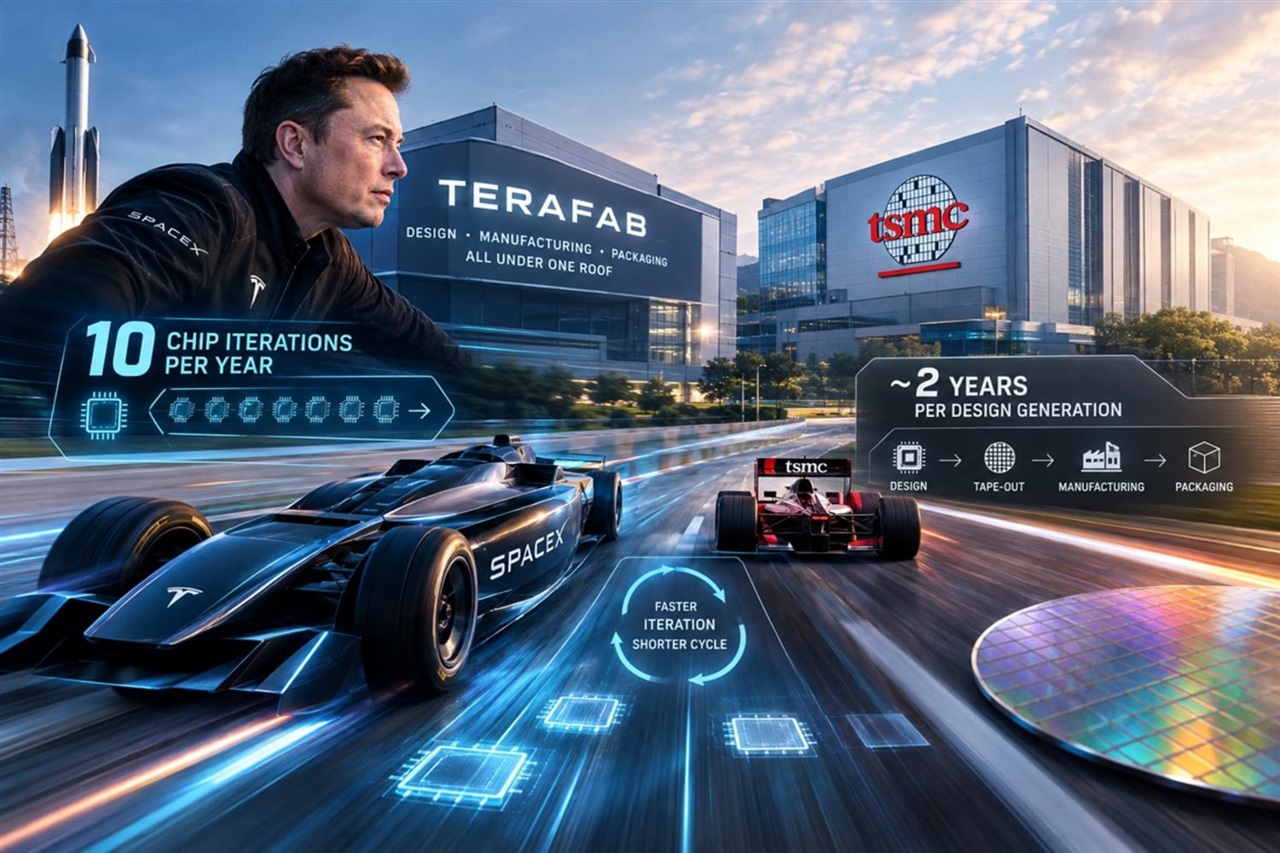
Musk’s comments suggest that Tesla is looking at chip development not as a side project, but as a core part of its long-term strategy. The idea of a Terafab points to a massive semiconductor-focused facility designed to support extremely rapid chip progress. According to Musk’s vision, Tesla could aim for as many as 10 chip iterations per year, a pace that would be unusually aggressive in the semiconductor industry.
Chip development is typically slow, expensive, and technically complex. Designing a new processor, testing it, validating performance, improving efficiency, and preparing it for production can take a long time. Musk’s goal appears to be about compressing that timeline dramatically. If Tesla can speed up the feedback loop between chip design, testing, and real-world use, it could gain a major advantage in AI and autonomous systems.
The reason this matters is simple: Tesla’s biggest projects are becoming increasingly dependent on custom silicon. The company needs chips that can handle huge amounts of data from vehicle cameras, process AI models in real time, and operate efficiently inside cars and robots. Off-the-shelf hardware may not be enough for Tesla’s long-term needs, especially if it wants to scale self-driving technology and Optimus robots to millions of units.
By talking about a Terafab, Musk is signaling that Tesla may want more control over the chip supply chain. The global semiconductor industry has faced shortages, production delays, rising costs, and intense competition. For a company like Tesla, which wants to move quickly, relying too heavily on outside suppliers can create bottlenecks.
A Tesla-led chip manufacturing push could help reduce those bottlenecks, but it would also come with enormous challenges. Semiconductor fabrication is one of the most difficult industries in the world. It requires extreme precision, massive capital investment, specialized equipment, expert talent, and years of accumulated process knowledge. Musk’s admission that he personally does not know how to make chips highlights just how complex the field is.
Still, Tesla has a history of entering difficult industries and rethinking how they work. The company transformed electric vehicle production, scaled battery manufacturing, built its own software ecosystem, and pushed aggressively into AI training infrastructure. Musk’s approach often centers on vertical integration, bringing more critical work in-house when outside systems are too slow, too expensive, or too limited.
If Tesla can apply that same mindset to AI chip development, the potential impact could be significant. Faster chip iteration could allow Tesla to improve performance more often, adapt hardware to its software needs, and optimize chips specifically for autonomous driving and robotics. That could create a tighter connection between Tesla’s AI teams, vehicle engineering teams, and manufacturing operations.
For Tesla investors and supporters, the Terafab concept adds another layer to the company’s long-term growth story. Tesla is no longer competing only in electric vehicles. It is positioning itself as an AI, robotics, energy, and manufacturing company. Advanced chips could become one of the most important foundations for that future.
Musk’s remarks at the Austin event were candid, but they also carried a familiar message: Tesla wants to move faster than the rest of the industry. Whether the Terafab becomes a full-scale reality or remains an evolving concept, it shows how seriously Tesla is thinking about the hardware behind artificial intelligence.
The race for better AI chips is becoming one of the most important battles in technology. If Tesla can develop and iterate its own chips at the pace Musk described, it could strengthen its position in autonomous driving, robotics, and next-generation computing. The challenge will be immense, but for Tesla, the reward could be even bigger.