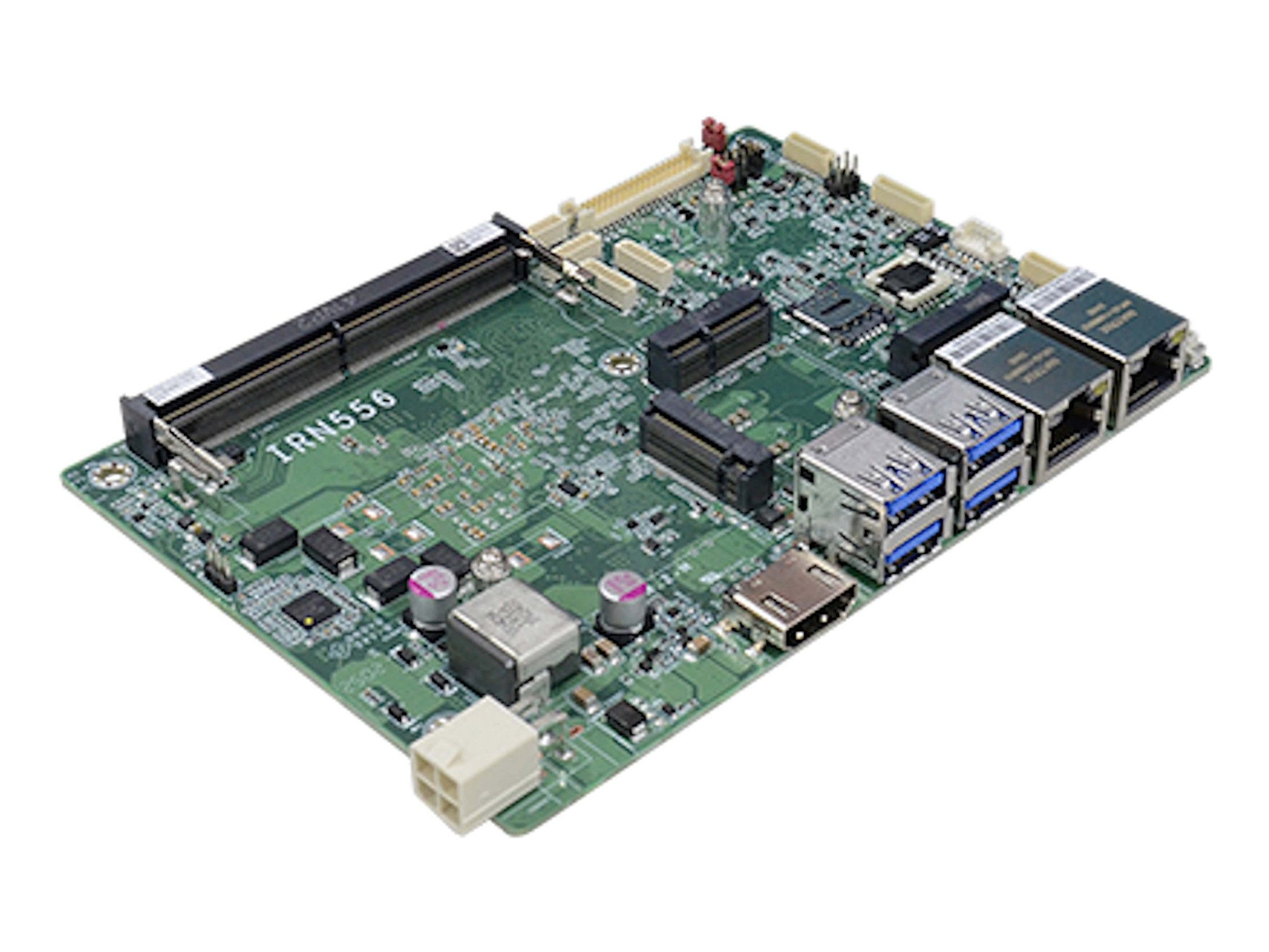
DFI has introduced the INR556, a ultra-compact industrial single-board computer built for embedded projects where space is tight but performance still matters. Measuring just 146 × 102 mm and based on a 1.8-inch SBC format, the INR556 positions itself as a flexible alternative to popular hobbyist boards—especially for users who want the option to run Windows alongside Linux.
One of the standout features of the DFI INR556 is its range of Intel processor options. Buyers can choose from the Intel Atom x7211RE, x7433RE, or x7835RE, as well as the Intel N150 and Intel Core 3 N355. This gives system designers more freedom to balance power consumption, CPU performance, and long-term availability depending on the deployment.
Memory support is also aimed at more demanding workloads. The board uses DDR5 and supports up to 16GB on a module, with speeds up to 4,800 MHz. That extra headroom can be useful for industrial applications, edge computing tasks, lightweight virtualization, or Windows-based software stacks that benefit from more RAM.
Expansion and storage are where the INR556 really leans into embedded versatility. The board includes multiple M.2 slots:
– An M.2 2242 slot with access via two PCIe 3.0 lanes plus SATA 3.0 support
– An M.2 3052 slot connected through one PCIe lane
– An M.2 2230 slot supporting Key E cards, USB 2.0, and one PCIe lane
There’s also a nano-SIM slot for mobile connectivity, opening the door to cellular WAN use cases such as remote monitoring, fleet applications, kiosks, and industrial gateways that need connectivity beyond Ethernet.
For display output, the INR556 includes HDMI with support up to 4096 × 2160 resolution at 24 Hz. It also provides LVDS output up to 1920 × 1200 at 60 Hz, which is particularly relevant in embedded and industrial display integrations where LVDS panels are still common.
Connectivity is built with industrial deployment in mind. You get dual Gigabit Ethernet ports for reliable networking, plus USB 3.2 for attaching fast external storage or peripherals. While it doesn’t include the typical 40-pin GPIO header found on many maker-focused boards, it compensates with RS232/422/485 interfaces and GPIO connectors designed for connecting sensors, actuators, and other control hardware used in automation environments.
Because the system relies on standard Intel processors, it supports Windows as well as various Linux distributions, making it easier to fit into existing enterprise and industrial software ecosystems without heavy porting work.
DFI has not yet shared pricing or availability details, but the INR556’s mix of Intel CPU options, DDR5 memory support, multiple M.2 expansion paths, dual Ethernet, and cellular readiness makes it a notable new option for anyone searching for a compact single-board computer for embedded Windows or Linux projects.