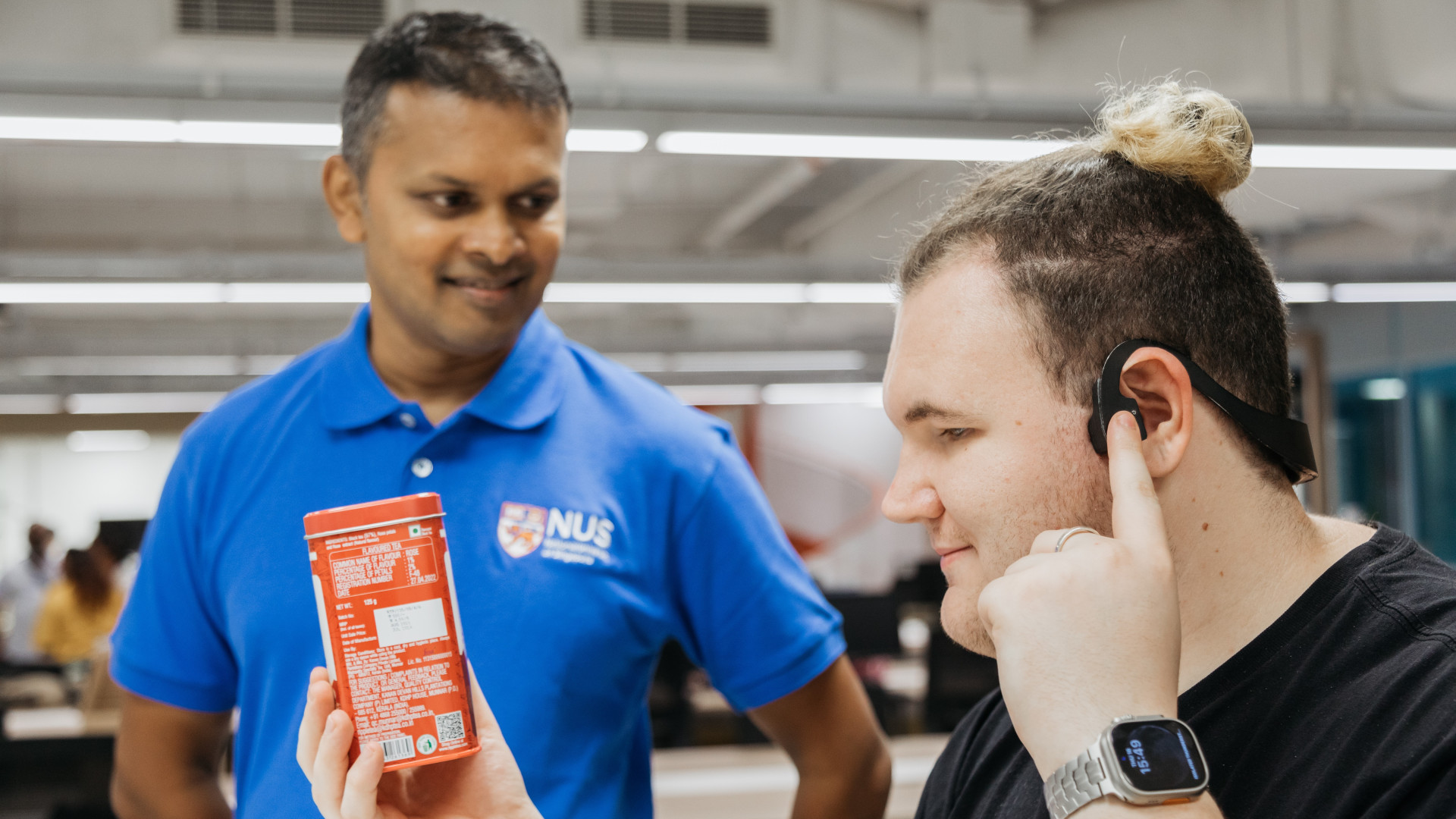
Researchers from the National University of Singapore (NUS) have taken significant strides in assisting visually impaired individuals to ‘see’ the world around them. The School of Computing at NUS has introduced AiSee, an innovative assistive device that utilizes artificial intelligence (AI) to help people with visual impairment identify objects through voice descriptions.
The AiSee project, which commenced in 2018 and saw continuous enhancements over five years, employs the latest AI technology to interpret the surrounding environment and relay comprehensible information to the user in real-time. Unlike other systems that rely on smartphone pairing, AiSee functions independently, using a discreet headset design to avoid stigma associated with wearing assistive technology.
How AiSee Enhances the Lives of the Visually Impaired
1. The Eye: Vision Engine Computer Software
AiSee features a micro-camera that captures images from the user’s perspective, forming the core of the vision engine computer software. This software extracts crucial features from the image, such as text and logos, for further analysis.
2. The Brain: AI-Powered Processing Unit
Once an image is captured, it is processed using advanced cloud-based AI algorithms. The system can engage in interactive Q&A sessions to provide additional details about objects, leveraging speech-to-text and text-to-speech capabilities. These features utilize a large language model, ensuring the system’s responses are both prompt and accurate.
3. The Speaker: Bone Conduction Sound System
The device employs bone conduction technology for sound transmission, enabling users to hear AI voice descriptions without blocking out vital ambient sounds, important for safety and decision-making.
Associate Professor Suranga Nanayakkara, the leading researcher of Project AiSee at the Department of Information Systems and Analytics, stresses the importance of this innovation to empower visually impaired individuals to perform tasks independently. With current user testing in partnership with SG Enable and backed by philanthropic support from B.P. De Silva Holdings Pte Ltd, the team is dedicated to refining AiSee for widespread use and affordability.
SG Enable, the focal agency in Singapore for disability and inclusion, sees assistive technologies like AiSee as transformative solutions that can make a substantial impact on the lives of persons with disabilities. They, along with their partners, aim to lower the barriers to employment and promote independent living, embodying their mission towards inclusivity and accessibility.
This integration of AI and human-computer interface technologies in tools like AiSee reflects the potential of such innovations to foster a more inclusive society and provide a greater range of technology options for people with disabilities.


