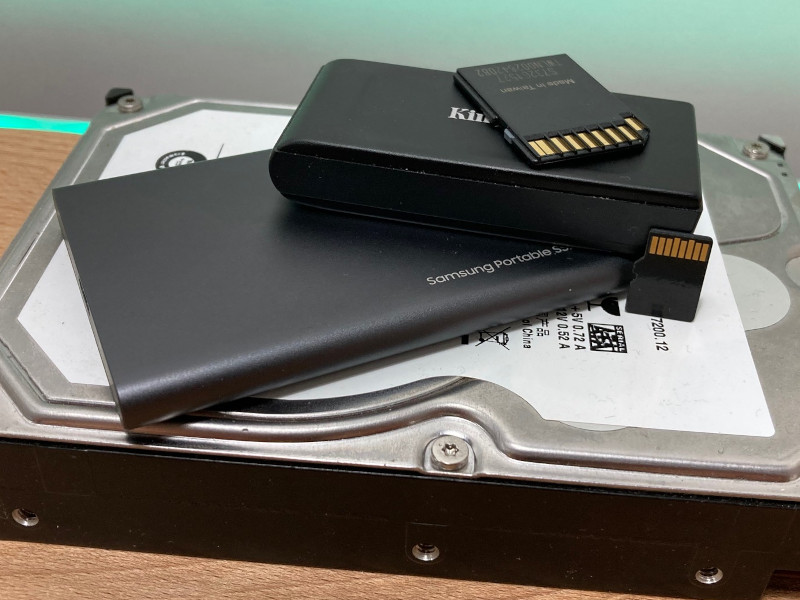
The technology sector is witnessing a significant breakthrough with the development of a new type of memory that could offer a substantial improvement over traditional NAND flash memory. Leveraging the ferroelectric properties of hafnium combined with other elements, scientists have engineered a memory material that has the potential to revolutionize data storage in memory cards and solid-state drives (SSDs).
The key advantage of this innovative semiconductor technology is the method by which it changes polarization in response to an electrical field. Unlike NAND flash memory, which relies on addressing individual segments with a series of electrical pulses, this new material can swap its polarization state much more rapidly, leading to substantially faster and more efficient memory access.
Advancements in technology have expanded the viable voltage bandwidth for this material. By integrating aluminum with hafnium oxide, the applicable voltage range has been boosted from 2 to a robust 10 volts. This development could pave the way for the creation of quad-level cells (QLC) capable of storing 4 bits per transistor, equating to 16 distinct states in a single cell. By utilizing this design, small chips have the capacity to contain several terabytes of data, and when incorporated into SSDs, the storage capacity could increase exponentially.
This technological leap promises not only faster access to data but also requires less power compared to NAND flash. The system operates at 10 volts instead of the usual 18 volts needed by NAND flash, therefore decreasing the power consumption necessary for reading and writing operations.
Durability tests indicate promising strides in the practical application of this technology, with individual cells enduring over one million write and access cycles. Despite the excitement surrounding these developments, one challenge remains: the scarcity of the key element, hifnium. Although more abundant than gold, hifnium doesn’t exist in a pure state in nature, making it difficult to extract since it’s only present in minute amounts within other minerals.
Though the amount of hafnium required per cell is less than 25 nanometers thick, its rarity may result in high costs if alternatives aren’t discovered in the future.
As the technology industry continues to seek innovations in memory storage, the development of hafnium-aluminum oxide memory presents an exciting possibility for enhancing our data storage capabilities. This advancement may lead the way to faster, more power-efficient, and larger storage solutions that could someday redefine what we expect from memory cards and SSDs. With continual research and development, who knows what the future holds for our digital storage needs.