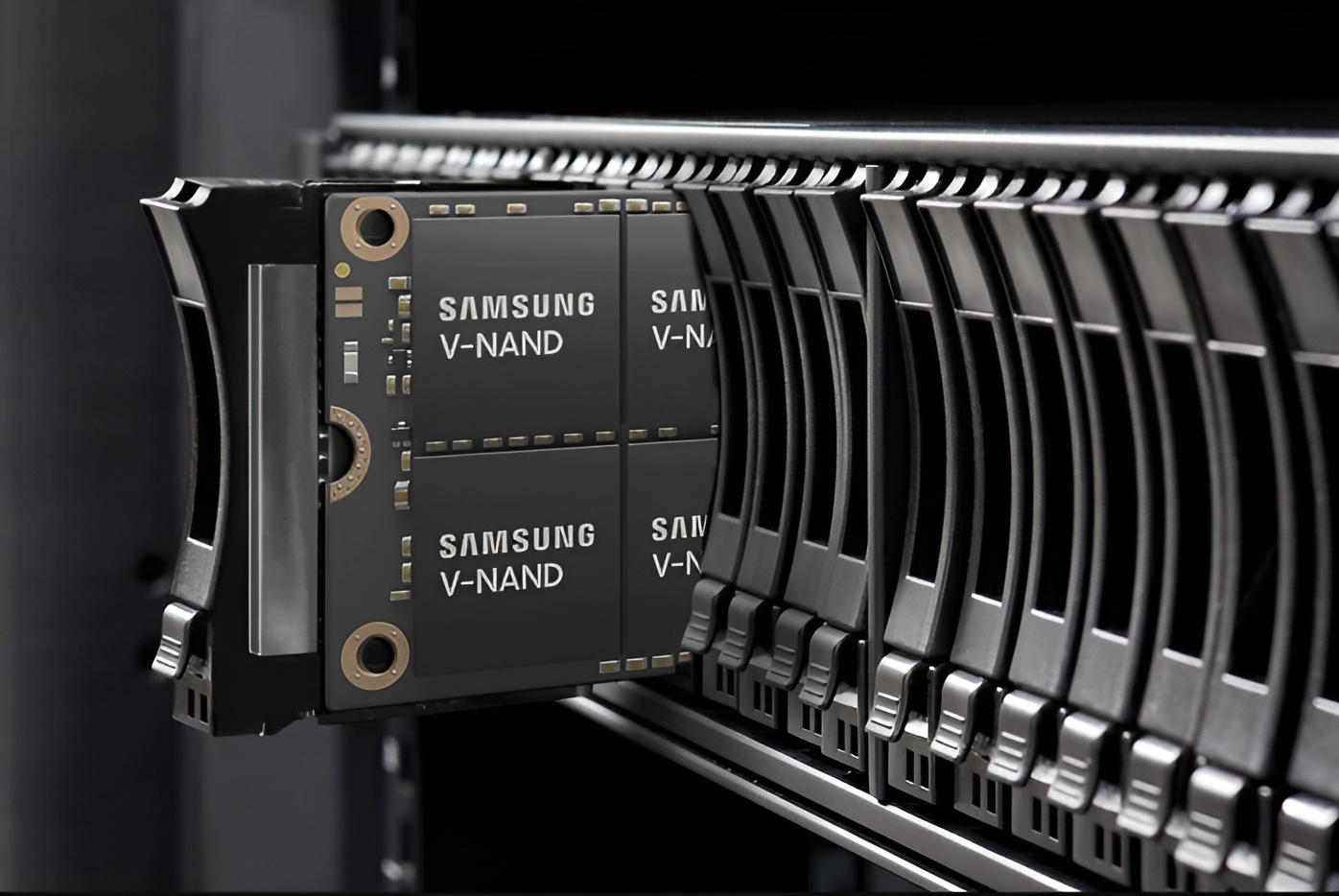
Samsung Electronics is pushing the boundaries of data storage with its ambitious aim to create solid-state drives (SSDs) that can store a petabyte of data. This target, once considered a distant dream, is becoming more tangible as the company explores innovative materials and technologies, like ferroelectric materials, which might pave the way to achieving over 1000-layer NAND technology.
The drive for more storage capacity has always been a cornerstone of the tech industry, and recent developments suggest that the bar is continually being raised. Samsung has already set new standards with its 9th Gen V-NAND flash, which boasts a staggering 290 layers. And it doesn’t stop there—the anticipated 10th Gen V-NAND will have a remarkable 430 layers, taking us one step closer to achieving petabyte-capable SSDs.
The spotlight now turns to the exciting advancements happening in materials science. At the renowned VLSI Technology Symposium in Honolulu, researchers from the Korea Advanced Institute of Science and Technology (KAIST) are to present their findings on a new class of materials called Hafnia Ferroelectrics. These materials have become the subject of much intrigue due to their ability to demonstrate ferroelectricity under certain conditions, hinting at the potential for more condensed, effective capacitors and memory devices.
The research delves into the capabilities of Hafnia Ferroelectrics as a pivotal element for advancing low voltage and quadruple-level cell (QLC) 3D V-NAND technologies beyond 1000 layers. An experimental model displays impressive performance enhancements, which are attributed largely to the interplay of charge trapping and ferroelectric switching effects in specially engineered FeFETs (ferroelectric field-effect transistors). Demonstrated results show lower operation voltages, expanded memory windows, and minimal disturb voltages, which indicate the effectiveness of Hafnia Ferroelectrics.
Although Samsung is not directly linked to the research and development, the contributors are reportedly connected to the multinational conglomerate. The exact influence of Hafnia Ferroelectrics on the roadmap to petabyte storage remains to be seen, but their introduction could prove crucial in achieving such high-capacity storage.
The implications of reaching over 1000-layer NAND are immense, not only for data centers but also for consumer technology. As we approach these technological milestones, the ability to store and access huge amounts of data quickly and efficiently will transform everything from cloud computing to the personal storage of digital media.
By keeping an eye on these developments, users and industry professionals can anticipate the direction of future storage solutions. Companies like Samsung leading these innovations indicate a dynamic and rapidly advancing field, with new storage frontiers on the horizon that were unimaginable just a few years ago. As such advancements integrate into daily life, we might see a significant paradigm shift in how data is stored and managed on both personal and enterprise levels.