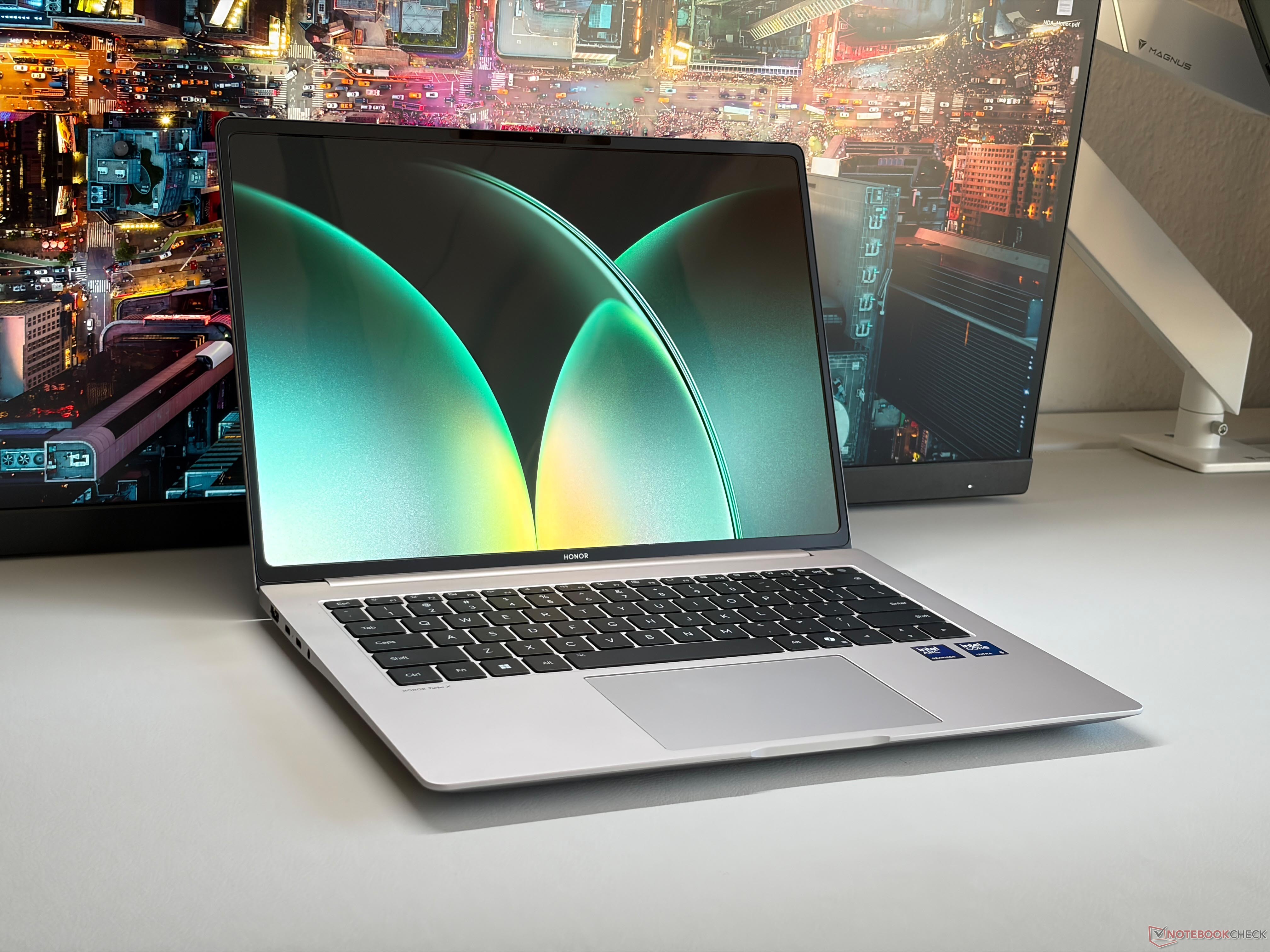
Honor’s MagicBook Pro 14 (2026) is a strong reminder that an OLED touchscreen laptop doesn’t have to compromise on image clarity. While many premium multimedia laptops now rely on OLED displays for their deep blacks, high contrast, vibrant colors, and fast response times, adding a touch layer often introduces an unwanted side effect: a slightly grainy look, especially on bright backgrounds. With the MagicBook Pro 14, Honor shows that this common drawback isn’t inevitable.
One of the first things you’ll notice is the tall 3:2 aspect ratio. Compared to the more common 16:9 or 16:10 screens, 3:2 delivers noticeably more vertical space, which can make a real difference for productivity. Scrolling through web pages, working in documents, editing photos, and managing spreadsheets all feel more spacious and less cramped. It’s not the most cinematic format for movies, but for work-focused users who still want a premium multimedia experience, the trade-off makes sense.
The main highlight, though, is the display quality. Honor pairs a high-resolution OLED touchscreen with a 120Hz refresh rate, delivering smooth motion and a polished feel during everyday use—from scrolling and window animations to fast-moving visuals. More importantly, the screen manages to avoid the grainy texture that affects many OLED touch laptops, even when displaying bright content. That alone makes it stand out in a crowded field of premium notebooks.
Color performance is also a major plus. The MagicBook Pro 14 (2026) ships with accurate color profiles for common color spaces like sRGB and P3, and color deviations are already kept below the key threshold of 3 right out of the box—meaning most users can enjoy reliable color accuracy without needing to tweak anything. While manual calibration can still squeeze out a bit more quality, it’s not something you’ll need to do to get an excellent experience.
Brightness is the one area where there’s still some room to grow. In SDR, the panel reaches a solid 525 nits, which is already strong for indoor use and many brighter environments. HDR brightness can climb to around 770 nits, though some competing laptops manage to go higher. Even so, this doesn’t take away from what the display does best: delivering an impressive, high-contrast OLED image with smooth motion and clear touch visuals.
Another practical touch is a feature many laptop makers still ignore: the ability to disable touch input quickly when you don’t need it. Through the control center, you can switch off the touchscreen functionality, which can be helpful if you’re typing, using an external mouse, or simply prefer to avoid accidental touches. It’s a small quality-of-life option that feels genuinely useful, and it would be great to see it become more common across premium laptops.
Overall, the Honor MagicBook Pro 14 (2026) makes a compelling case for anyone looking for a premium OLED touchscreen laptop with a productivity-friendly 3:2 screen, 120Hz smoothness, and strong out-of-the-box color accuracy—without the typical grainy look that can come with touch-enabled OLED panels.


