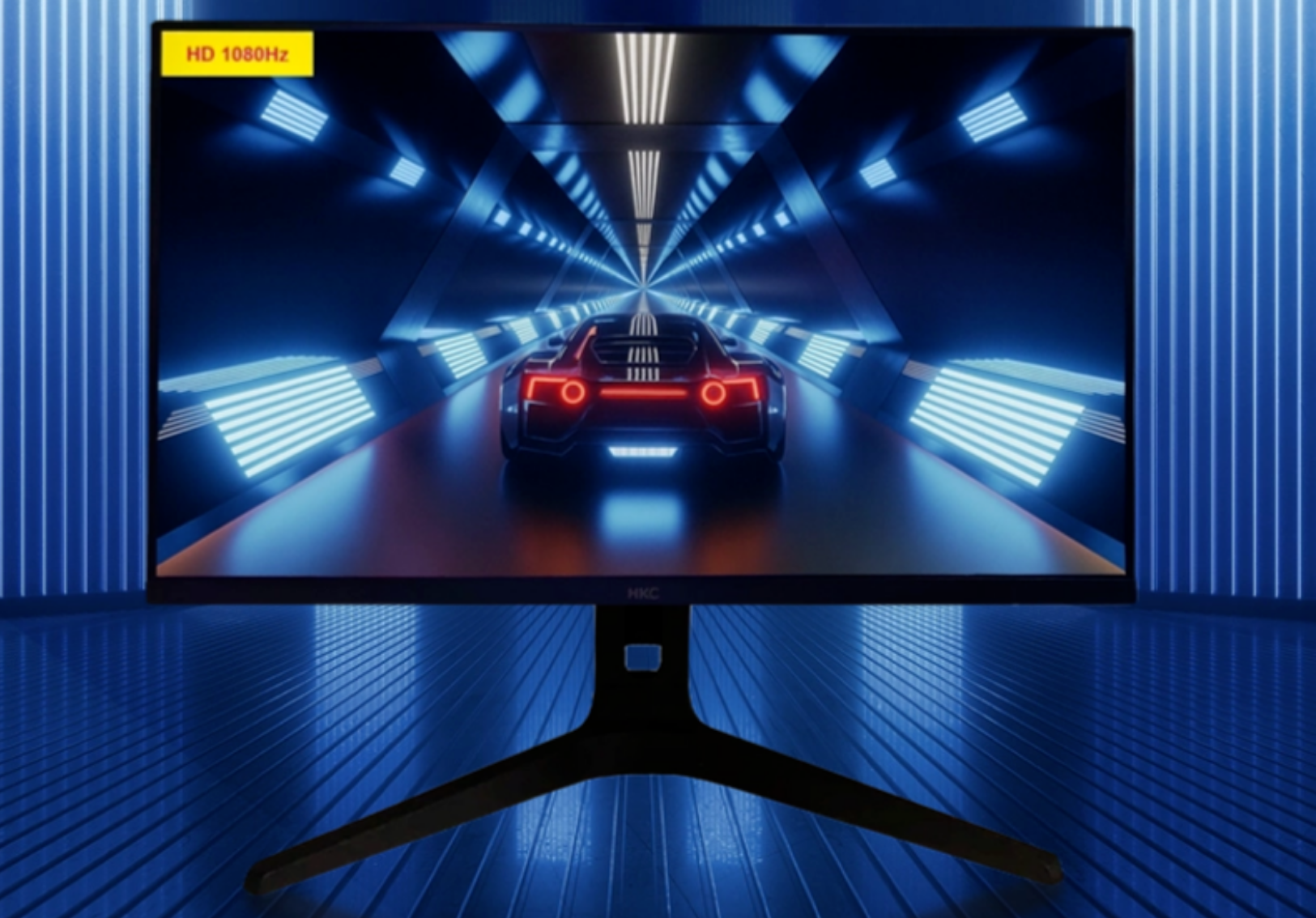
HKC has just raised the bar for competitive gaming displays by becoming the first monitor maker to announce a 720p gaming monitor capable of reaching an eye-watering 1080Hz refresh rate. That figure currently sits at the very top of the market, and it signals how quickly 1000Hz-plus gaming monitors are turning from experimental tech into the next battleground for serious eSports players.
Ultra-high refresh rate monitors have been ramping up across the industry, with major display brands pushing beyond 720Hz and into the 1000Hz range in both 1080p and 720p options. What makes HKC’s announcement stand out is that it nudges past recent 1000Hz-class launches and claims the highest refresh rate revealed so far.
A big part of the appeal is flexibility. HKC’s new monitor is built around a dual-mode concept designed to let gamers switch between smoother motion at lower resolution and sharper visuals at higher resolution:
In its QHD (1440p) mode, the monitor runs at up to 540Hz. This setting is aimed at players who want a cleaner, more detailed image while still getting extremely high refresh rates for fast-paced gameplay. For many competitive titles, 1440p at 540Hz hits a sweet spot between clarity and speed.
Switch to HD (720p) mode, and the display unlocks its headline feature: up to 1080Hz. This is tailored for hardcore competitive gaming where every millisecond matters, and where the goal is to reduce perceived motion blur and input delay as much as possible. HKC is positioning this mode as a near-zero latency experience meant for situations where a split-second reaction can decide a match.
HKC hasn’t shared full specifications yet, including panel type, brightness, color coverage, or the exact port lineup. Still, a display aiming at 540Hz and 1080Hz operation will almost certainly need modern connectivity such as HDMI 2.1 and DisplayPort 2.1 to make those extreme refresh rate modes practical on current and upcoming gaming hardware.
The broader trend is clear: 1000Hz+ gaming monitors are quickly becoming a new performance category, especially for competitive gamers who prioritize responsiveness above all else. Dual-mode designs help widen the appeal by letting users choose between maximum speed (low resolution, ultra-high refresh) and better image fidelity (higher resolution, still-very-high refresh), often keeping refresh rates in the 200–600Hz range even in the sharper modes.
Pricing and release timing for HKC’s 1080Hz monitor weren’t announced. However, HKC also used the moment to highlight another first: an RGB Mini LED gaming monitor featuring 4K resolution, a 165Hz refresh rate, and up to 1000 nits peak brightness. That model is said to support up to 330Hz at 1080p and comes in a 27-inch size, making it a very different option for gamers who want high brightness and 4K detail but still value high refresh performance.
As more manufacturers chase extreme refresh rates, the race now isn’t just about who hits the biggest number—it’s about who can deliver meaningful real-world benefits with smart dual-mode features, strong motion handling, and the connectivity to actually run these modes at full speed.


