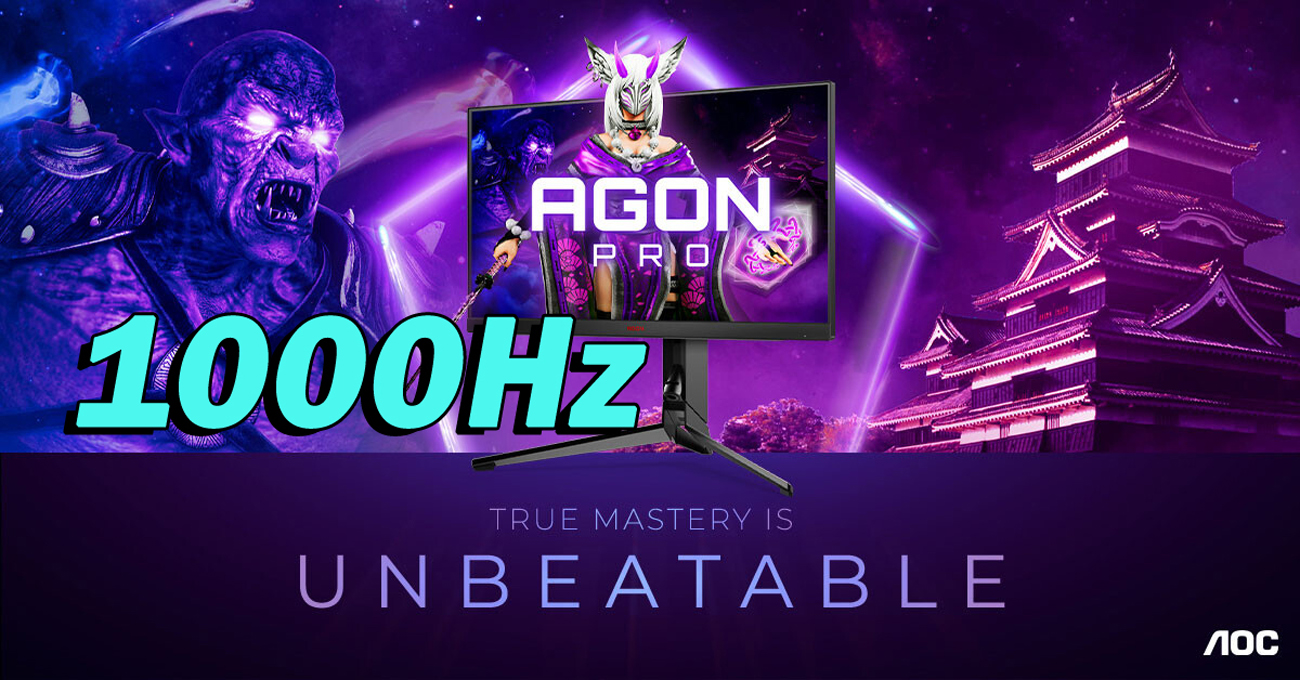
AOC reportedly readies 1000Hz-capable AGON gaming monitor lineup for 2026 — but who will actually benefit?
The high refresh rate arms race is accelerating again. A leaked roadmap suggests AOC is prepping six new AGON gaming monitors for 2026, headlined by a 27-inch dual‑mode model that targets 500Hz at 1440p and a staggering 1000Hz at 1080p. It’s an audacious push into four‑digit refresh territory aimed squarely at competitive esports, even as the industry debates whether such speeds are practical or perceptible for most players.
What’s rumored in AOC’s 2026 AGON lineup
– 27-inch 5K 165Hz with dual‑mode 1440p 330Hz
– 27-inch UHD (4K) 160Hz dual‑mode with AI features
– 27-inch QHD 500Hz with 1080p 1000Hz dual‑mode
– 27-inch QHD 420Hz with a circular polarizer
– 27-inch QHD 360Hz with PULSAR technology for a “1000Hz effect”
– 24.1-inch TN panel up to 400Hz
Across the range, AOC is said to be rolling out updated industrial design, a redesigned on‑screen display, and customizable physical buttons. An AI gaming mode is also mentioned, designed to auto‑tune visual settings based on the game genre.
How would a 1000Hz gaming monitor work?
True 1000Hz at 1080p is an aggressive target. To reach or simulate that level of motion clarity, manufacturers often lean on techniques such as backlight strobing or black frame insertion, which reduce perceived blur by shortening frame persistence. One of the models in this lineup even cites “PULSAR” tech with a 1000Hz “effect,” hinting at advanced strobing rather than a literal 1000 unique frames per second from the panel. Recent milestones like 720Hz at 720p have shown what’s possible at lower resolutions, but 1000Hz at 1080p would be a new frontier.
Do gamers really need 1000Hz?
For most players, probably not. Many already consider 240Hz to 360Hz a sweet spot for competitive gaming at 1080p or 1440p. The leap to 500Hz and beyond delivers diminishing returns unless you’re chasing the absolute smallest latency and motion persistence in twitch shooters. There’s also the massive system demand: sustaining frame rates anywhere near 1000 FPS requires extremely lightweight settings, esports‑focused titles, and top‑tier CPUs and GPUs. Even then, the benefit will be most noticeable to elite players with tuned sensitivity to micro‑latency and motion clarity.
Why the rest of the lineup matters
Beyond the headline‑grabbing 1000Hz claim, several models look genuinely practical for high‑end gaming:
– 1440p at 360Hz and 420Hz hits a compelling balance of resolution and speed for competitive play without dropping to 1080p.
– A 5K 165Hz panel that can switch to 1440p 330Hz offers premium productivity clarity with esports‑grade responsiveness on demand.
– A 24.1-inch 400Hz TN could appeal to purists who favor lowest possible latency and consistent response times.
– The circular polarizer variant at 420Hz should help with reflections and perceived contrast, improving clarity in bright setups.
Who should care
– Esports pros and serious aim trainers looking to minimize blur trail and input latency will be most interested in the 500Hz/1000Hz dual‑mode concept and the PULSAR strobing model.
– Competitive gamers who also want crisp visuals will likely gravitate toward the 1440p 360Hz and 420Hz options.
– Hybrid users who game and create might find the 5K/1440p dual‑mode display uniquely versatile.
Bottom line
If the leak holds, AOC’s AGON line is positioning to cover everything from sensible high-refresh 1440p options to bleeding‑edge experiments in 1000Hz motion clarity. Whether the 1080p 1000Hz target is truly native or achieved via advanced strobing, it signals that 2026 could be a landmark year for esports monitors. For most players, 240–360Hz remains the practical sweet spot, but for the tiny fraction chasing every last millisecond, AOC’s upcoming displays could be the next big step.