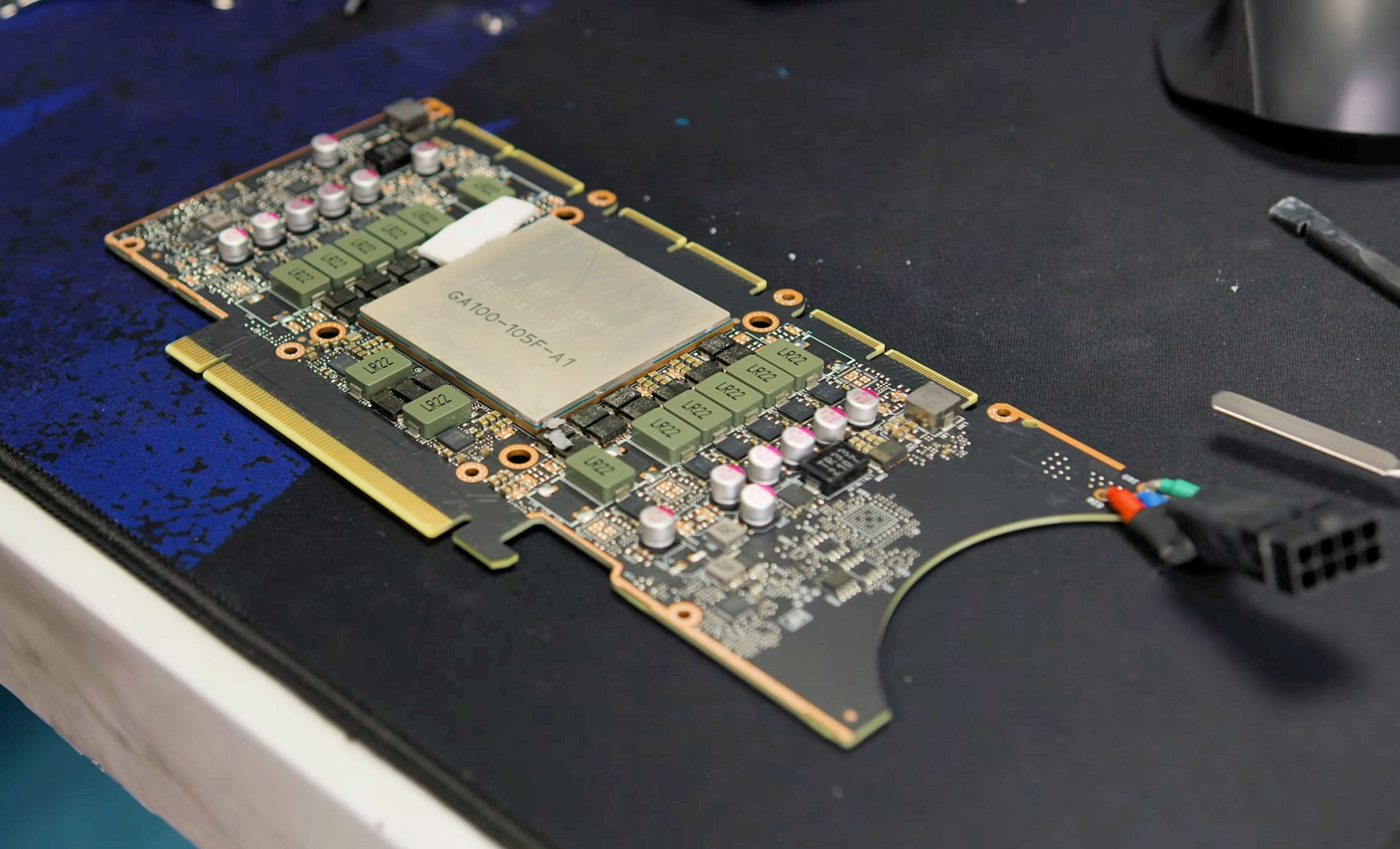
NVIDIA CMP 170HX mining GPUs are getting a surprising second life as budget AI accelerators
NVIDIA’s CMP 170HX, a GPU originally built for cryptocurrency mining, is suddenly back in the spotlight. A new community-made unlock tool reportedly allows some of these cards to access far more memory than they shipped with, turning what was once a limited mining card into a potentially useful option for local AI workloads.
The CMP 170HX first arrived in 2021 during the height of the crypto mining boom. It was based on a cut-down version of NVIDIA’s A100 Ampere GPU and came with limited VRAM configurations, usually 8 GB or 10 GB. After the crypto market cooled down, these cards lost much of their appeal because they lacked standard graphics features, including proper 3D rendering support. For gamers and workstation users, they were not especially useful.
Now, the rise of local AI, large language models, and high-memory compute workloads has changed the equation. A tool known as CMPUnlocker reportedly restores access to features that were restricted through NVIDIA’s firmware and hardware configuration. According to its description, the tool can unlock full SM compute throughput and expose additional HBM2e memory geometry on certain CMP 170HX cards.
In simple terms, some CMP 170HX cards may be able to use far more memory than their official specifications suggest. Reports indicate that 8 GB models can potentially be unlocked to 64 GB, while some 10 GB models may reach up to 80 GB. That sounds impressive, especially at a time when GPUs with large VRAM capacities are in high demand for AI inference and local model testing.
However, there is an important catch: not every card will unlock successfully, and not every card will remain stable.
The CMP 170HX is built from lower-bin A100 silicon. Many of the disabled memory stacks were likely turned off for a reason, such as defective or lower-quality HBM2e dies. Because of that, unlocking extra memory can be unpredictable. Some cards may expose large memory capacities but fail under heavy workloads. Others may work at reduced bandwidth or lower clocks depending on the quality of the memory chips.
Early user reports suggest that 64 GB is not guaranteed on every card. Some users have managed to run larger capacities, while others have found that 40 GB is a more reliable target under stress testing. The 10 GB models using Samsung memory have reportedly shown the ability to unlock up to 80 GB, but stability can be inconsistent. Meanwhile, some 8 GB models with Hynix memory appear to be more stable when unlocked to 64 GB.
Performance also comes with limitations. The CMP 170HX does not support newer AI data formats such as FP8, FP6, or FP4, which are available on more modern NVIDIA GPUs. It is limited to older formats such as INT8, and its compute performance is rated around 48 TOPS. That means it may be useful for certain AI inference workloads, but it will not compete directly with newer high-end consumer or data center GPUs in raw efficiency or modern AI feature support.
Another major limitation is PCIe connectivity. The card is generally restricted to PCIe Gen2 x4 speeds, which can create a bottleneck depending on the workload. Some advanced modifications may improve connectivity, but those require physical soldering and are not practical for most users.
Even so, the biggest attraction is memory capacity. AI users often need large VRAM pools to run bigger models locally, and GPUs with 48 GB, 64 GB, or 80 GB of memory are usually expensive. That is why the CMP 170HX suddenly became interesting again.
The market has reacted quickly. These cards were reportedly available for around $100 to $200 not long ago. After news of the unlock tool spread, prices surged dramatically, with many listings now appearing in the $1,200 to $2,000 range. Some buyers are reportedly purchasing large quantities, likely hoping to resell them or build low-cost AI compute clusters.
For buyers, the CMP 170HX is now a high-risk, high-reward option. If you get a good card, it could provide a large pool of HBM2e memory for AI experiments at a lower price than traditional professional GPUs. If you get a weaker bin, you may end up with instability, limited usable memory, reduced bandwidth, or a card that does not perform as expected.
The renewed interest in the NVIDIA CMP 170HX shows how quickly hardware value can change. A GPU once dismissed as a leftover crypto mining product is now being reconsidered as a possible AI accelerator. But anyone thinking of buying one should understand the risks clearly: the unlock is not guaranteed, stability varies from card to card, and the hardware still has major limitations compared with modern AI GPUs.
For local AI enthusiasts, researchers, and tinkerers, the CMP 170HX could be an exciting experiment. For anyone expecting a plug-and-play 80 GB AI GPU, it may be more of a gamble than a bargain.