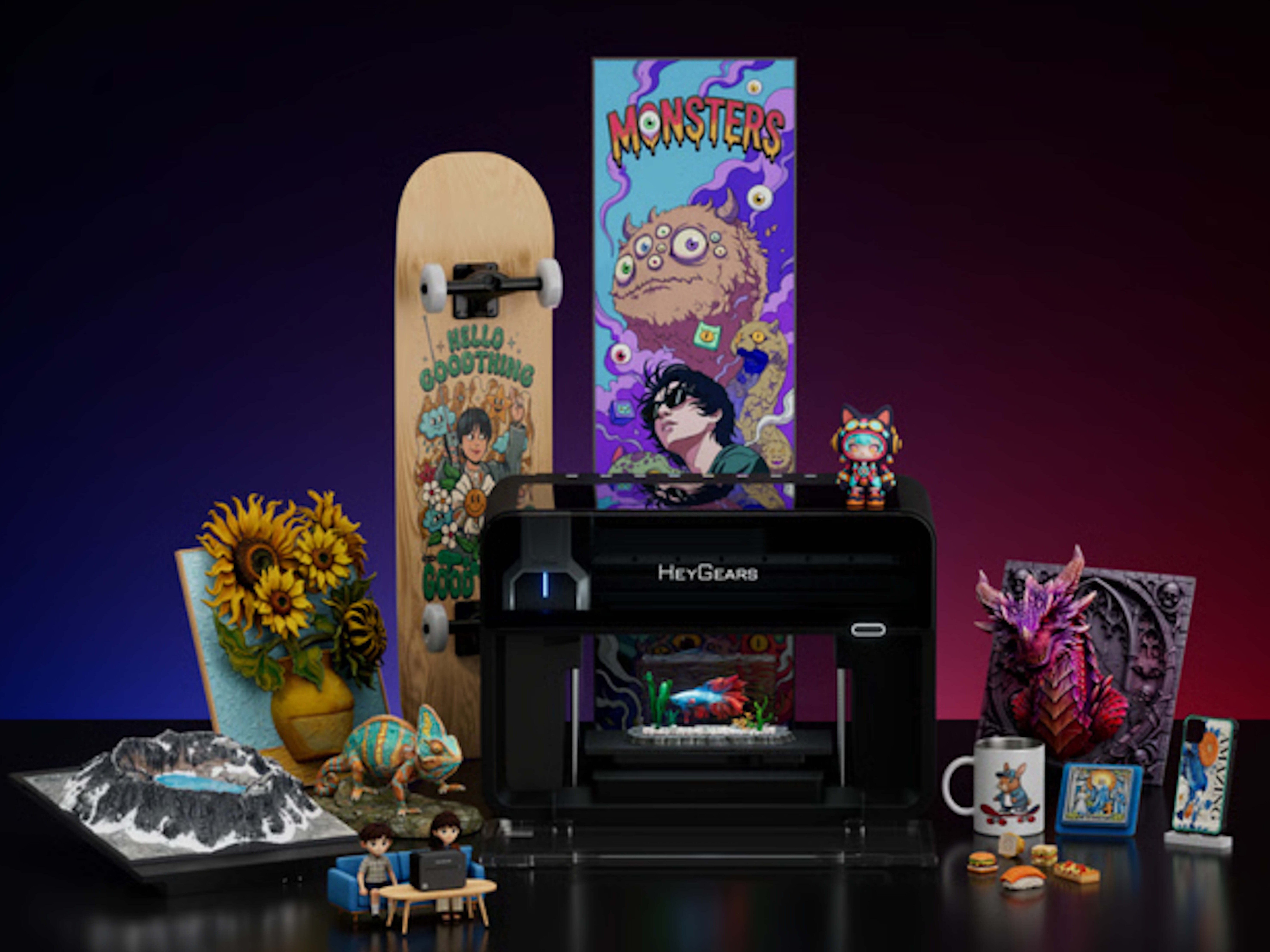
HeyGears G1 aims to change desktop 3D printing with full-color resin output and UV printing
HeyGears is preparing to bring a more ambitious kind of desktop fabrication system to makers, designers, and professional creators. The new HeyGears G1 is designed to combine multiple production tools in one machine, offering full-color 3D printing, 3D surface texturing, and 2D flatbed UV printing from a single desktop setup.
Unlike many traditional 3D printers that are limited to one material color at a time, the HeyGears G1 is built to create vivid, detailed objects with a much broader color range. Depending on the configuration, the system can produce full-color 3D models with detailed surface finishes, making it especially interesting for product designers, model makers, artists, prototyping studios, and small businesses that need eye-catching physical samples.
The most capable version, the HeyGears G1X Full-3D Pack, unlocks the complete feature set. It is being offered to early campaign supporters at a price of $3,599. As with any crowdfunded hardware project, buyers should keep in mind that delivery timelines, final specifications, and long-term support can involve some level of risk.
One of the standout features of the HeyGears G1 is its ability to combine color and shape in a way that standard desktop 3D printers typically cannot. The machine uses resin-based printing rather than filament, but it does not follow the same approach as many conventional resin printers that lift objects from a vat. Instead, the G1 uses a different mechanical design and prints dedicated water-soluble supports alongside the main object.
These water-soluble supports are intended to make post-processing easier and cleaner. Once a print is finished, the supports can be removed without leaving the rough marks or stubborn residue that often require sanding, cutting, or additional cleanup. For users producing display models, consumer product mockups, collectibles, or high-detail prototypes, that could be a major advantage.
The build volume measures 420 x 330 x 130 mm. While the footprint is generous in width and depth, the maximum height is relatively limited, meaning the system is better suited to shallow objects, panels, models, signs, prototypes, and decorative pieces rather than tall vertical prints. For many professional use cases, however, the available workspace should still be practical.
Print resolution is another key selling point. HeyGears lists layer thicknesses of just 10 to 20 microns, which suggests the G1 can produce extremely fine detail. This level of precision could be useful for miniature models, product textures, medical or educational models, jewelry concepts, architectural samples, and other applications where smooth surfaces and small details matter.
Color reproduction is handled by an eight-channel ink system that the company says can generate more than 10 million colors. If the system performs as claimed, this could make the HeyGears G1 far more flexible than ordinary desktop 3D printers, especially for users who want finished-looking parts directly from the machine without painting or coating.
The device can also function as a UV flatbed printer, allowing users to print directly onto flat surfaces. That expands the machine’s potential beyond 3D objects. It could be used for custom signage, branded samples, decorative panels, personalized items, packaging prototypes, and other small-format production tasks.
There are also long-term cost considerations. The higher-end i3200-U1HD printhead is rated for up to 2,100 operating hours, while the more budget-focused F1080 printhead is rated for 700 hours. That means users will need to consider printhead lifespan, UV ink pricing, resin costs, and maintenance when calculating the true cost of ownership.
Compared with standard FDM 3D printing, where filament is relatively affordable and widely available, the HeyGears G1 is clearly aimed at users who value professional output, color accuracy, and surface quality over the lowest possible material cost. The company’s own cost estimates suggest that this is not meant to be a casual hobby machine, but rather a desktop production system for serious creators and commercial environments.
For makers who only need simple plastic parts, a conventional filament printer may still be the more economical choice. But for studios and professionals who want full-color 3D prints, textured surfaces, and UV printing in one compact device, the HeyGears G1 could offer a compelling all-in-one solution.
If HeyGears can deliver reliable performance, strong color quality, and manageable operating costs, the G1 may become an important option in the growing market for professional desktop 3D printing. It is not just trying to print objects; it is trying to produce finished, colorful, presentation-ready pieces straight from the machine.