External GPU docks have come a long way, but they’ve traditionally had one big disadvantage compared to desktop PCs: limited bandwidth. Without a native PCIe connection, even the best eGPU setups can fall behind, especially as modern graphics cards increasingly prefer wider links like PCIe 4.0 x8 or x16 for consistently high performance.
Now a new connection standard is aiming to close that gap in a serious way. GPD has unveiled two upcoming products built around the MCIO 8i connector, a newer interface designed to bring much higher bandwidth to external graphics and compact PCs. The claim is simple but significant: with MCIO 8i, the performance difference between an external GPU and a GPU installed directly via PCIe can largely disappear.
Compared with recent eGPU options such as Thunderbolt 5 and OCuLink, MCIO 8i is positioned as a major leap forward. It’s said to deliver PCIe 5.0 x8-equivalent bandwidth—roughly 256 Gbps, or up to 512 Gbps bi-directional—about four times more bandwidth than those popular alternatives. That kind of headroom matters because it helps prevent the connection from becoming the bottleneck, which is often what limits eGPU performance in demanding games and GPU-heavy workloads.
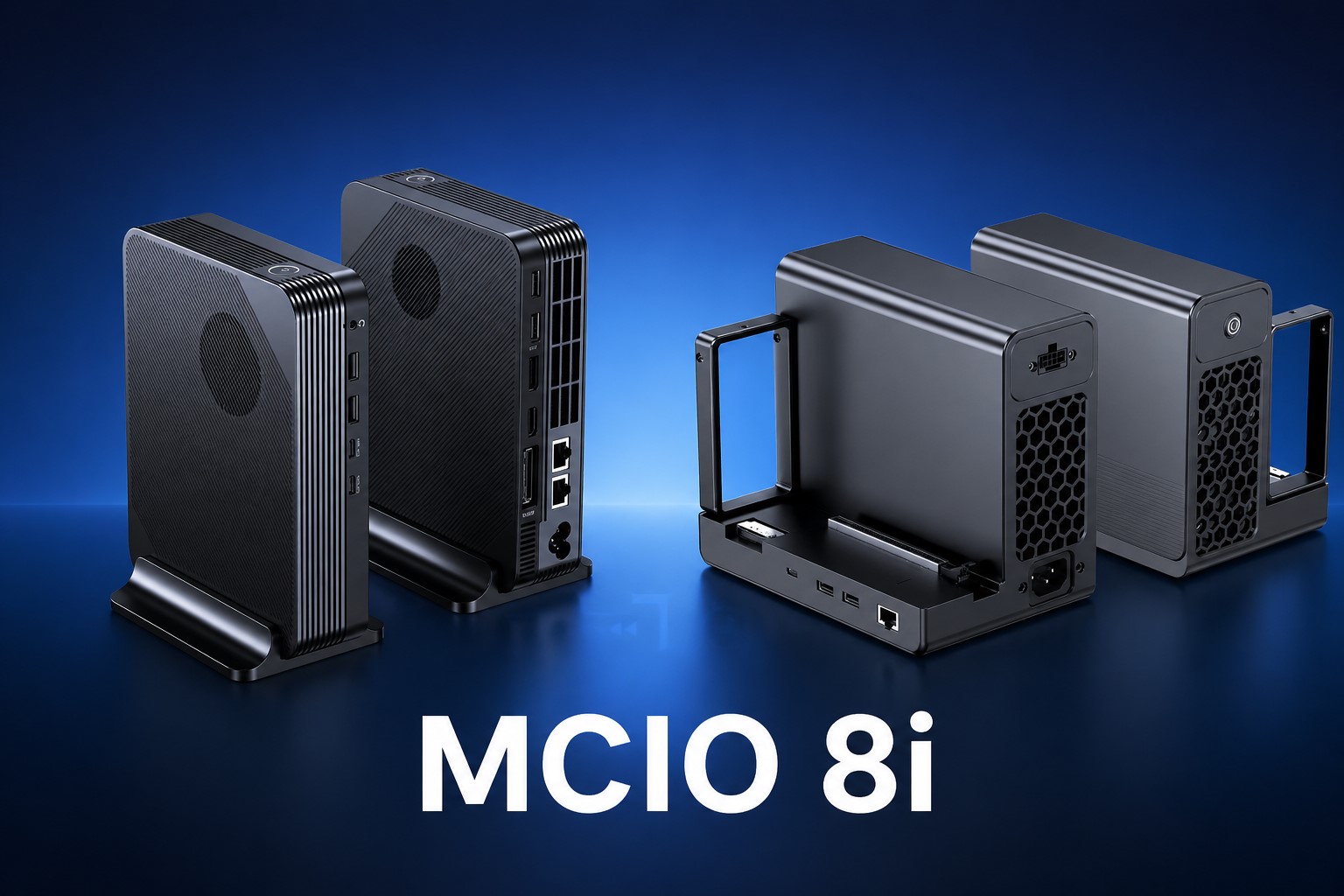
The first new device is the GPD G2 external GPU. It’s described as an eGPU solution built around Intel’s upcoming Panther Lake platform, and it includes both an MCIO 8i port and a USB4 v2 option for connectivity. GPD is pitching it as capable of desktop-class performance, and one of the standout claims is that pairing it with an RTX 4090 results in only around a 2% performance loss when using the MCIO 8i connection—an unusually small gap for an external setup.
GPD also markets the G2 as a “dual ports” eGPU dock, featuring extras that make it more than just a graphics attachment. Alongside GPU connectivity, it includes an additional M.2 storage connector and supports up to 100W power delivery for charging a connected device. Hardware details shown so far also point to built-in Ethernet (LAN) and a 16-pin power connector placed on the unit.
The second product is the GPD BOX mini PC, another Panther Lake-based system that also includes the MCIO 8i interface. GPD hasn’t confirmed exactly which Panther Lake configurations will be available, but the idea is clear: this mini PC is designed to take advantage of the same high-bandwidth external GPU approach. It also features dual USB4 v2.0 ports, and GPD suggests combining it with the GPD G2 for a compact, high-performance gaming and productivity setup.
Both the GPD G2 eGPU and the GPD BOX mini PC are expected to launch soon, with fuller specifications and pricing still to come. If MCIO 8i delivers on its bandwidth promise in real-world testing, it could redefine what buyers can expect from external GPU performance—especially for users who want desktop-level graphics power without committing to a full-sized desktop tower.