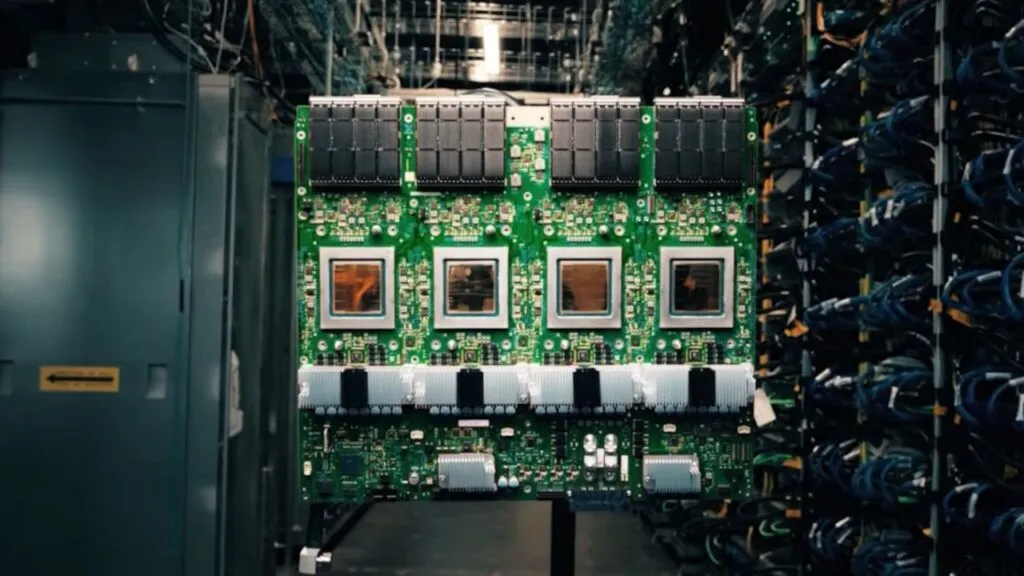
Google has introduced its latest breakthrough in AI technology with the development of the Ironwood, a custom AI accelerator that’s creating waves in the tech industry. This is Google’s “7th-generation” custom chip, uniquely designed to target inference workloads, marking a decisive step forward in artificial intelligence.
Revealed at the recent Google Cloud Next 25 event, Ironwood is celebrated as the company’s most robust and efficient accelerator to date. Its design focuses on inference workloads, which Google identifies as pivotal for the next phase of AI advancement. For those utilizing Google Cloud, the chip will be available in two configurations: a 256-chip setup and a larger 9,216-chip layout, tailored to meet varying demands of workload and inference power.
What sets Ironwood apart in the competitive AI market is its ability to outperform traditional computing resources. Particularly the 9,216-chip configuration, which boasts an astonishing 42.5 Exaflops of power, surpassing the capabilities of the world’s largest supercomputer, El Capitan, by 24 times. Beyond sheer power, Ironwood demonstrates twice the perf/watt efficiency relative to its predecessor, Trillium TPU, highlighting remarkable advancements in each generation.
Ironwood’s enhancements don’t stop there; it features several impressive upgrades. The High Bandwidth Memory (HBM) capacity has seen a significant boost, offering 192 GB per chip—six times more than Trillium. This enriches the ability to process larger models and datasets with minimal data transfer interruptions, thus enhancing overall performance. Moreover, HBM bandwidth reaches an impressive 7.2 TBps per chip, a 4.5x increase compared to Trillium, ensuring fast data access crucial for memory-heavy AI workloads. The improved Inter-Chip Interconnect (ICI) bandwidth of 1.2 Tbps bidirectional, up to 1.5x that of Trillium, also supports quicker communication between chips, streamlining distributed training and scalable inference.
Google’s progress with Ironwood signifies a significant shift in custom AI solutions, potentially disrupting NVIDIA’s market hold. These advancements underline the potential for growth in AI applications, with competitors like Microsoft’s Maia 100 and Amazon’s Graviton chips joining the race. It’s clear that many companies are recognizing the vast opportunities that tailored, in-house AI solutions present, signaling an exciting era of innovation in artificial intelligence technology.