Truly borderless displays are edging closer to reality, and a key breakthrough is coming from deep-ultraviolet laser cutting. At the Mid-Europe Chapter Conference of the Society for Information Display in Germany, Coherent outlined how its laser technology could finally eliminate the need for the visible frames that have long protected and concealed the delicate edges of screens.
Today’s so-called bezel-less designs still rely on clever tricks. Many manufacturers fold the edges of the panel to make borders look thinner, but the material typically fractures at the edge, and a protective frame remains necessary. The challenge has been achieving a clean, precise separation of the layered display stack so that the edge doesn’t flake, delaminate, or require a visible surround.
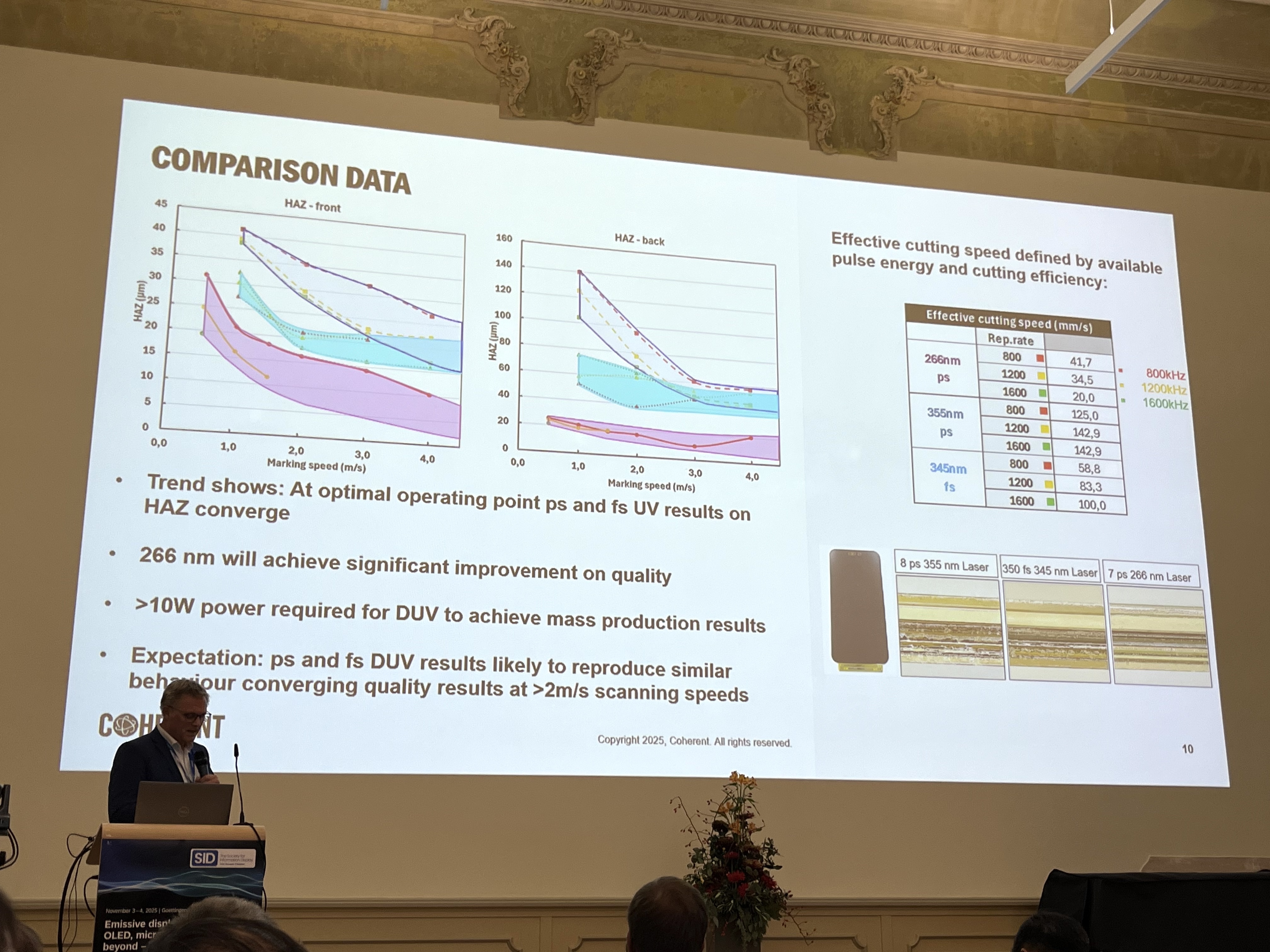
Coherent is addressing that problem with deep-UV lasers. The company, based in Göttingen, already supplies key tools for display production, including laser annealing systems used early in the manufacturing process. Its next focus is the final cut. Tests highlight why wavelength matters: at 355 nm, a common UV laser, the cut looks uneven and the layers at the separation edge are not cleanly divided, making a border unavoidable. Moving to 345 nm improves the result, but not enough for a truly bezel-free finish.
The big shift happens at 266 nm. In this deep-UV range, the laser can separate the display stack with much higher precision, causing minimal damage at the edge. Coherent indicates that material loss along the cut line can be kept to less than one pixel. Since there is already a natural gap of about 50 to 60 micrometers between pixels, the cut can be guided along that space, preserving the active area. Even with this level of precision, the cut edge still needs protection for durability, but it no longer demands a visible frame.
There’s a caveat: manufacturing speed. The deep-UV lasers currently available at around 10 watts aren’t powerful enough to cut fast, and slow throughput would push production costs too high for mass-market devices. Coherent expects that moving to roughly 20-watt systems should unlock the speed needed for volume manufacturing. The company hasn’t provided a timeline, and any rollout would require shipping new equipment from Göttingen and integrating it into existing production lines.
If the power and throughput hurdles are cleared, the implications are significant. Phones, laptops, monitors, and TVs could gain truly edge-to-edge screens without the visual compromises that have defined recent generations. Cleaner cuts can also translate into better yields and more consistent edge integrity, which are essential for reliability and cost control in high-volume display production.
For now, the technology is promising but not production-ready. Deep-UV cutting at 266 nm demonstrates the precision necessary for borderless displays, yet scaling it economically remains the final barrier. The moment more powerful lasers hit the factory floor, the long-promised era of truly bezel-free devices will be within reach.