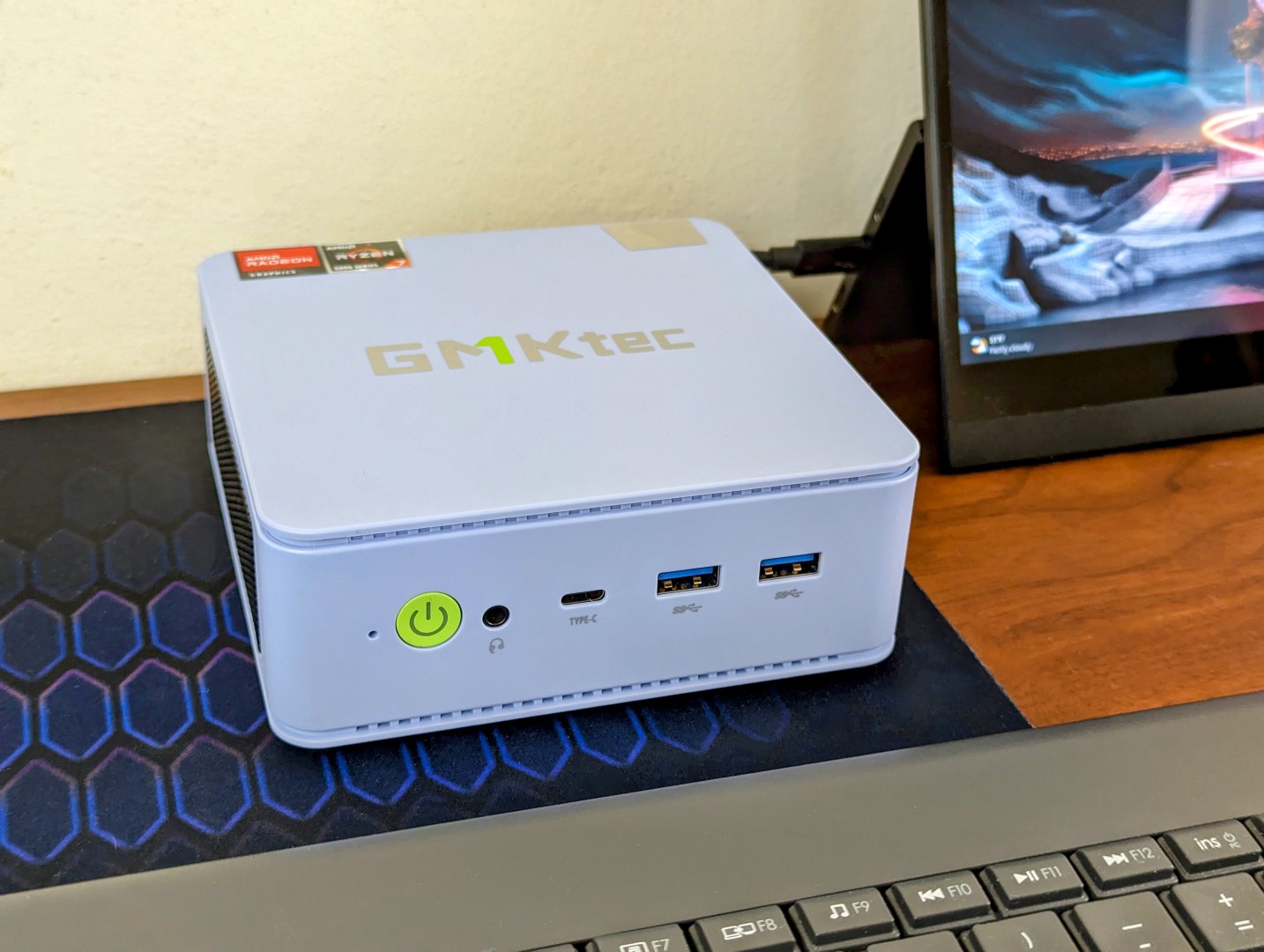
### GMK NucBox M5 Mini PC: An Evaluation of AMD Zen 2 Performance
When it comes to compact computing solutions, the GMK NucBox M5 mini PC has attracted interest with its promise of robust performance in a tiny form factor. Featuring an AMD Ryzen 7 5700U processor and AMD Radeon RX Vega 8 integrated graphics (borrowing from the Ryzen 4000/5000 series), it targets a balance of efficiency and capability. But, with the rapid pace of technological advancements, how does this machine hold up, particularly when the AMD Zen 2 architecture starts showing its age?
#### Performance Benchmarks and Comparisons
In the arena of performance, mini PCs are increasingly being subjected to the same rigorous standards as their larger counterparts. The GMK NucBox M5 is put through its paces, compared against a selection of similarly configured devices.
It’s worth noting that mini PCs like the Geekom A7, GMK NucBox K6, and Acemagic F2A feature comparable or advanced specifications, harnessing AMD and Intel processors along with their respective integrated or discrete GPU counterparts. Notably, the Intel NUC X15 showcases a powerful combination of an Intel Core i7-12700H processor with the latest Intel Arc A730M graphics, catapulting its frame rates leagues ahead in comparison.
The NucBox M5, with the AMD Ryzen 7 5700U at its core, holds its own in a landscape populated with various integrated and discrete GPU options. The metrics of its gaming frame rates, productive workload handling, and graphical performance stand as a testament to the capability of the Ryzen and Vega duo. However, in comparison to newer offerings that boast the Intel Arc series or Radeon 780M graphics, the NucBox M5’s performance may not dazzle but serves adequately for users with moderate expectations.
#### Insights on Technological Longevity
With the progression from Zen 2 to Zen 3 and beyond, there is an evident gap that emerges in performance and efficiency. The NucBox M5’s showing places emphasis on the growing need for more powerful and efficient processing in smaller packages. As manufacturers continue to innovate, devices such as Intel’s NUC 13 Pro Desk Edition Kit and GMK’s own K-series mini PCs offer glimpses of the future where miniaturization does not trade off power.
#### Daily Use and Practical Advice
The real-world application of the GMK NucBox M5 hinges on user requirements. For everyday tasks, such as web browsing, office productivity, and media consumption, the M5 would glide through with little difficulty. However, for individuals interested in gaming or more intense creative applications, considering systems armed with newer hardware could make a significant difference.
Recent trends leaning towards remote work and portability have bolstered the appeal of mini PCs, yet it remains crucial to align the choice of machine with anticipated use-cases. Potential users should weigh performance, connectivity, expandability, and power-consumption against their specific needs. For tasks not overly demanding on graphical intensity, the M5 still contends as a space-saving, power-efficient option.
In conclusion, the GMK NucBox M5 delivers reasonable performance for its class, but as technology marches forward, it may not keep pace for long. Its user base might be better described as those who prefer stable, tried-and-tested systems over cutting-edge powerhouses..beginTransaction()Exploring the Latest Trends and Performance in Small Form Factor PCs
Small form factor PCs have gained immense popularity for their compact size, power efficiency, and adequate performance, which makes them suitable for a variety of uses from home entertainment to office productivity. Recent advancements have further enhanced their capabilities, introducing a new lineup of processors and integrated graphics options.
With the introduction of Intel’s Core i7-1360P coupled with Intel Iris Xe Graphics and AMD’s Ryzen 7 processors paired with Radeon RX Vega graphics, the landscape of mini PCs and compact computing solutions is becoming increasingly competitive. The AMD Radeon RX Vega 8 (Ryzen 4000/5000) series, for example, has displayed a range of performance levels in benchmarks, illustrating the diversity available to consumers.
Among the notable machines in the SFF (Small Form Factor) category, the GMK NucBox series, Geekom A7, Acemagic F2A, and various models of Intel NUCs stand out. These devices incorporate a variety of processors and integrated GPUs, catering to different performance needs and budgets.
GMK NucBox models, such as the M5 with its AMD Ryzen 7 5700U and Radeon RX Vega 8 graphics, provide a balance between performance and power consumption, ideal for everyday tasks and light gaming. Going up the performance ladder, the GMK NucBox K6 and K2 bring in higher-performing AMD Ryzen 7 processors with more robust Radeon graphics options, pushing the boundaries of what’s possible in SFF computing.
For those seeking Intel-based solutions, the Intel NUC series offers versatility with processors like the Core i5-1240P, Core i7-12700H, and the Core i7-1360P—each paired with Intel Iris Xe Graphics of varying capabilities to meet different levels of graphical demands. The NUC11ATKPE and NUC11ATKC2 cater to budget-conscious buyers with efficient Pentium Silver and Celeron CPUs, respectively.
When considering an SFF PC, it’s essential to understand your usage requirements—whether you need a machine for light productivity, content consumption, or more demanding tasks such as content creation or casual gaming. The performance capability of the integrated GPUs, such as Intel’s UHD Graphics or Intel Arc Graphics, can significantly influence the user experience, especially in visually intensive tasks.
Recent trends show a promising direction with the integration of Intel’s Arc series GPUs, providing additional options for consumers seeking discrete-level graphics performance in a mini PC form factor. As compact PCs continue to evolve, we can expect further advancements in integrated GPU performance, power efficiency, and thermal management.
For users looking to integrate these compact PCs into their daily lives or work, it’s vital to consider connectivity options, upgradeability, and the ecosystem of peripherals that can complement these devices. With their increasing capabilities, small form factor PCs are becoming a mainstream choice where space savings, energy efficiency, and a minimalistic setup are desired.
The performance data of various SFF PCs, particularly the frame rates in gaming scenarios, show significant gains across different models and configurations. It is crucial for potential buyers to consider these metrics while assessing the performance-to-price ratio.
In conclusion, the contemporary landscape of small form factor PCs offers a diverse range of configurations to suit various needs and budgets. Whether it’s the economical Intel NUC variants or the performance-centric AMD-equipped GMK NucBoxes, consumers can find a mini PC that aligns with their intended use. As technology progresses, the gap between compact PCs and their full-sized counterparts narrows, making them an enticing option for an ever-growing user base.When examining the processing and graphics capabilities of various compact computing devices, it is essential to delve into some recent hardware performances. Notably, the Intel NUC 13 Pro Desk Edition Kit, powered by an Intel Core i7-1360P along with Intel Iris Xe Graphics G7 featuring 96 Execution Units (EUs), presents itself as a competent player in the compact desktop space. Another notable entry is the GMK NucBox M5, standing out with its AMD Ryzen 7 5700U processor coupled with AMD Radeon RX Vega 8 graphics from the Ryzen 4000/5000 series.
Additionally, the performance graph extends to devices like the Intel NUC11ATKPE and NUC11ATKC2, both offering graphical outputs through Intel UHD Graphics with 32 and 16 EUs, respectively, supported by Jasper Lake processors. On the contrast, the GMK NucBox K6, Geekom A7, and GMK NucBox K2, all armed with varying AMD Radeon graphics chips, represent the AMD front convincingly.
When we move on to more hefty configurations, like the Intel NUC X15 LAPAC71H housing a powerful Intel Core i7-12700H processor and an Intel Arc A730M GPU, graphics and processing performance see a significant uptick. Similarly, the Acemagic F2A, with its Intel Core Ultra 7 155H coupled with an Arc 8-Cores integrated graphics processing unit (iGPU), shows how Intel’s Arc platform plays out in this product segment.
Performance benchmarks of these devices are telling; we often see the AMD Radeon RX Vega 8 GPUs holding their own across various testing scenarios. But the newer entries, such as the Intel Arc series, introduce a fresh competitive edge. As benchmarks range widely depending on specific model configurations and cooling solutions, consumers need to regard the balance between their performance needs and the thermal design of these compact systems.
In day-to-day use, these nuanced differences in GPU and CPU performance will dictate the types of applications and games that can be smoothly run on each device. For professionals and gaming enthusiasts looking into the mini-PC market, it is worthwhile to consider how these hardware specifics align with their intended use-cases.
To harness the power of these robust mini-PCs in daily life or work, it’s important to match their capabilities with your requirements. Whether it is content creation, running complex simulations, or enjoying the latest games, paying attention to the CPU and GPU specs is crucial. Look at frame rates in various scenarios, the number of execution units for graphics performance, and the cooling solutions that impact the thermal throttling and, consequently, the sustained performance of these machines. By doing so, you can tailor your choice to ensure you have a system that meets, if not exceeds, your performance expectations while fitting into the compact form factor these devices offer.When it comes to assessing the performance of integrated and discrete graphics in small form factor PCs like Intel NUCs and other mini PCs, the frames per second (fps) metric is a key indicator of their capabilities, particularly in gaming and graphic-intensive applications. Here is an insight into various systems and their graphics performance:
The AMD Radeon RX Vega 8 (Ryzen 4000/5000 series) GPUs typically deliver a range of performance, with some systems averaging 22.7 fps, which can vary between 13.8 to 40.6 fps based on the specific configuration and the demand of the application.
The Intel NUC 13 Pro Desk Edition Kit, featuring an Intel Core i7-1360P processor and Intel Iris Xe Graphics G7 with 96 Execution Units (EUs), shows a significant performance in this category, capable of handling more graphically demanding tasks.
On the lower end, we have systems like the Intel NUC11ATKPE powered by an Intel Pentium Silver N6005 and Intel UHD Graphics with 32 EUs, delivering around 20.9 fps. This can drop to a minimum of 10.5 fps, indicating that it may struggle with more intense graphical operations.
Another more budget-friendly option, the Intel NUC11ATKC2 with an Intel Celeron N4505 and Intel UHD Graphics (Jasper Lake 16 EU), delivers an even lower performance averaging at about 10.8 fps.
For the ultra-compact and portable gaming experience, mini PCs like the GMK NucBox K6 equipped with an AMD Ryzen 7 7840HS and AMD Radeon 780M, or the Geekom A7 with an AMD Ryzen 9 7940HS and AMD Radeon 780M, offer decent gaming performance. Their fps averages vary, showing that users can still enjoy casual gaming on such small form factor systems.
For those who prioritize a balance between performance and portability, devices like the GMK NucBox K2, with an AMD Ryzen 7 7735HS and AMD Radeon 680M, and the Acemagic F2A with an Intel Core Ultra 7 155H and Intel Arc 8-Cores integrated GPU, offer a mid-range solution.
Finally, for users seeking an efficient yet more powerful mini PC, the GMK NucBox M5 featuring an AMD Ryzen 7 5700U and AMD Radeon RX Vega 8 (Ryzen 4000/5000 series) provides a blend of performance that can cater to everyday tasks and some light gaming.
It’s important to note that these performance metrics represent the potential of these systems under specific test conditions and the actual performance can vary widely depending on several factors including system configuration, software optimization, and the type of workload. Users should consider their specific needs and usage scenarios when selecting a mini PC, balancing the portability and power required for their personal or work-related tasks.