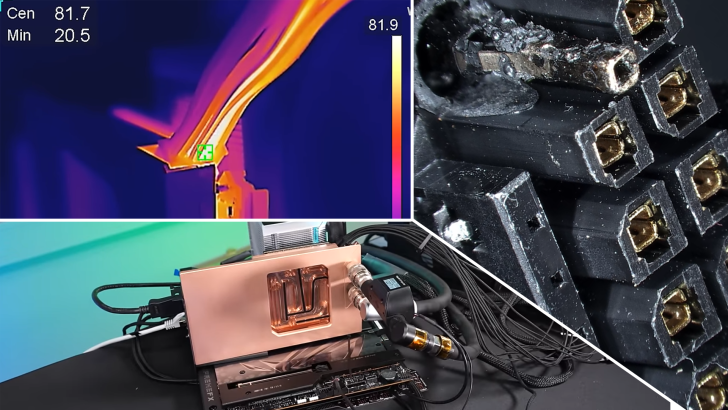
In an unexpected twist, recent tests have suggested that the notorious melting issue with the RTX 5090 and 12VHPWR connectors may not be primarily due to user error, as previously assumed. This groundbreaking revelation comes from the demonstration conducted by Der8auer, who ran an insightful experiment to shed light on the mystery behind the melting connectors.
The experiment used Der8auer’s liquid-cooled GeForce RTX 5090 FE alongside a Corsair 12VHPWR cable, simulating operational conditions with the Furmark stress test. Alarmingly, within just five minutes, thermal imaging revealed that the connector temperatures soared. The power supply unit (PSU) side reached 150°C, while the GPU side touched 90°C.
One might initially suspect improper connector insertion, yet Der8auer confirmed that both the PSU and GPU had correctly inserted connectors. The real issue emerged from a disparate distribution of electrical load across the wires. Specifically, two wires in the 12-pin connector cable were shouldering an excessive current load—each exceeding 20 Amps—despite being designed to handle only up to 8 Amps. This imbalance resulted in one wire melting, echoing the concern of a Reddit user who first reported the issue.
These findings highlight a potential design flaw rather than a problem with cable quality. Thorough inspection under a microscope confirmed that the Moddiy 12VHPWR cable, akin to top cables from leading manufacturers, was not inherently to blame.
As the RTX 5090 is a power-intensive card, the current 12VHPWR configuration’s limitations are becoming evident. Unlike its predecessor, the RTX 4080, the increased power demand of the 5090 seems to be bringing these issues to light. Der8auer emphasizes that this issue parallels the earlier RTX 4090 melting incidents.
For prospective solutions, it might be prudent to consider the use of dual 12-pin power connectors for the RTX 5090 to effectively distribute the power load. This adjustment could potentially bring significant relief to the overheating woes, ensuring a safer and more reliable performance. As these developments unfold, users are advised to remain vigilant about connector integrity and power load management.


