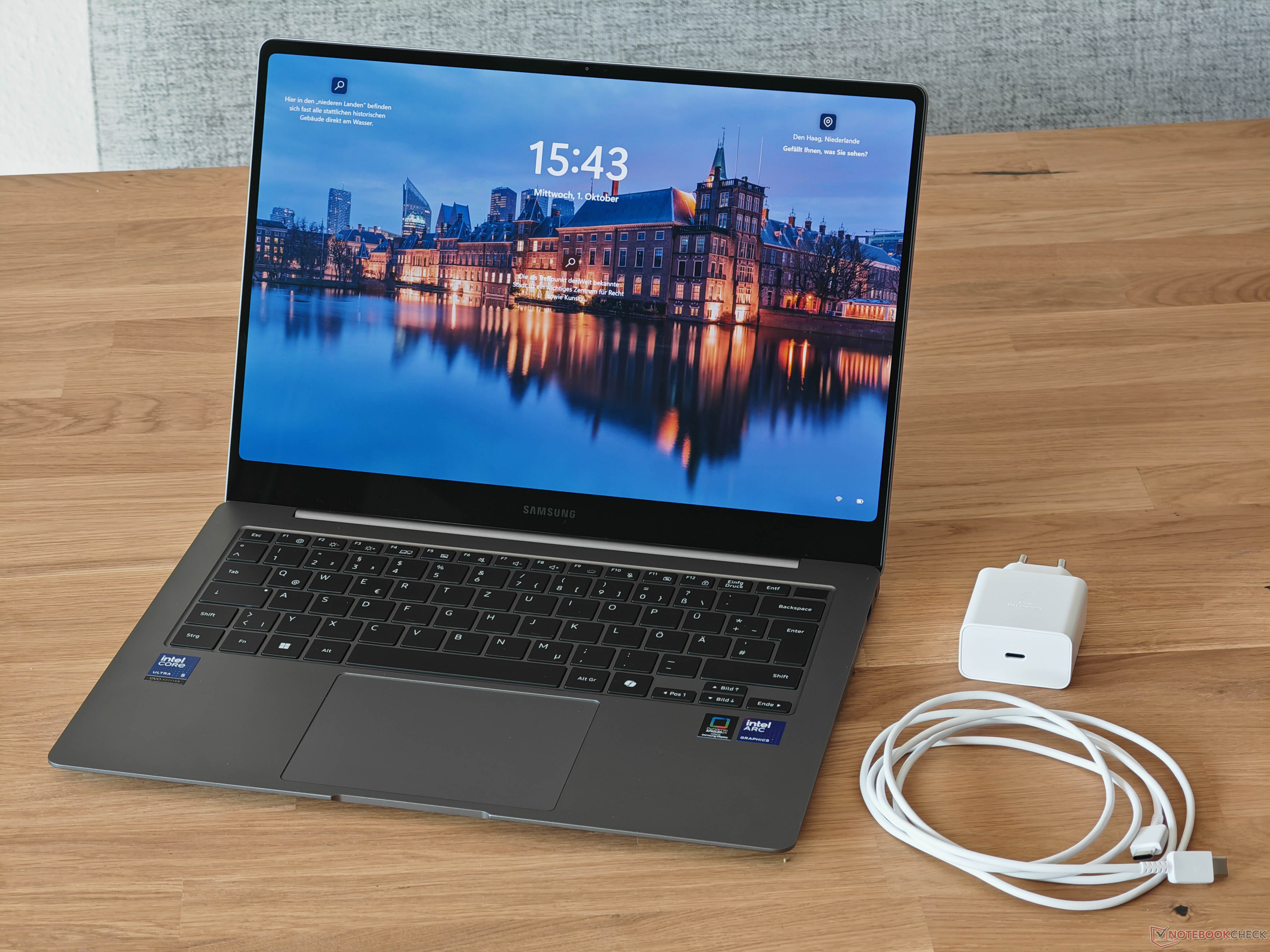
Samsung Galaxy Book5 Pro 14: Gorgeous OLED, but brightness and flicker hold it back
The Galaxy Book5 Pro 14 aims to blend portability with premium visuals, and at first glance it delivers. Its 14-inch OLED touchscreen runs at 2880 x 1800 with a 120 Hz refresh rate, producing crisp text, punchy colors, and inky blacks. Content looks clean rather than grainy, even on bright backgrounds—a common gripe with some touch OLEDs. You also get accurate presets for both P3 and sRGB, which is great for color-sensitive work and content creation.
Where the shine fades is in brightness and flicker performance. In SDR, the panel reaches around 400 nits, which is acceptable indoors. HDR, however, tops out at roughly 530 nits, and that’s where the competition surges ahead. Several 14-inch OLED rivals now push peak brightness close to or above 1,000 nits, improving highlight detail, outdoor visibility, and HDR punch. Recent models like Lenovo’s Yoga Slim 7 14 G10 exemplify this jump, and Honor’s MagicBook Art 14 pairs high resolution with an OLED implementation that’s stronger across the board.
Another concern is PWM flickering. The Galaxy Book5 Pro 14’s OLED reportedly modulates at a steady 240 Hz with a relatively large amplitude. Users who are sensitive to PWM may experience eye strain or fatigue, especially at lower brightness levels. Competing OLED laptops increasingly employ higher PWM frequencies—often above 1 kHz—and smaller amplitudes to mitigate these issues.
This gap is surprising given the brand’s prominence in OLED manufacturing and the laptop’s premium positioning. The result is a device that still looks fantastic in most everyday scenarios but no longer sets the pace for OLED laptop displays.
Who will love it
– Users who value a lightweight 14-inch laptop with a sharp 2880 x 1800 OLED touchscreen
– Fans of smooth scrolling and animations thanks to the 120 Hz refresh rate
– Creators who want solid color profiles for P3 and sRGB without post-calibration
Who should think twice
– Anyone who needs strong HDR impact or frequent outdoor use; rivals offer far brighter OLEDs
– Users sensitive to PWM flicker; the 240 Hz modulation may cause discomfort
– Shoppers expecting a class-leading panel at a premium price
Bottom line
The Galaxy Book5 Pro 14 still delivers eye-catching OLED image quality with fluid 120 Hz motion and accurate color modes. But with SDR brightness around 400 nits, HDR peaks near 530 nits, and low-frequency PWM at 240 Hz, it’s falling behind newer 14-inch OLED competitors that now combine higher peak brightness with more eye-friendly flicker characteristics. If brightness and flicker comfort rank high on your checklist, consider the latest alternatives; if you mostly work indoors and want a compact OLED with great color and smooth performance, this laptop remains an appealing option.