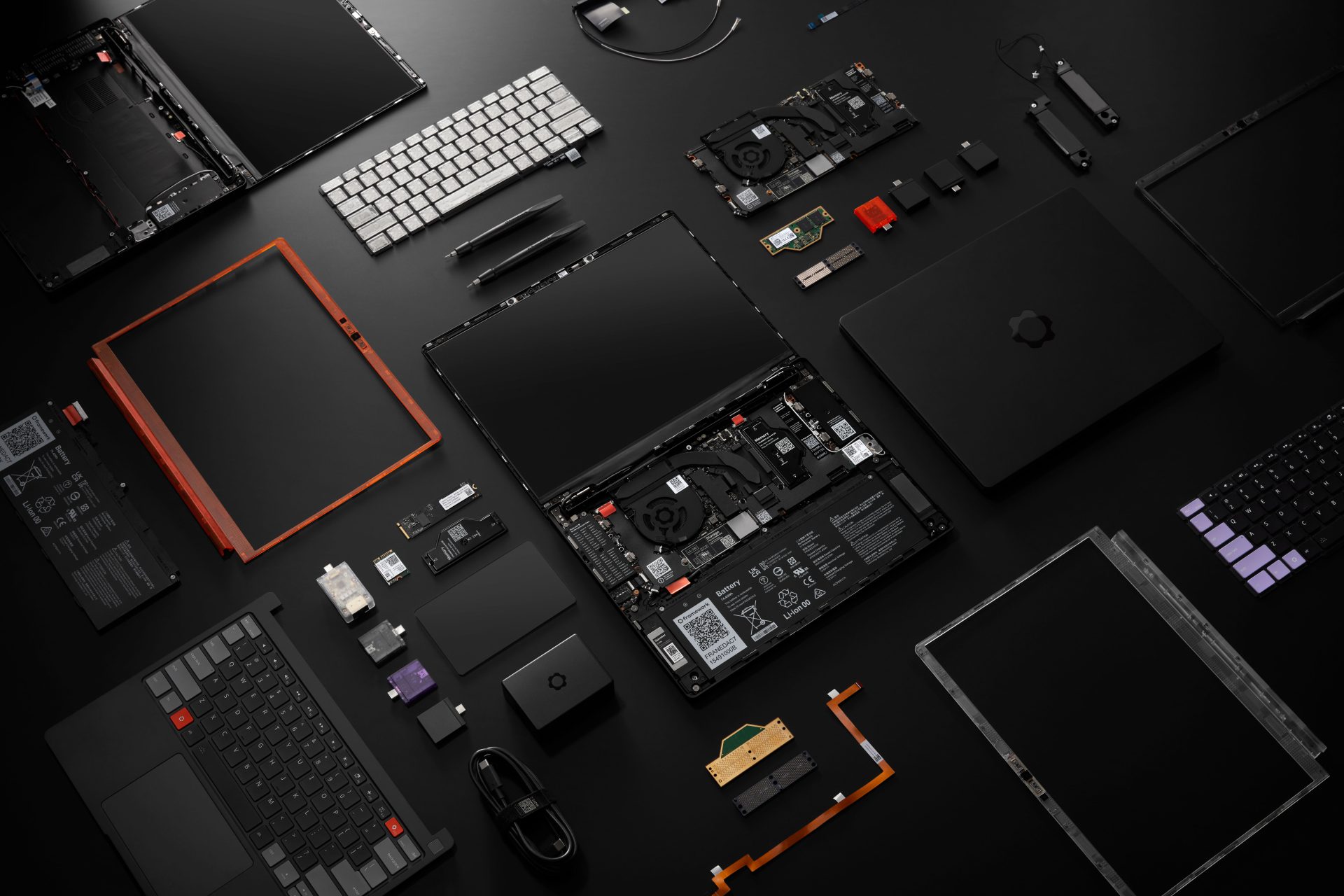
Framework has just pulled the curtain back on a major new wave of upgrades at its Next-Gen Event, led by the debut of the Framework Laptop 13 Pro. Built from the ground up, this new 13.5-inch modular notebook targets people who want more performance and longer battery life without giving up the repairable, upgrade-friendly approach that Framework is known for.
At the heart of the Framework Laptop 13 Pro are Intel Core Ultra Series 3 processors. Framework says these chips bring stronger CPU performance, quicker integrated graphics, and dramatically improved efficiency. To capitalize on those gains, the Laptop 13 Pro pairs the new platform with a larger 74Whr battery and support for LPCAMM2 memory, a compact memory format designed to improve both space efficiency and power use while still allowing upgrades.
One of the most attention-grabbing claims is battery life. Framework estimates up to 20 hours of Netflix 4K streaming on the Laptop 13 Pro, which it says is around 12 hours more than the previous generation. That’s a substantial jump for a thin, portable machine, especially one that still focuses on modularity rather than sealing everything permanently inside.
Framework is planning multiple CPU options, starting with Core Ultra 5 and scaling up through Core Ultra X7 to the flagship Core Ultra X9 lineup. The Core Ultra X-series models also bring more capable integrated graphics, with B390 and B370 iGPU options aimed at pushing gaming and graphics performance further than typical integrated solutions.
Memory is another highlight. The Laptop 13 Pro uses LPCAMM2 DDR5 modules in 16GB, 32GB, and up to 64GB configurations, with speeds listed at 7467 MT/s. Because LPCAMM2 is designed to be upgradable, users can increase RAM later rather than replacing the whole laptop.
Storage gets a major lift too. The Framework Laptop 13 Pro is the first Framework laptop to support a PCIe Gen5 NVMe SSD, with quoted read and write speeds reaching up to 14,000 MB/s and capacity options up to 8TB. As with previous Framework systems, storage remains user-expandable.
Connectivity and ports are equally modern. The Laptop 13 Pro includes Wi‑Fi 7 via Intel’s BE211, four Thunderbolt 4 USB‑C ports, and a 100W GaN power adapter that charges over USB‑C. On the front, you’ll find a 13.5-inch 3:2 touchscreen display with a sharp 2880×1920 resolution, a variable 30–120Hz refresh rate, and up to 700 nits of brightness—specs that fit well for productivity, content creation, and bright-room use.
Framework is also leaning into premium build quality this time around. The Laptop 13 Pro comes in a slim CNC‑machined aluminum chassis, measuring 15.85mm thick and weighing about 1.4kg. There’s a new haptic touchpad design using four piezo elements, plus a fingerprint sensor for quick sign-ins. Framework says the chassis is only slightly longer than a 14-inch MacBook Pro, positioning it as a compact but high-end machine. First shipments are expected in June.
Framework also shared updates around the Framework Laptop 16, its larger AMD-powered system designed as an “ultimate portable workstation.” The 16-inch model is getting refinements such as a one-piece haptic touchpad, a one-piece keyboard option, and a new bezel color. Framework says the Laptop 16 will be offered with a Ryzen AI 5 340 CPU, opening the door to a lower starting price than before.
To round out the announcements, Framework introduced a new discrete graphics module concept designed to work with its Expansion Bay ecosystem. The company is offering an OCuLink-based solution aimed at high-speed, high-power external expansion over a PCIe x8 interface. In practical terms, this setup is meant to let users connect full-length PCIe graphics cards and other add-in hardware such as high-speed networking cards or capture cards—turning the Framework Laptop 16 into a more flexible workstation-style platform when docked.
The OCuLink development kit includes an OCuLink 8i interface and a dock designed to connect to a GPU module. Framework says the dock includes a Corsair SF850 SFF power supply and dual cooling fans to help manage airflow for a graphics card or other PCIe add-in card.
With the Laptop 13 Pro leading the charge—bringing Intel Core Ultra Series 3, LPCAMM2 upgradable memory, PCIe Gen5 storage support, and a big battery life claim—Framework is clearly aiming to prove that modular laptops don’t have to compromise on premium performance or modern features.