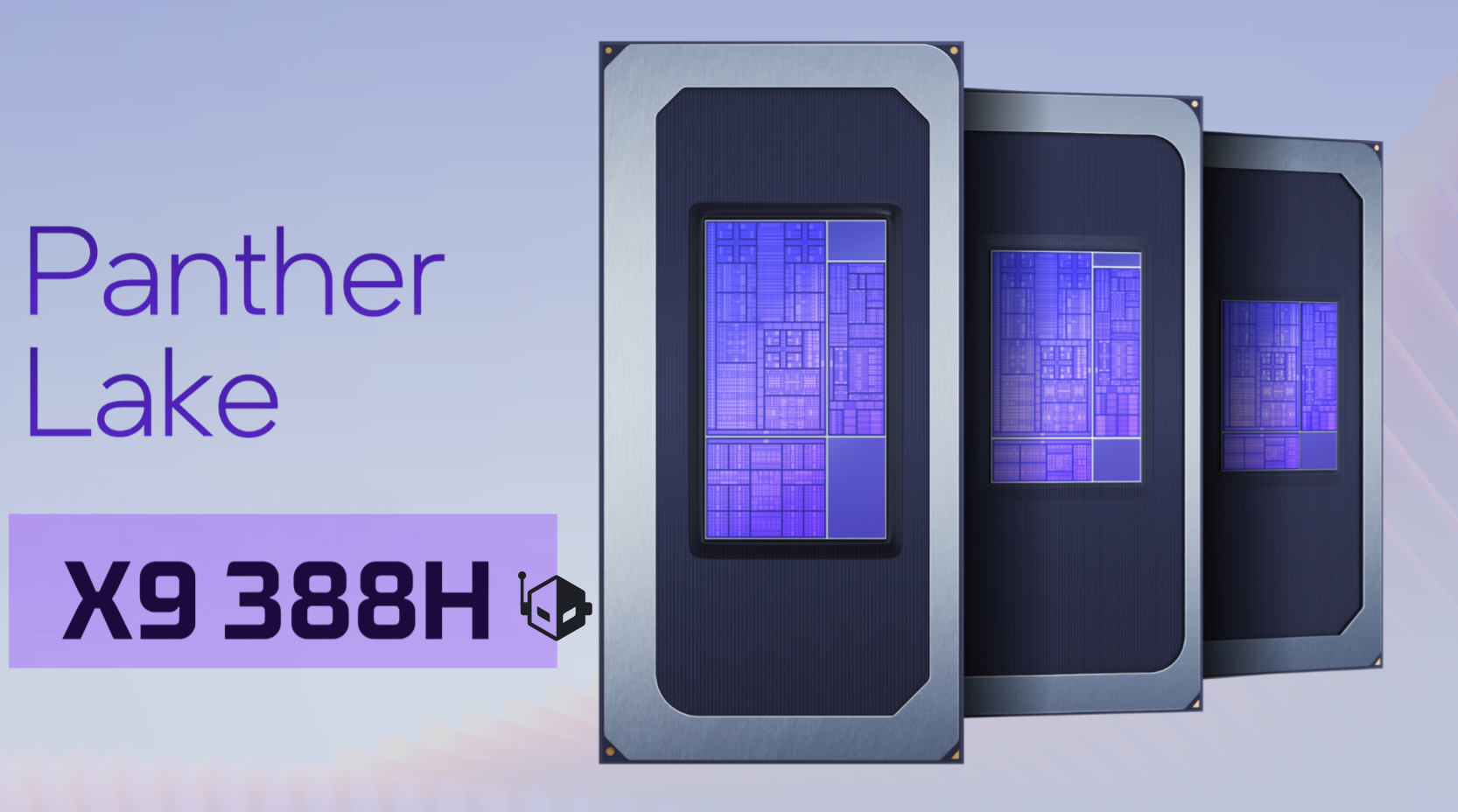
Intel’s next flagship mobile processor is shaping up to be a meaningful step forward. Early results for the Core Ultra X9 388H, part of Intel’s Core Ultra Series 3 lineup (Panther Lake), suggest the new chip delivers a solid CPU uplift while also bringing what’s expected to be the fastest integrated GPU in the family. If these trends hold, Panther Lake could be one of the more compelling laptop upgrades in recent Intel generations—especially for users who want stronger performance without relying on a dedicated graphics card.
Fresh benchmark sightings put the Core Ultra X9 388H in PassMark for the first time, giving a clearer look at how it stacks up against its predecessor, the Core Ultra 9 285H. Across the available listings, single-threaded performance appears broadly comparable between the two, but the bigger story is multi-threaded speed. In one result, the 388H lands close to a 10% multi-threaded lead, and in another entry it shows an even larger gain—roughly in the neighborhood of 17%—while also posting a slightly better single-core score.
Of course, benchmark databases can vary from run to run depending on system configuration, cooling, power limits, and memory settings. It’s also worth noting that looking only at the best result from one chip can be misleading, since the competing processor may have equally strong top-end scores in other entries. Still, when you compare the overall direction across multiple leaked tests, the Core Ultra X9 388H repeatedly shows a noticeable edge over the Core Ultra 9 285H in multi-threaded workloads, even though both chips have the same total core count.
Part of what makes the comparison interesting is that Panther Lake changes how those cores are arranged. The Core Ultra X9 388H reportedly uses two fewer Performance cores, but adds two LP-E cores designed for efficient background and low-power tasks. This type of configuration shift can help laptops stay responsive while improving efficiency—potentially boosting sustained performance when power and thermals are limited.
Power characteristics also look promising. The 388H is said to run at a lower TDP than the 285H, which could translate into better battery life or improved sustained clocks in thin-and-light designs. Clock speeds differ as well: the X9 388H reportedly boosts up to 5.1 GHz, while the older 285H can reach up to 5.4 GHz. Even so, the early multi-threaded results indicate Intel is getting more overall work done, likely through architectural improvements and efficiency gains rather than simply pushing frequency.
Integrated graphics may be the biggest upgrade of all. The Core Ultra X9 388H is expected to feature Arc B390 integrated graphics built on Intel’s Xe3 architecture, and early chatter suggests it’s well ahead of what Core Ultra Series 2 iGPUs can offer. That could make a real difference for lightweight gaming, creative apps that use GPU acceleration, and everyday performance on laptops that don’t include discrete graphics.
If you’re considering your next laptop purchase, Panther Lake’s Core Ultra X9 388H is a chip to watch. Between the reported multi-threaded uplift, the efficiency-focused core configuration, and a major iGPU leap, it’s shaping up to be a notable generational improvement—especially for users who want strong CPU performance and the best possible integrated graphics in a premium mobile system.