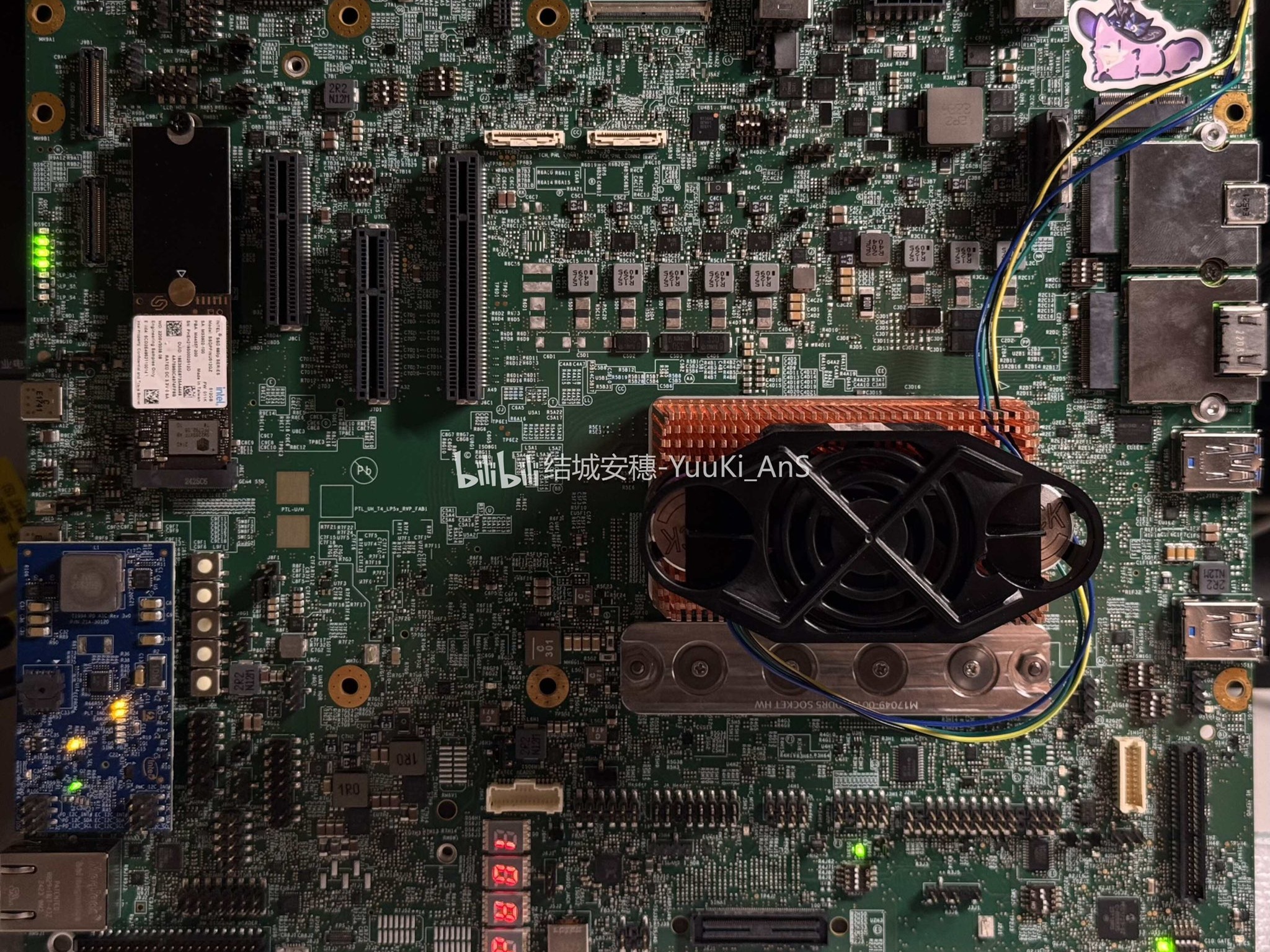
Intel’s next-gen Panther Lake platform has surfaced again, this time in fresh photos and early tests of an engineering sample running on Intel’s own reference hardware. The chip in question sports a 10-core layout paired with 16 GB of LPDDR5X memory and operates within a 25 W PL1 power target, briefly boosting to 65 W PL2.
Shared by hardware leaker YuuKi_AnS on X, the processor appears to use the PTL 16C/4Xe3 tile configuration, though only 10 cores are enabled on this sample. The core mix is unusual for retail parts: 2 P-cores, 4 E-cores, and 4 LP-E cores, pointing to internal validation rather than a final SKU. The package is labeled 000C06C0 and uses the BGA-2540 socket, a strong indicator of a mobile-focused design.
Clocks on this early silicon are conservative. All P-cores reportedly run at 3.0 GHz, the four E-cores at 2.6 GHz, with boost clocks topping out around 3.2 GHz. Cache is split between 11 MB of L2 and 12 MB of L3. Graphics come via a compact Xe3 iGPU with four execution units, noted as linking through a 2.5 GT/s interface.
Testing was performed on Intel’s Reference Validation Platform with an ADL-P frame, mated to 16 GB of LPDDR5X memory. The configuration used four SK hynix H58G56BK8BX068-418A modules rated at 7467 MHz, underscoring a push toward high-bandwidth, low-power memory in thin-and-light laptops.
Early performance looks restrained, which is typical for engineering samples. CPU-Z single- and multi-thread results reportedly fall short of retail hardware expectations, likely due to immature firmware, conservative voltage tables, and early power management. Telemetry shows a 25 W PL1, 65 W PL2, and a high 160 W PL4 ceiling, with a 100°C TjMax—figures that fit a low-power mobile part still undergoing tuning.
What this leak does reveal is the likely positioning of at least one Panther Lake variant: a compact, efficiency-first laptop processor balancing modest clocks with modern memory and a lean integrated GPU. The unusual 2P + 4E + 4 LP-E layout suggests Intel is experimenting with core mixes to optimize responsiveness and battery life across everyday workloads.
Key details at a glance:
– 10-core ES sample: 2 P-cores, 4 E-cores, 4 LP-E cores
– Package: 000C06C0, BGA-2540
– Clocks: 3.0 GHz all-core P, 2.6 GHz E, up to 3.2 GHz boost
– Cache: 11 MB L2, 12 MB L3
– iGPU: Xe3 with four execution units, 2.5 GT/s link
– Memory: 16 GB LPDDR5X (7467 MHz) on Intel RVP
– Power: PL1 25 W, PL2 65 W, PL4 160 W, TjMax 100°C
As always with pre-release hardware, treat performance and configuration details as fluid. Intel is expected to share official Panther Lake information at CES 2026, where final core counts, clocks, and graphics configurations should come into focus.