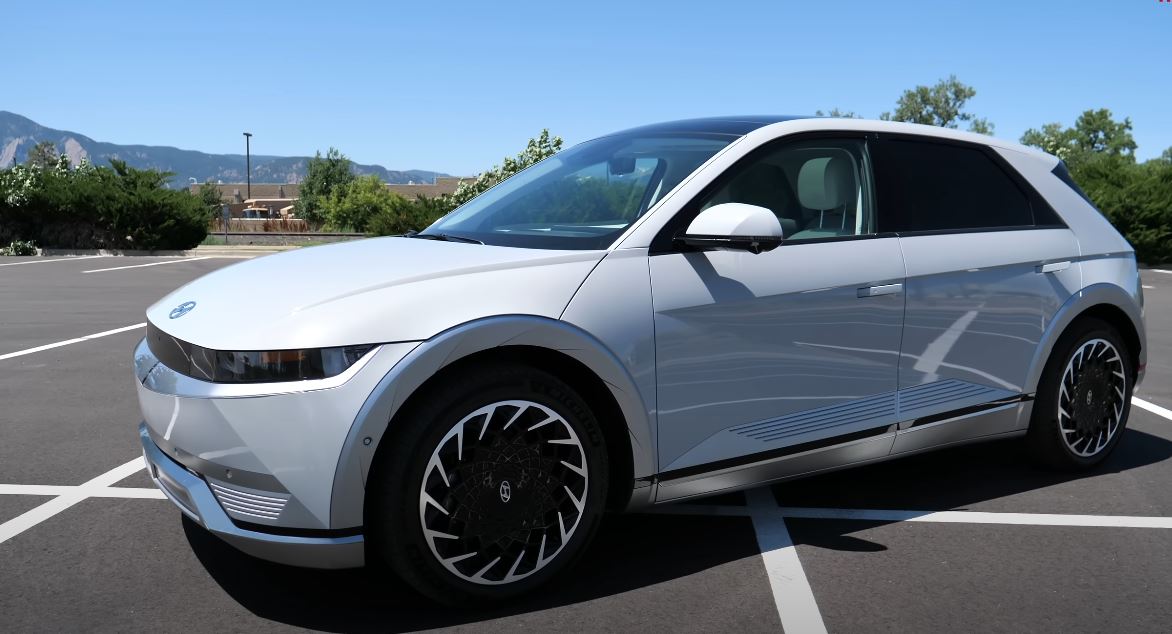
The Ioniq 5 EV has been known for its sleek design and noteworthy efficiency, but its capabilities go beyond just looks and mileage. A curious group of EV enthusiasts took on the task to understand precisely how much battery charge the Ioniq 5 could recover while making a downhill trip, an aspect of electric vehicles that often sparks interest among potential buyers and technology aficionados alike.
At the start of their journey, the Ioniq 5 was nearly at full capacity with a battery charge of 99%, showing an estimated range capability of about 254 miles. As anticipated, the uphill climb demanded more power, with energy consumption becoming noticeably higher. Roughly 70 miles into their ascent, the battery level dropped to 61%, and the new estimated range stood at 150 miles. Despite the power-intensive climb, the vehicle maintained an impressive efficiency rate near 2.34 miles/kWh.
The real test began with the downhill return trip. The drivers were eager to witness the performance of the Ioniq 5’s regenerative braking system, an innovative feature designed to recover kinetic energy and convert it back into usable electrical power to recharge the battery. Regenerative braking systems are a key highlight in electric vehicles, as they contribute significantly to energy efficiency, particularly in stop-and-go traffic or situations like a downhill drive.
During the descent, the drivers were offered a range of driving experiences thanks to the vehicle’s adjustable regenerative braking mechanism. The Ioniq 5 comes with steering-mounted paddles which allow the driver to toggle between different levels of regenerative braking. Drivers can opt for a more traditional coasting experience, where the car behaves more like a conventional internal combustion engine (ICE) vehicle and does not recuperate any energy. Alternatively, the ‘i-Pedal’ mode allows for a single-pedal driving experience. In this mode, simply releasing the acceleration pedal gradually brings the car to a complete stop, all the while harnessing the car’s momentum to recharge the battery.
Upon completing the 75 miles descent, the vehicle had impressively used only about 10% of the battery. This achievement highlights the efficiency of the regenerative braking system of the Ioniq 5, illustrating that significant energy recovery is possible in the right conditions, such as prolonged downhill driving.
Understanding how regenerative braking works and its benefits can greatly enhance the driving experience of an EV. For anyone considering an electric vehicle, seeing tangible results such as these can be quite reassuring. Not only does regenerative braking support the notion of sustainable driving, but it also highlights the potential savings in energy, and consequently, running costs over time.
For those interested in maximizing the efficiency of their EV through regenerative braking, it is advisable to familiarize oneself with how the system operates in the vehicle of choice. If available, using modes like the mentioned ‘i-Pedal’ can give drivers greater control over energy recovery and can lead to improved overall vehicle range. Additionally, paying attention to driving patterns that allow for maximum energy recuperation can further enhance the practicality and appeal of electric vehicles in everyday use.