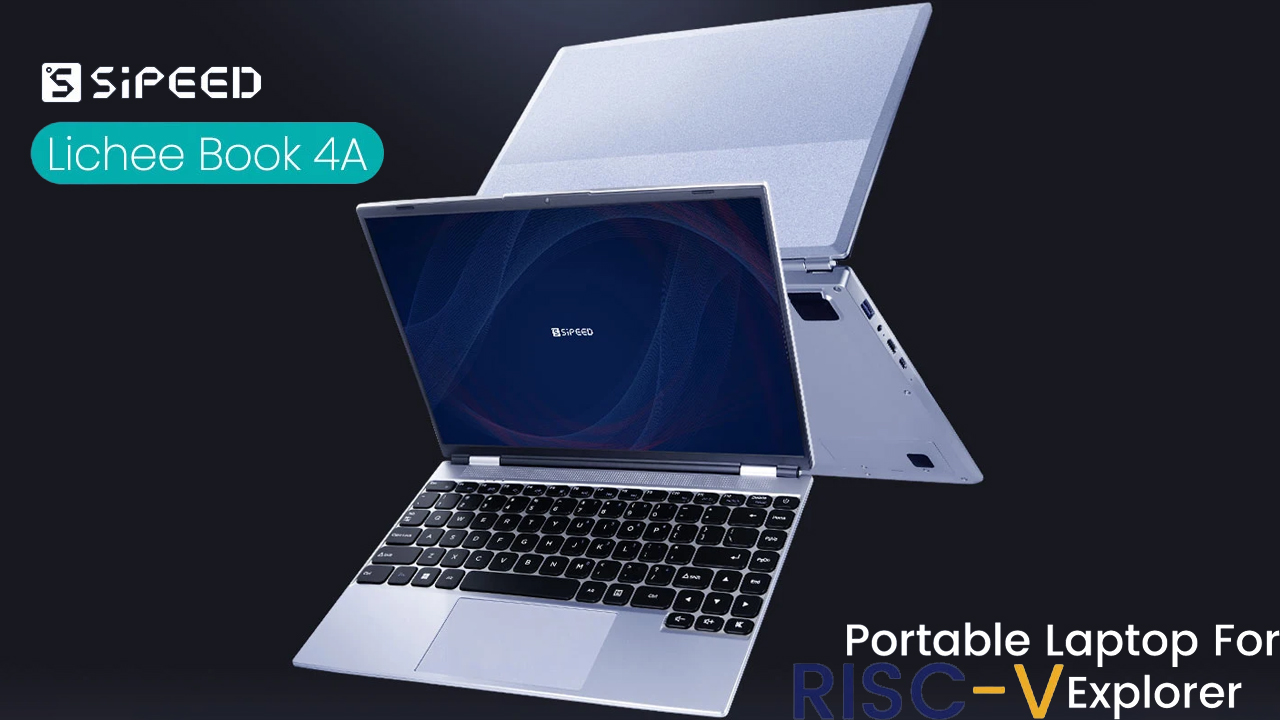
The Sipeed Lichee Book 4A represents an intriguing entry in the laptop market, particularly for those interested in the emerging RISC-V architecture. This laptop offers a unique blend of affordability and processor upgradeability seldom seen in today’s tech landscape.
At the heart of the Lichee Book 4A is the LM4A compute module, a compact system complete with a RISC-V processor—the T-Head TH1520. This module supports robust hardware specs, including up to 16 GB of LPDDR4X RAM and 128 GB of eMMC storage. Previously seen in the Lichee Console 4A, the LM4A is now housed in a 14-inch laptop boasting a crisp 1920×1200 pixel resolution screen. The laptop even accommodates an optional SATA SSD for additional storage.
The headline feature of the Sipeed Lichee Book 4A laptop is its modular design, which allows easy upgrades to the RISC-V processor. Two additional compute modules are anticipated for release: the LM3A, sporting a SpacemiT K1 CPU with eight cores, up to 16 GB of RAM and a 2 TOPs Neural Processing Unit (NPU); and the LM5A, equipped with an ESWIN EIC7700 processor with four cores, accommodating up to 32 GB of RAM and a 20 TOPs NPU.
In contrast, the currently available LM4A module houses a 4 TOPs NPU, and its TH1520 processor features four SiFive C910 cores. These modules aren’t competing with top-tier Intel, Qualcomm, or AMD processors in performance but rather provide developers a cost-effective means to work on the RISC-V architecture.
Other features of the Lichee Book 4A include a 34 Wh battery, USB connectivity (including two Type-A ports and one USB 3.0 Type-C), WiFi 6, and Bluetooth 5.4 support. This device is flexible enough to serve various users, from tech enthusiasts to software developers looking to explore the RISC-V platform.
As for pricing, the pre-order phase is offering various configurations. The barebones option starts at $189, and the fully-equipped version, including the LM4A module with 128 GB storage and 16 GB RAM, is priced at $349.
The Sipeed Lichee Book 4A laptop represents a unique offering in the computing world. It may not claim the most powerful specs on the market, but it stands out for its modular approach to CPU upgrades, focused on RISC-V development. This feature alone makes it a compelling choice for certain customers, especially those involved in development or who have an interest in emerging computing architectures.