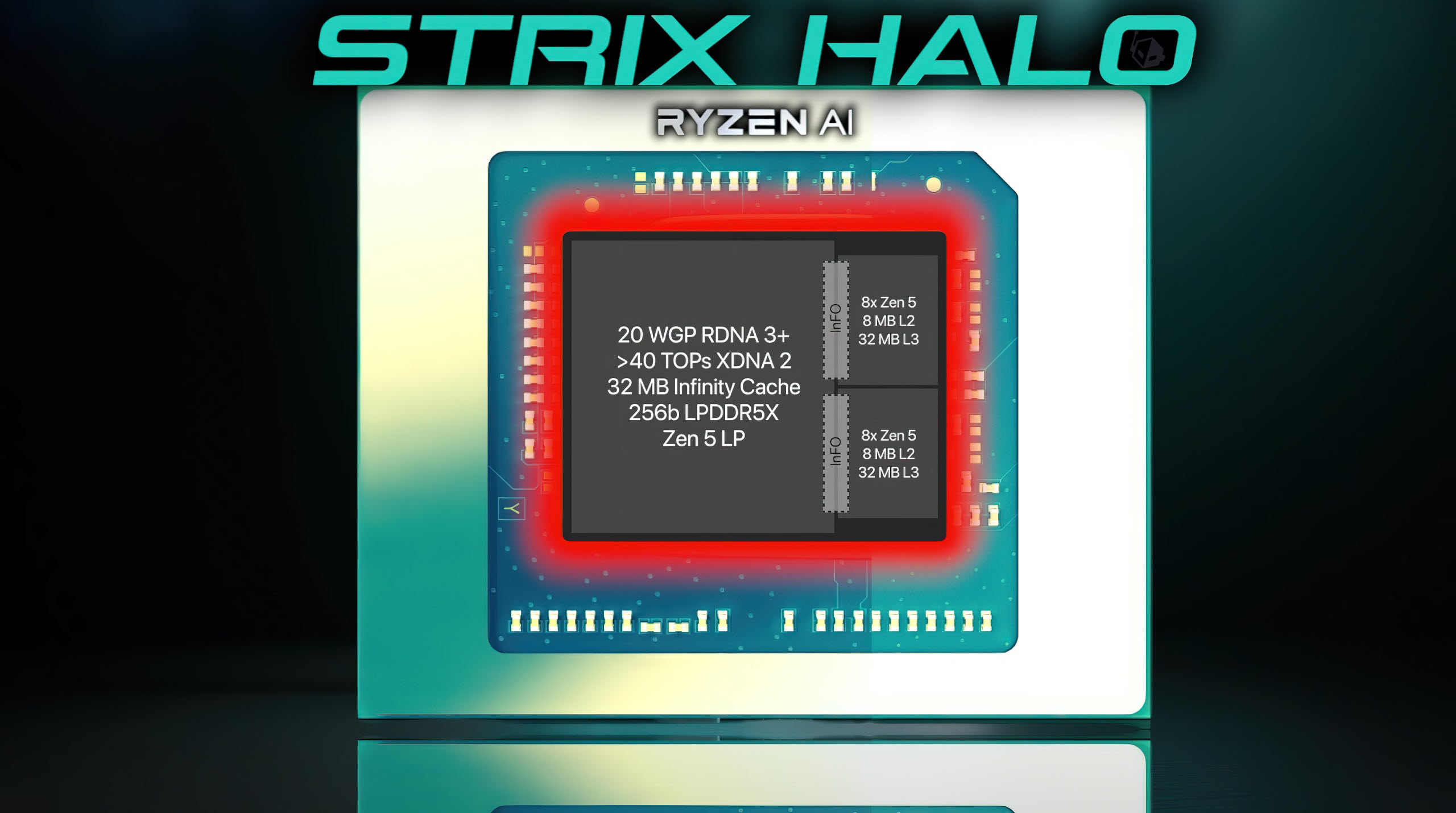
The AMD Strix Halo APU represents a monumental leap forward for enthusiasts looking to push the boundaries of laptop performance. The upcoming high-end Ryzen APU, known for its advanced chiplet-based design, is set to power a new generation of powerful laptops. With a line-up boasting up to 16 Zen 5 CPU cores and 40 RDNA 3+ GPU cores, the Strix Halo is making headlines in the tech world.
The architecture of the AMD Strix Halo APUs integrates up to three dies, including two CPU Core Complex Dies (CCDs) and one Graphics Core Die (GCD). This robust configuration supports up to 32 threads. The maintainance of the L1 and L2 cache structures from previous generations allows for up to 16 MB L2 cache. However, a notable enhancement is seen in the L3 cache, which has doubled to 32 MB per CCD, leading to a whopping total of 64 MB of L3 cache in the top-tier configurations.
The Strix Halo APU’s GCD is expected to be the hub of the system, featuring all I/O blocks. Moreover, it comes equipped with an XDNA 2 AI Neural Processing Unit (NPU) delivering over 40 tera operations per second (TOPs), and an incredible 32 MB of Infinity Cache. It supports 256-bit Low Power Double Data Rate 5X (LPDDR5X) memory, and there’s talk of Zen 5 Low-Power (LP) cores being included within the same die.
For graphical prowess, the RDNA 3+ graphics architecture within the Strix Halo APUs is rumored to contain 20 Work Group Processors (WGPs) or 40 Compute units. To address any potential bottlenecks due to the high-end integrated GPU (iGPU) built on the chiplet design, there’s an additional 32 MB of MALL cache on the GCD.
Potential specifications for the Strix Halo APUs are impressive, with support for LPDDR5x-8000 (256-bit) memory, TDPs of 70W (configurable TDP down to 55W), and peak power ratings capable of reaching up to 130W. This places these APUs within the specifications of the latest FP11 platforms, balancing power and performance for high-end gaming and productivity tasks.
Connectivity and display options for the Strix Halo APUs are comprehensive, including embedded DisplayPort (eDP), external DisplayPort (DP) capabilities, USB-C and USB4 Alt-DP, all supporting high-bandwidth data transfer. The Strix Halo model is said to feature up to DP2.1 UHBR20 support, further extending its capabilities in media-intensive applications.
Looking ahead, the tech community anticipates AMD’s formal announcement of its next-generation Zen 5 “Ryzen” CPU portfolio at the Computex 2024 keynote. Until then, details on the specifications and benchmarks for these new technological advancements remain eagerly awaited. AMD’s focus on delivering high-performance, versatile CPUs with advanced GPU cores keeps them at the forefront of innovation in the laptop market.
The aforementioned features of the AMD Strix Halo APU are expected to redefine the capabilities of enthusiast laptops. With these potential specifications and advancements, AMD is setting the stage for a future where laptops rival the performance of some desktops, blending portability with unprecedented power.