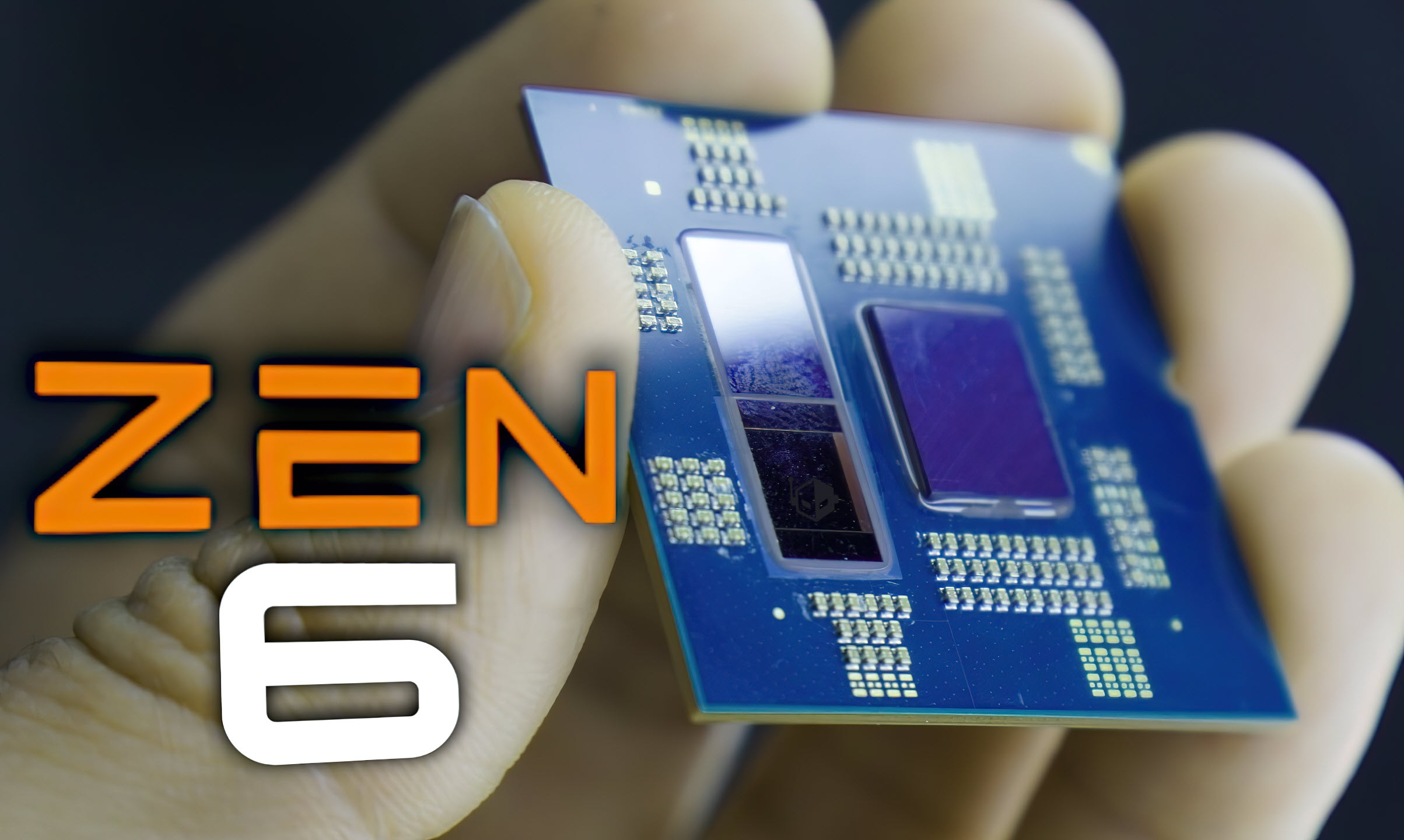
AMD is gearing up for a computing revolution with its upcoming Zen 5 and Zen 6 core architectures. The future looks bright for enthusiasts and professionals alike, as AMD plans to deliver more powerful and efficient CPUs.
Zen 5 Core Configurations Set to Innovate
The Zen 5 core architecture is expected to bring more compact cores compared to the current Zen 4 cores, which creates the opportunity to fit more CCDs (Core Complex Dies) into a CPU package. With the objective of increasing core density, AMD is looking to stack up to 16 CCDs with the standard Zen 5 and 12 CCDs with the high-performance Zen 5C architectures.
At the heart of these advancements is the CCX (Core Complex), a central unit within a CCD. In the standard Zen 5 architecture, each CCD will retain a single CCX with 8 cores, totaling up to 128 cores. However, Zen 5C chips will feature a single CCX configuration housing 16 cores, aiming for a maximum of 192 cores.
The details of the next-gen architectures can be illustrated as follows:
– Zen 5C: Up to 12 CCDs (targeted at the EPYC server platform) with 16 cores per CCD resulting in a maximum of 192 cores.
– Zen 4C: Up to 8 CCDs with 16 cores per CCD for up to 128 cores.
– Zen 5: Up to 16 CCDs with 8 cores per CCD, reaching up to 128 cores.
– Zen 4: Up to 12 CCDs with 8 cores per CCD, summing up to 96 cores.
The Zen 6 Core Architectural Leap
Following the Zen 5, AMD’s Zen 6 core architecture is rumored to take things even further. It is purported to be available in configurations ranging from 8 cores to an astonishing 32 cores per CCD. The enthusiast and professional markets could see dual CCD parts in the Ryzen lineup, with up to 32 cores. And in the higher-end models, we may witness up to 64 cores following the same CCD layout.
Increased Core Counts and Their Implications
The enhancement in core counts with the advent of 16 and 32 core CCDs in next-gen AMD CPUs will be a significant headway for multi-threaded applications. These advancements will benefit high-performance segments like the Threadripper and EPYC families.
For the mainstream audience, it’s expected that AMD will continue to push the envelope in core count. However, many current games and software engines aren’t optimized for such high core counts. In such scenarios, AMD’s 3D V-Cache CPUs, such as the Ryzen 7 7800X3D with 8 cores and additional stacked cache, present a more cost-effective and suitable option for high-end gaming and applications.
AMD Zen CPU/APU Roadmap Overview:
The roadmap for AMD’s Zen CPUs and APUs outlines a diverse assortment of codenames and target segments, including EPYC for servers, Ryzen Threadripper for high-end desktops, and Ryzen for mainstream desktops and notebooks.
Forthcoming releases anticipate using process nodes ranging from the venerable 14nm to the cutting-edge 3nm/2nm processes. With each successive generation, consumers can expect enhanced performance, improved energy efficiency, and ever-increasing core counts, catering to a broad spectrum of computing needs.
As the industry awaits the formal introduction of Zen 5 at Computex 2024 and the first products hitting shelves by Q3 2024, the anticipation builds for what could signify a monumental shift in computing prowess and capability. The ongoing evolution of AMD’s Zen architecture promises to keep the company at the forefront of high-performance computing for the foreseeable future.