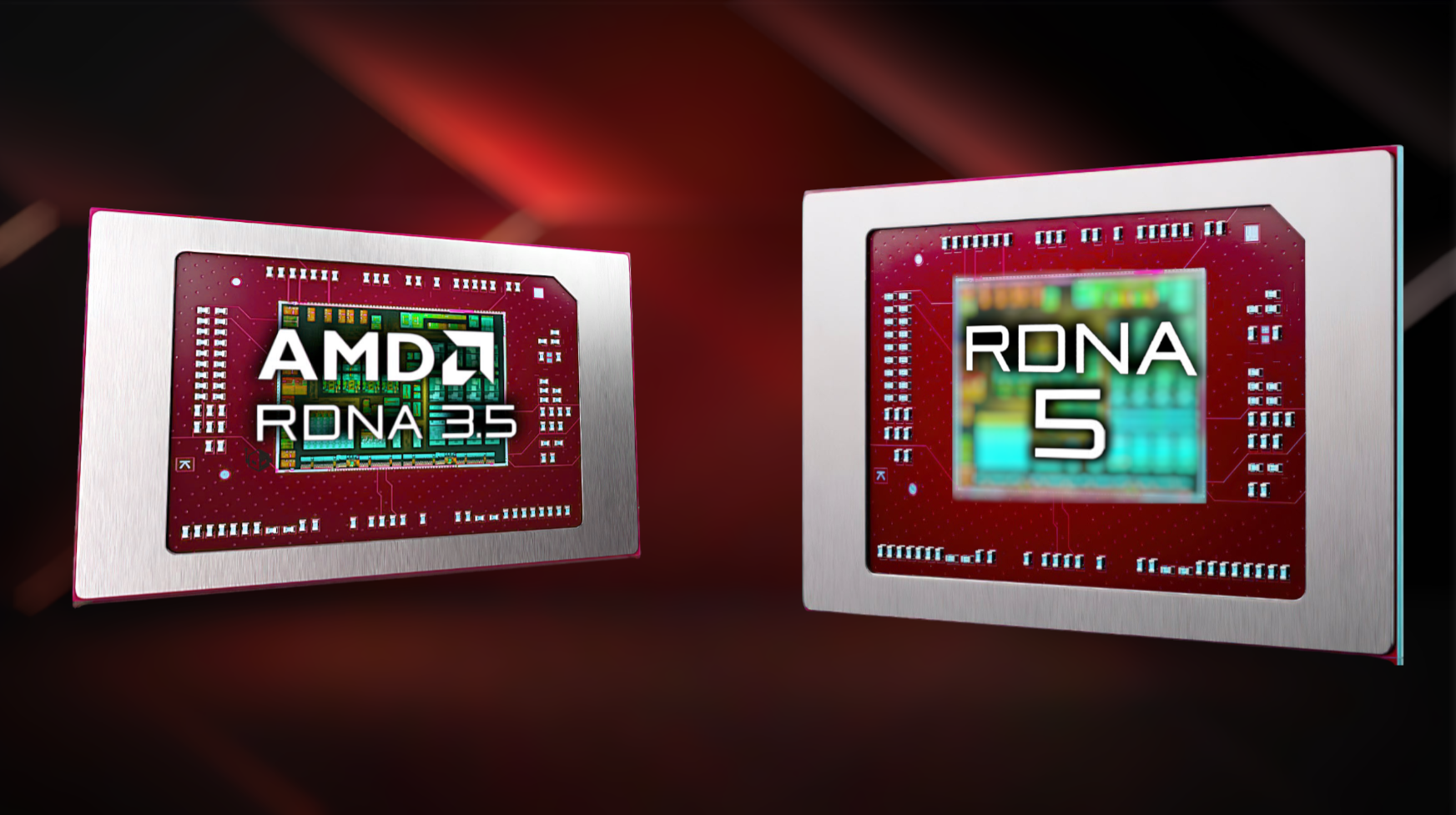
AMD appears to be settling into a two-track strategy for integrated graphics in its laptop and mobile APU lineup: RDNA 3.5 will remain the workhorse for mainstream chips for several more years, while higher-end “premium” APUs are expected to jump straight to RDNA 5 for a bigger leap in graphics features and performance.
The key takeaway is longevity. A new report from well-known industry insider Kepler_L2 suggests AMD will continue using RDNA 3.5-based iGPUs across much of its APU roadmap all the way through 2029. That might sound surprising given AMD already introduced RDNA 4 on the discrete GPU side, bringing improvements to ray tracing and AI-focused hardware along with support for newer upscaling and feature updates. But if this roadmap holds, RDNA 4 won’t become the standard iGPU architecture in typical AMD APUs.
RDNA 3.5 stays for mainstream and value-focused APUs
AMD’s recent Ryzen AI 400 “Gorgon Point” launch continues to rely on RDNA 3.5, largely boosted via higher clocks rather than a new architecture. Even AMD’s more powerful iGPU-forward families like Strix Halo and Gorgon Halo (often positioned as “Ryzen AI MAX”) still use RDNA 3.5—just scaled up dramatically, with configurations reaching up to 40 compute units compared to the 16-CU ceiling seen in more mainstream designs.
According to the insider claims, this is by design. AMD is expected to keep RDNA 3.5 in products aimed at lower-end markets, office and productivity laptops, and systems where integrated graphics isn’t the main selling point (including laptops that lean on a strong discrete GPU). In other words: stable, cost-effective graphics for the bulk of the lineup.
Medusa Point may be the last big RDNA 3.5 stop before the split
AMD’s next major APU family, Ryzen AI 500 “Medusa Point,” is widely expected to be the final major generation to feature RDNA 3.5 iGPUs in the mainstream track. After that, the rumor is AMD will skip RDNA 4 entirely on the iGPU side and move premium APUs directly to RDNA 5.
That transition is where things get interesting.
RDNA 5 reserved for “Premium” APUs and Halo-class chips
The reported plan is to use RDNA 5 iGPUs specifically for premium-tier APUs—think “Premium” and “Halo” variants designed to deliver standout integrated graphics performance. This approach lets AMD keep costs and efficiency in check for mainstream parts, while still having a clear answer for buyers who want near-discrete-level iGPU gaming and GPU compute capabilities in thin-and-light systems.
In the same set of claims, Medusa is described as having multiple forms:
– Medusa Point: a more traditional, monolithic design that keeps RDNA 3.5
– Medusa Premium: expected to use an RDNA 5 graphics die (described as “AT4 GMD”)
– Medusa Halo: expected to use another RDNA 5 graphics die (described as “AT3 GMD”)
One notable detail is that these RDNA 5 GPU dies are said to be separate from the main compute tiles in the premium designs, suggesting AMD may be leaning further into chiplet-style flexibility to scale performance across tiers.
Why AMD would draw the line here
Competitive pressure is rising fast in integrated graphics. Intel is pushing forward with Xe3, which is expected to bring a sizable iGPU performance jump, and there are also expectations around Xe3P using a Celestial-based design under a refreshed Arc branding approach. With rivals aiming higher, AMD likely needs a clear iGPU performance escalator—especially for premium laptops where buyers increasingly expect real gaming capability without a discrete GPU.
At the same time, keeping RDNA 3.5 alive for mainstream APUs through the decade offers AMD consistent platform tuning, predictable power/performance behavior, and potentially better pricing control for high-volume laptop segments.
A quick look at how AMD iGPU compute has scaled over time
Over the years, AMD’s APUs have steadily climbed in iGPU capability—from Vega-based designs in earlier Ryzen generations to RDNA 2 in Ryzen 6000, RDNA 3 in Ryzen 7000 “Phoenix Point,” and now RDNA 3.5 in the Ryzen AI era. The biggest iGPU configurations today sit in the Ryzen AI MAX class with up to 40 compute units on RDNA 3.5, while mainstream Ryzen AI parts top out around 16 compute units.
What to watch next
If these roadmap details are accurate, the next big inflection point for AMD integrated graphics won’t be RDNA 4—it’ll be the first premium APUs that land with RDNA 5 inside. That’s also when we should learn what AMD’s next-gen iGPU feature set looks like in practice, how far performance can scale in Halo-class laptops, and whether RDNA 5 can keep AMD ahead as Intel continues to iterate on Xe and explores new collaborations that could reshape high-end x86 SoCs.
For now, the message is clear: RDNA 3.5 is sticking around for the mainstream for years, and RDNA 5 is being positioned as the major step up for premium integrated graphics systems.