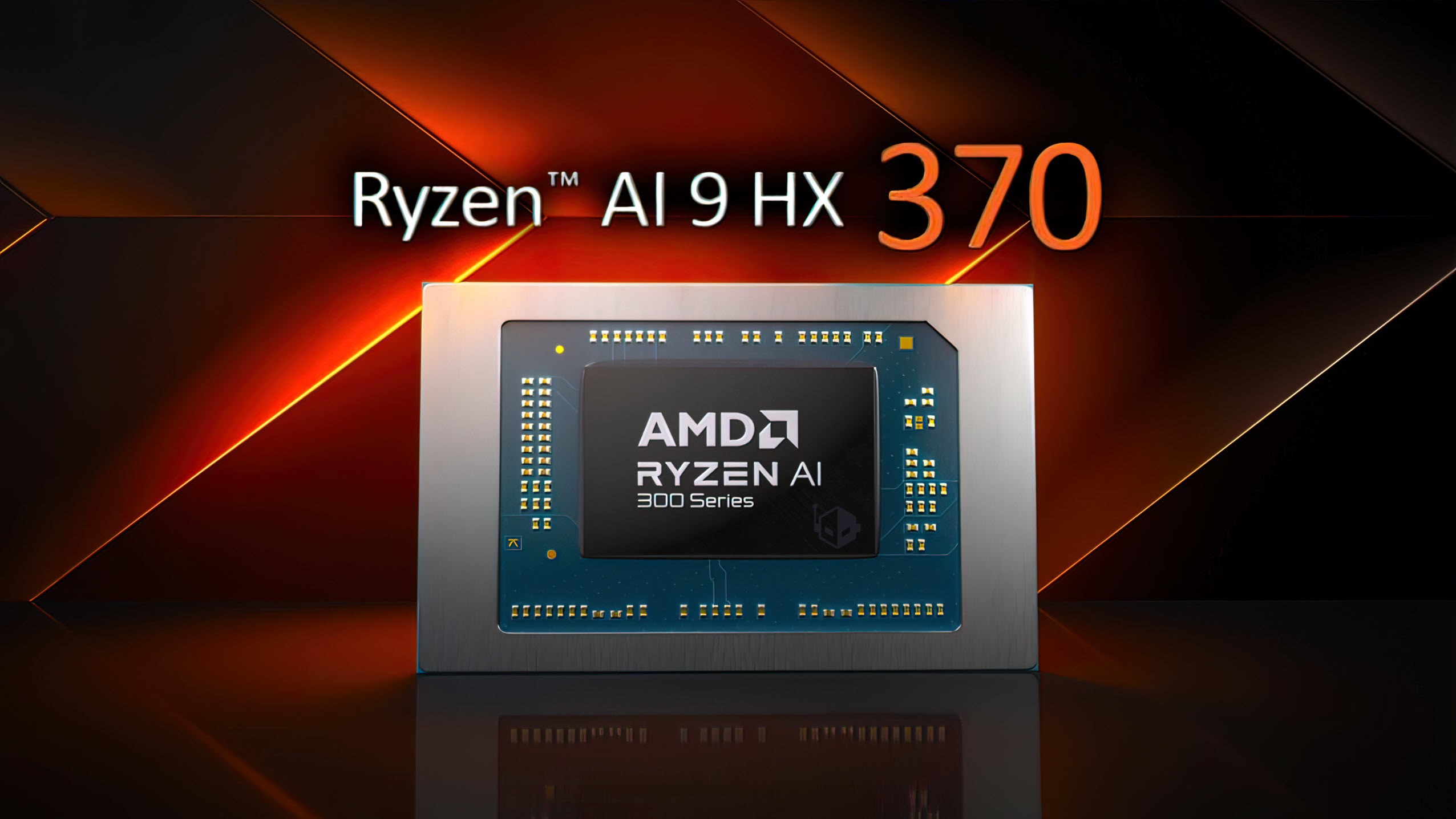
The computing world is abuzz as recent benchmarks from AMD’s Ryzen AI 9 HX 370 APU point to remarkable performance improvements. Reports indicate that this CPU showcases a single-threaded performance jump of up to 17% and an even more impressive multi-threaded boost of up to 25% when compared with its predecessor.
The Ryzen AI 9 HX 370 APU is a notable member of AMD’s “Strix Point” Ryzen AI 300 series. Featuring 12 cores and 24 threads split between a hybrid architecture of four Zen 5 and eight Zen 5C cores, the CPU exhibits robust speed with boost clocks reaching up to 5.1 GHz. Additionally, it houses a healthy 36 MB of total cache and a Radeon 890M integrated GPU with 16 compute units, equivalent to 1024 cores.
When compared with the previous flagship, the Ryzen 9 8945HS, the Ryzen AI 9 HX 370 APU steps up game with 50% more cores and threads, a significant increase in compute units (33.3% more), and an impressive 3.12 times the NPU performance. These generational enhancements underscore a strong forward leap in technological advancement.
Specifically, in CPU-z 2.09.0 benchmarks, the Ryzen AI 9 HX 370 with the OPN ID “100-000000994-37_Y” achieved a stellar score of 798.6 in single-core tests and a whopping 8893.6 in multi-threaded tests. When we compare these scores to other Ryzen models’ performance, such as the 7940HS in a default 45W TDP laptop setting or the 8949HS in a 65W TDP Mini PC setup, the AI 9 HX 370 APU demonstrates tangible advancements in performance.
It’s essential to note, however, that the benchmark results were derived from an engineering sample and were conducted at an unspecified TDP (Thermal Design Power). These APUs are known to operate within a range, scaling from 15W up to 54W, with a standard configuration of 28W. While the exact TDP used in the benchmark remains unknown, it is speculated that given its placement in an ASUS TUF Gaming A14 laptop designed for gamers, the TDP could indeed be on the higher end of the scale.
Looking ahead, there is an anticipation for exceptional performance metrics from the final version of the Ryzen AI 9 HX 370 APU when juxtaposed with current Ryzen 7040/8040 APUs built on Zen 4 cores. The advent of Zen 5 promises a 16% increase in instructions per cycle (IPC), which, coupled with the substantial upsurge in core count, paints a promising picture for AMD’s next-gen processors. The Ryzen AI “HX” series APUs, ranging from the high-end AI HX 370 to more mid-range offerings, all feature varying core counts, cache sizes, integrated GPUs, and AI capabilities, establishing a broad portfolio for different user needs and power requirements.
As enthusiasts and professionals alike eagerly await precise results post-release, the leaked figures suggest AMD’s latest offerings could substantially raise the bar for computing performance, particularly in the realm of gaming laptops and small form-factor PCs.
Moving forward, such advancements are likely to influence the wider technology landscape, where increased processing power can prove critical in fields ranging from gaming to professional content creation. With users set to harness these gains in everyday applications, the evolution of computing power continues to be an exciting journey.