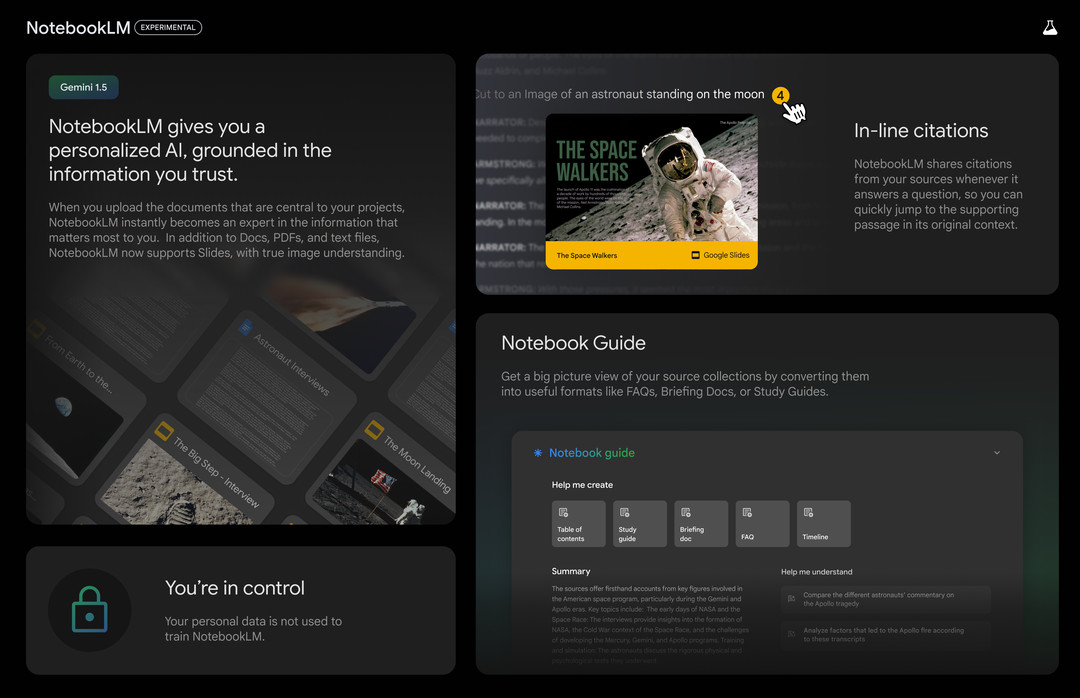
Google’s AI-powered note-taking application, NotebookLM, has reached a new chapter by integrating fresh, advanced features. Now at the ripe age of one year, NotebookLM is diversifying the types of content it can process. Building upon its ability to parse text files and PDFs, the application has evolved to include direct web content reading through URL uploads. Users can now feed the app with a broader array of information such as Google Slides, images, and diagrams, thanks to an upgrade to Gemini 1.5 Pro.
This enhancement signifies a major leap for Google’s AI assistant, which is now accessible in more than 200 regions globally. The app’s newfound capability to accept web URLs and Google Slides as inputs aims to refine the efficiency of generating responses to queries. Unique to this update, the answers provided by NotebookLM come with in-line citations, creating a direct link back to specific sections within the source material. Additionally, users can leverage the enhanced Notebook guide to create comprehensive summaries, overviews, and frequently asked questions.
By incorporating the multimodal features of Gemini 1.5 Pro, NotebookLM can now analyze uploaded images and reference their content accordingly. Despite operating as a ‘closed system,’ which limits exploration to user-provided sources and avoids information from exterior web searches, the application has significantly expanded its capacity. The limit for source materials has increased from five to fifty, with a word cap of 500,000 per source, allowing the AI to analyze up to 25 million words in a single notebook.
Google’s demonstration of the expanded NotebookLM functionality through various case studies illuminates the diverse applications of the technology. From historians like Walter Isaacson delving into Marie Curie’s personal journals, to podcasters and documentary makers probing for insights, the use cases portray a tool adept at navigating complex data while minimizing errors such as ‘hallucinations’ commonly associated with AI tools.
Despite the progress, privacy considerations linger. Users are required to upload materials to engage the AI’s analytical prowess. A potential future synergy with Gemini Nano – a scaled-down iteration currently implemented in Google’s Pixel 8 Pro – could potentially provide a more seamless, integrated experience.
NotebookLM’s journey as an experimental initiative has already attracted a robust and varied community of 14,000 members, including authors, publishers, students, and RPG fans. With Google’s deployment of this enhanced AI note-taking agent on a global scale, it’s poised to see its community flourish even further.
The inclusion of multiple formats such as Google Docs, Slides, text files, and web URLs, opens up a world of possibilities for those seeking to extract knowledge and organize information effortlessly. As technology continues to progress and become integral in our everyday lives, innovations like Google’s NotebookLM serve as a testament to the enduring pursuit of merging human creativity with the boundless potential of AI.


