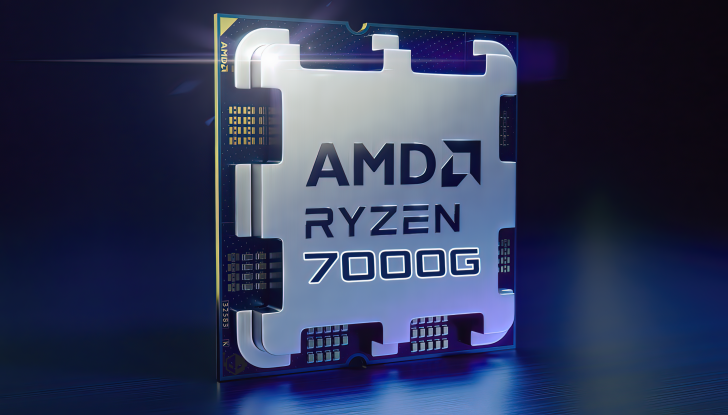
A recent discovery has indicated that AMD had different intentions for its Ryzen APU lineup, which includes the inclusion of the Ryzen 5 PRO 7500G and Ryzen 3 PRO 7300G models. These “Hawk Point” desktop APUs were spotted, and their existence suggests that AMD initially planned to release them as part of the Ryzen 7000 family.
The naming convention for APUs in the Zen 4-based lineup has departed from the pattern seen in previous generations. However, leaked images from tech forums have shown Zen 4-based CPUs with the Ryzen 5 Pro 7500G and Ryzen 3 Pro 7300G labels, suggesting that the shift in naming schemes was a decision made relatively late in the development process.
AMD’s lineup eventually went to market with different names, including the Ryzen 5 8500G, Ryzen 3 8300G, along with the Ryzen 5 8600G and Ryzen 7 8700G. While there’s no information on whether the latter two APUs were part of the original Ryzen 7000G series, the switch in naming suggests this could have been the case.
What’s evident from the product markings is that these APUs were produced in 2022, implying that AMD possibly planned to launch them earlier. Recalling the release patterns of previous APUs and CPUs, there seems to have been a shift in the usual timing. For example, the Ryzen 5000G APUs were launched a year after the Ryzen 5000 CPUs, but the rollout of subsequent generations did not follow the same annual schedule.
The introduction of the Ryzen 9000 Desktop CPUs in 2024 was particularly interesting as they were meant for a 2025 release based on the pattern. Similarly, the Ryzen 8000 APUs were launched on time in 2024, while the mobility lineup arrived at the latter end of 2023, deviating from expectations.
In January of the current year, AMD launched new APUs, following around one and a half years after the Ryzen 7000 series CPUs were brought to market. It’s worth noting that the Ryzen 2000G series APUs were based on the original Zen architecture, differing from the standard Ryzen 2000 series CPUs, which used Zen+ cores. This highlights that a shift from the 7000G to 8000G series within the naming convention shouldn’t be too surprising.
One speculation for AMD’s naming transition might be related to the decision to go with the Ryzen 9000 name for the upcoming Zen 5 CPUs rather than using Ryzen 8000. Furthermore, AMD is preparing to release the 800 chipset series, such as X870, X870E, B850, and B840, with planned launch dates later in the year or into early 2025.
With both the Ryzen 3 8300G and Ryzen 5 8500G categorized under the Phoneix2 lineup, these APUs blend Zen 4 and Zen 4C architectures, contrasting with the Phoenix1 lineup’s Ryzen 5 8600G and Ryzen 7 8700G that exclusively utilize Zen 4 cores.
The Ryzen 3 8300G and Ryzen 5 8500G serve as budget gaming APUs that target entry-level gaming systems, allowing users to enjoy gaming without the need for a discrete GPU. These models, along with other Ryzen processors, can be found within AMD’s Ryzen PRO 8000 Desktop APU series, showcasing that they do indeed exist, albeit under a revamped naming strategy.
As for the specifics of the different Ryzen 8000G Desktop APUs, they encompass varying core, thread, clock speeds, L3 cache sizes, GPU capabilities, TDPs, and prices, with options designed to cater to different segments of the PC market.
Consumers interested in the latest from AMD’s APU offerings should keep these insights in mind, as they showcase the fluid nature of product releases and the evolution of naming conventions within AMD’s expansive hardware lineup.