Elon Musk’s vision for Tesla’s future chip supply is getting bolder—and a lot more unconventional.
At a recent Tesla shareholder discussion, Musk floated the idea of building a dedicated chip manufacturing network to secure long-term access to custom silicon. The reasoning is straightforward: as AI workloads explode and more products rely on specialized processors, semiconductors are becoming one of the biggest bottlenecks for major technology companies. Tesla, which increasingly depends on advanced chips for AI training and in-vehicle computing, doesn’t want to be stuck competing for limited capacity.
Since then, Tesla has also deepened efforts to secure cutting-edge chip development through partnerships, including work tied to future AI-focused chips. But while speaking at an event with Peter Diamandis, Musk added a new twist to the plan—suggesting Tesla’s proposed “TeraFab” could eventually produce 2nm chips, while dismissing what he sees as excessive reliance on cleanroom rules in modern semiconductor fabs.
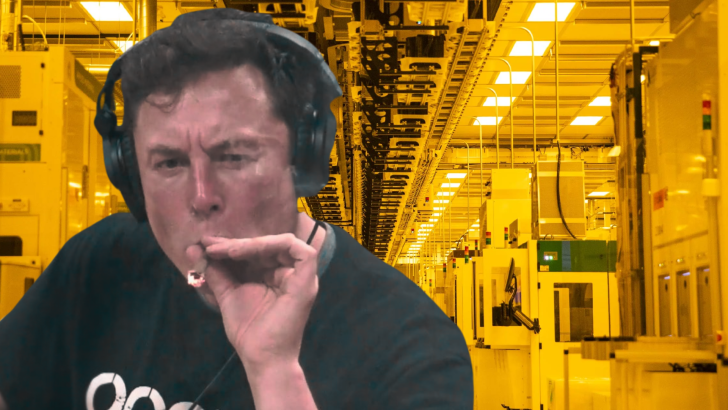
Musk even joked that cleanrooms may be overdone, saying he’d be willing to eat a cheeseburger and smoke a cigar inside the fab. The comment grabbed attention because cleanrooms aren’t just a formality—they’re one of the core requirements of chip manufacturing.
Why does that matter? Semiconductor fabs rely on ultra-controlled environments because tiny contamination particles can ruin production. Cleanrooms are designed to minimize dust, chemicals, and airborne particles that can damage wafers and slash yield rates. For the most advanced nodes, manufacturers spend enormous sums on filtration systems and contamination controls, and workers typically wear full protective suits to keep human particles away from sensitive processes. The cleaner the environment, the better the chance that more chips per wafer actually work—something that directly affects output, cost, and the ability to meet demand.
That’s also why the jump to 2nm is such a big claim. Producing chips at 2nm is among the most difficult feats in modern manufacturing, requiring cutting-edge process technology, extreme precision, and years of operational expertise. Tesla doesn’t currently run semiconductor manufacturing at that level, so if Musk truly wants Tesla-branded production at 2nm, it would likely require deep collaboration with existing leaders in the foundry industry—at least in the early stages.
Musk also noted that chip demand is arriving sooner than expected, citing eye-popping numbers in the range of 100 billion to 200 billion chips per year. Even if those figures sound ambitious, the broader point aligns with what the industry is seeing: the AI boom is pushing demand for compute hardware to unprecedented levels, tightening supply chains and raising the stakes for companies that rely on high-performance silicon.
Whether Tesla’s “TeraFab” becomes a serious path to advanced-node manufacturing—or remains an aspirational concept—one thing is clear: Musk believes the next era of competition in AI and advanced computing won’t just be about software and data. It will also be about who can reliably secure the chips that power everything.